FLA 36: Jamie Muir (14/12/2025)

To round off series three of First Last Anything conversations, it was an utter delight to chat to producer, director and filmmaker Jamie Muir. Jamie has worked for fifty years in television, joining ITV company London Weekend Television in the mid-1970s as a researcher on the weekly arts series Aquarius. He was part of both the respective teams that created and developed Aquarius’s successor, Melvyn Bragg’s The South Bank Show for LWT from 1977, and The Late Show, a nightly BBC2 arts magazine that ran for six years from 1989–95. He also produced Book Four, a regular books series in the early years of Channel 4, hosted by Hermione Lee.

Since 1992, Jamie has made a wide variety of documentary films and series, for BBC, ITV and Channel 4, on arts, factual and history, fronted by figures including Lucinda Lambton, Simon Schama, Alan Yentob, Tom Holland, and David and Jonathan Dimbleby.

There was a lot to ask Jamie, as you can well imagine – and there was the small matter of discussing music as well, plus early family life, especially with his dad Frank Muir, the extraordinary comedy writer and executive with a notable broadcasting career of his own. But over Zoom, one afternoon in late November 2025, we talked about some of Jamie’s notable record purchases, as well as the power of photojournalism, why humour in arts television is underrated, and even music that turns up too often in documentaries. We hope you enjoy our chat – and wish you the merriest of Christmases. See you in 2026.

—–

JUSTIN LEWIS:

What music do you remember first hearing at home? You mentioned when we were setting this up things like comedy records, musicals.

JAMIE MUIR:

Yes, definitely comedy records, so Peter Sellers, Songs for Swingin’ Sellers, and then things like Bernard Cribbins’ ‘Hole in the Ground’, Lance Percival’s ‘Riviera Caff’: those kind of things which we found hilarious. And then probably My Fair Lady, Oliver!, Carousel – those were the kinds of records my parents had. They also loved French chanson, so Edith Piaf, Charles Trenet… which they had on old 78s until I used them for target practice, and shot them up with an air rifle.

JUSTIN LEWIS:

You were how old at this point?

JAMIE MUIR:

Ten.

JUSTIN LEWIS:

This is about the time you’d have started buying records yourself, if I’ve got the maths right. It’s interesting you mention Peter Sellers. Your dad Frank co-wrote things with Denis Norden, like ‘Balham – Gateway to the South’, a very famous sketch Sellers did on record.

JAMIE MUIR:

Yes he did, he wrote two or three things for Sellers with Denis, and there’s one about a young pop star [Twit Conway], ‘So Little Time’, which is sort of based on Elvis. It’s got some great jokes in it:

‘Now I’ve got some money I’ve been able to move my old mum and dad into a small house.’

‘I bet they’re delighted.’

‘No, they ain’t, they was in a big house.’

JUSTIN LEWIS:

Your dad was one of the most familiar faces on TV when I was growing up in the 70s and 80s: Call My Bluff, My Music, all sorts of things. As with Denis Norden: I didn’t know there was this whole writing career that came before it. How aware were you as a child of all this?

JAMIE MUIR:

I was very small, but every Sunday afternoon, he would disappear, to record the weekly episode of Take it From Here for radio. And then during the week, he would go and write with Denis, who we knew as children. They were incredibly long runs, something like 35 or 40 episodes.

JUSTIN LEWIS:

For twelve years!

JAMIE MUIR:

Yeah, for twelve years. It was a ridiculous, extraordinary work rate. Then in summer breaks, they’d go off and script-doctor Norman Wisdom films.

JUSTIN LEWIS:

Oh my god, so it didn’t stop.

JAMIE MUIR:

No, it didn’t. And of course, because nothing was recorded… jokes had no long tail.

Talbot Rothwell was in the same writing stable, and when the series was over, he asked if he could borrow some jokes. Someone had typed all their jokes up in a book, they lent them to him, and that’s how ‘Infamy, infamy, everyone’s got it infamy’ ended up in Carry on Cleo.

JUSTIN LEWIS:

So that started in Take It from Here?

JAMIE MUIR:

They just said, ‘Sure, we don’t need it anymore.’

JUSTIN LEWIS:

There was probably this thought back then that this was all ephemeral.

JAMIE MUIR:

[With Denis], my dad also wrote something for television that’s a bit dubious, I suppose: Jimmy Edwards [from Take It from Here] as the headmaster of a school, who was very free with the cane.

JUSTIN LEWIS:

Oh yes, Whack-O!

JAMIE MUIR:

Which I remember loving as a child. And one of the boys in the film spin-off of that [Bottoms Up, 1960] went on to be a member of the Jimi Hendrix Experience. Mitch Mitchell, the drummer.

JUSTIN LEWIS:

What I was going to say about your dad’s connection with television and pop is that he was on things like Juke Box Jury [1962].

JAMIE MUIR:

He did quite a lot. When television came back after World War II [in 1946], I think he was an announcer. I’ve always meant to ask John Wyver about this because he’s about to publish a book called Magic Rays of Light: The Early Years of Television [out on 8 January 2026].

JUSTIN LEWIS:

Which I must get!

JAMIE MUIR:

I think Dad worked at Alexandra Palace really quite early on. And we were certainly unusual amongst my friends growing up. We were a telly household very early on too, I think late 50s.

JUSTIN LEWIS:

Oh, so ITV was up and running.

JAMIE MUIR:

Yup, and because Dad was an executive [in comedy] at the BBC in the 60s, he would watch everything, and we’d sit and watch with him and he’d ask us what we thought of it. So we were a family that watched television critically which was, again, quite unusual. [One night], I’d gone to bed and he got me up and said, ‘There’s a play on you might enjoy. It’s by a writer called Harold Pinter. And it’ll be quite strange, but it’ll also quite funny. So we watched the Tea Party [BBC1, 25 March 1965, repeated BBC2, 30 April 1965]. And that was magic.

And we’d also seen a production of Hamlet Live from Elsinore [BBC1, 19 April 1964, the night before the chequered launch of BBC2], with Christopher Plummer [and Michael Caine as Horatio]. That is etched in my memory as an early example of watching grown-up television.

JUSTIN LEWIS:

One thing I remember Denis Norden saying about his writing partnership with Frank: he recalled that Frank thought comedy was essentially a kindly medium whereas Norden, in his own words, ‘liked the bastards, the WC Fields and Larry Sanders’, the untrustworthy characters.

JAMIE MUIR:

There was a sort of slight Lennon and McCartney thing about the two of them. But what we sometimes forget is that back in those days, the comedy had to suit all ages, eight to eighty. Dad used to say, ‘It would have been nice to have been able to write for my peers.’ He was quite envious of the freedoms that came with alternative comedy later.

JUSTIN LEWIS:

I had often wondered what he thought of that era. Did he keep up with all that too?

JAMIE MUIR:

Oh god, yes. He loved Steve Coogan, The Young Ones, The Fast Show. He just didn’t like anything that he felt was a bit lazy – recycling old gags.

—-

JUSTIN LEWIS:

When did you start to think you’d like to work in television yourself?

JAMIE MUIR:

A bit later on – once I’d started watching arts programmes, I think, because I’d watch Monitor and then one presented by James Mossman called Review [BBC2, 1969–71], with this exploding television screen in the opening titles.

JUSTIN LEWIS:

And were you watching pop shows, entertainment shows?

JAMIE MUIR:

Absolutely. That Hughie Green show…

JUSTIN LEWIS:

Opportunity Knocks

JAMIE MUIR:

That’s right: ‘Sincerely, folks!’ Crackerjack, obviously.

JUSTIN LEWIS:

Well, that’s where a lot of the pop groups would go.

JAMIE MUIR:

And then Sunday Night at the London Palladium on ITV. And I was there watching at home when John Lennon said on the Royal Variety Performance [4 November 1963]: ‘Those of you in the posher seats, rattle your jewellery.’ I saw those kinds of things go out, rather than see them in clip form later on.

JUSTIN LEWIS:

Because you wouldn’t have known, you couldn’t have known, that would happen.

JAMIE MUIR:

Yes, so that was incredibly exciting, to grow up in a household where something like television was just taken as a really valuable experience in terms of educating us.

JUSTIN LEWIS:

And did your parents observe what was going on in pop music because the generation gaps in those days were wider than they might be now? Were your parents up for rock’n’roll, generally?

JAMIE MUIR:

Yeah, they absolutely loved it, because the big influence – The Beatles – happened when I was nine or ten. I remember hearing ‘Love Me Do’ on a tiny little transistor radio. They kind of lived pop music through our enthusiasm.

And then very touchingly, Justin, after my sister and I left home, for many years, they’d carry on watching Top of the Pops because it had been part of our family life, sitting around commenting on the bands. So they just carried on. Dad, he died when he was 77 [in 1998], but even in those last few years, he could name all the members of Oasis. He had no kind of hierarchies in terms of knowledge, he was interested in everything. Each day, he’d get the Times, the Daily Mail and the Daily Mirror for the TV reviewing. So he would know what the poshos thought and also what the Mirror thought. Again, a big influence on my sister and I – the photojournalism in the Mirror. Taking the news in through images, rather than through masses of text.

JUSTIN LEWIS:

Well, in those days, with television, you’d see something and the chances are you wouldn’t see that again, or at least nobody expected to. So a photograph in a newspaper, that would be important. Which leads us neatly into the first record you bought, then…

FIRST: ELVIS PRESLEY: ‘Wooden Heart’ (1961, single, RCA Records)

JUSTIN LEWIS:

…because obviously Elvis never came to Britain – save for that ten-minute stop at Prestwick Airport – so how did you first become aware of Elvis? Did you see him on television somehow, was footage being shown there?

JAMIE MUIR:

Do you know, I think it was in either Egham or Virginia Water, in the newsagents, seeing Elvis Monthly, a little fan booklet, and I think I started asking Mum to buy me copies of that. And I possibly knew of Elvis through that magazine, these strong images – and then hearing ‘Wooden Heart’ on the radio. I fell in love with that and went out and bought it. So I think I came to Elvis through images rather than hearing the music. Then later on, my sister Sal and I became big fans of the films, and we’d go and see Girls, Girls, Girls or whatever.

JUSTIN LEWIS:

Because ‘Wooden Heart’ is from GI Blues, the first film after he left the army, isn’t it?

JAMIE MUIR:

Exactly. It’s quite interesting, because this song is safe, exactly what you would buy when you’re eight or nine, rather than ‘Jailhouse Rock’.

JUSTIN LEWIS:

It’s that middle section of his career where he’s an all-round entertainer, in between the rock’n’roll period and the Vegas period. It’s the in-between bit, not often discussed now, but he was selling absolutely zillions of records.

JAMIE MUIR:

I’m absolutely sure this was the first thing I bought with my own money. The next stage came when I bought ‘Concrete and Clay’ by Unit 4 Plus 2 (1965) – I just thought the lyrics to that were wildly romantic. Of course, The Beatles were romantic, but somehow, they were inextricably a part of my childhood. ‘Concrete and Clay’ was the beginning of my understanding older adult emotions in song, I suppose.

JUSTIN LEWIS:

I think Salman Rushdie heard this in his formative years too – you know he wrote a novel called The Ground Beneath Her Feet (1999), which led to a collaboration with Bono, but which started as the inspiration from ‘Concrete and Clay’. But you never know what records will cut through and stay with you, do you?

JAMIE MUIR:

I’m trying to be as honest as one can be all these years later.

JUSTIN LEWIS:

It’s a series of accidents, really. [JM agrees] And for once in this series, we’re going to switch round the order of Last and Anything, because I’m intrigued to know how you get from ‘Concrete and Clay’ to this, just a couple of years later?

ANYTHING: THE DOORS: Strange Days (1967, Elektra Records)

Extract: ‘Strange Days’

JUSTIN LEWIS:

It must have been incendiary to hear this at the time.

JAMIE MUIR:

The Beatles were becoming more and more surreal, but because I had grown up with them, they were never shocking. Not even Sergeant Pepper because it was clearly a continuum, and these were people you heard about through the newspapers or the telly – you were familiar with them as characters, and so the surrealism of the lyrics didn’t really strike me as something outrageously new.

JUSTIN LEWIS:

Also, the Beatles and George Martin have that connection with The Goons, the British sense of absurdism. George Martin even produced the Peter Sellers records we talked about earlier. But this, from America – that’s a different thing altogether.

JAMIE MUIR:

Probably through friends at school, I heard about this band called The Doors, and I asked for it for Christmas. The lyrics were something close to poetry, a poetry that you couldn’t quite understand.

JUSTIN LEWIS:

That feeling of ‘What does it mean?’ but also ‘Does it matter if I don’t know?’

JAMIE MUIR:

And that was kind of thrilling.

JUSTIN LEWIS:

Would you have gone to the Roundhouse concert (1968), because they didn’t play Britain very often?

JAMIE MUIR:

I saw the film [The Doors Are Open, Granada, December 1968], not at the time, I don’t think, but I do remember seeing a proto-pop video for ‘Five to One’ off the next album, Waiting for the Sun.

JUSTIN LEWIS:

I really hadn’t listened to The Doors for a long time before preparing for this interview, but I was at college when the film came out in 1991, the Oliver Stone film.

JAMIE MUIR:

Oh, where he shoots rock concerts like they’re battlefields.

JUSTIN LEWIS:

I always think of that bit where they’re noodling around, trying to come up with the ‘Light My Fire’ organ riff, and we chuckled a lot at that back then. Although watching Get Back, I’ve realised that sometimes that is exactly how a riff comes about. But some of Strange Days is absolutely terrifying.

JAMIE MUIR:

The spoken word interlude, ‘Horse Latitudes’, is so odd.

JUSTIN LEWIS:

That’s exactly the track I was thinking of.

JAMIE MUIR:

‘When the still sea conspires an armour…’

JUSTIN LEWIS:

Which Jim Morrison wrote at high school.

JAMIE MUIR:

Oh did he?

JUSTIN LEWIS:

I gather. So over here, this record must have seemed terribly exotic.

JAMIE MUIR:

And kind of adult, as opposed to the Beatles – who obviously were adult but came out of childhood… They were something you were beginning to grow out of. And after the Doors came Cream and Jimi Hendrix…

JUSTIN LEWIS:

On Strange Days, you get the Moog synth, the idea that the studio itself becomes an instrument. Apparently, they’d heard an acetate of Sergeant Pepper and decided, ‘We should do something like that’ because their first album had not been like that.

JAMIE MUIR:

Often people’s second album is a pale version of the first, but there really is a shift of gears with this, isn’t there?

—-

JUSTIN LEWIS:

So how did your career in TV start? Was Aquarius at London Weekend Television your first thing, ’74, ‘75ish?

JAMIE MUIR:

I did a history degree at University College in London and had no idea what I wanted to do, but right at the end of my time there, I was a kind of roadie for a poetry festival at Southbank [1973 at the Young Vic], just putting the leaflets on chairs. And Aquarius did an omnibus edition [eventually broadcast on ITV, 25 May 1974] where they took the best acts from the festival. I met the team then, and Humphrey Burton, the programme editor and presenter, was about. I said, ‘I’d love to work on Aquarius.’ And he said, ‘Well, I never take people straight out of university.’ I could see why, so I went off and got a job as an archaeologist – even though I don’t have any theoretical knowledge – working on Roman timber waterfront sites on the banks of the Thames.

Literally a year later, I rang up Aquarius and Humphrey said, ‘Okay, well you’d better come and have lunch, then. Can you come now?’ Which was kind of impressive. I said, ‘I’m not really dressed for it.’ He said, ‘No, come on, we’re very broad minded.’ I literally went in gumboots, and a jersey with a great hole in it. And he said to me, ‘Actually, we could do with some extra help with picture research.’ So I went in to do that once a week.

From there, I went to three days a week, and then full time for a couple of months. But then, to carry on, I had to be formally boarded, go through that process, because obviously it was very unionised in those days. But I got through that, and that’s when I joined properly as a researcher [1975] and had a fantastic 18 months with Humphrey and Russell Harty, and Peter Hall as well.

JUSTIN LEWIS:

What’s the earliest Aquarius film you can remember working on? The other day, I was watching a really nice little feature (via YouTube) about Erik Satie where LWT’s graphic designer Pat Gavin had made this animation [ITV, 2 July 1977].

JAMIE MUIR:

I wrote the script for that!

[Pat Gavin’s animation in full on Satie, Passing Through, can be seen here: https://www.youtube.com/watch?v=3Xa4gGXE7YQ&list=RD3Xa4gGXE7YQ&start_radio=1]

JUSTIN LEWIS:

And that led me to other Aquarius items. I saw the Kyung Wha-Chung interview with Humphrey, after which she plays the Bruch Violin Concerto [ITV, 29 September 1974], which I feel almost certain I saw at the time. Because it had a spell on Sunday afternoons, that series, rather than late Saturday nights.  And I even found this send-up of sports commentators that John Cleese and Eric Idle made for the strand [ITV, 14 August 1971). It’s interesting how arts programmes could be quite irreverent. People can often misunderstand arts TV, I think, they assume nobody involved has a sense of humour.

JAMIE MUIR:

Yes, later on [in the 1990s] I was able to make humorous documentaries with Lucinda Lambton, which were good fun to do, to have the licence to make something that was intentionally light-hearted and funny.

JUSTIN LEWIS:

People rightly talk up the Jonathan Meades documentaries, but Lucinda Lambton was also making a lot of things in that same spirit.

JAMIE MUIR:

I made a series with Lucy called Alphabet of Britain.

JUSTIN LEWIS:

I was watching the episode about concrete last night! [BBC2, 27 February 1995].

JAMIE MUIR:

‘These are stirring times for concrete…’ – it’s great being able to do a documentary where you can just put silly puns in. But anyway, in the early days, at LWT, I was taken on, along with a researcher called Nigel Wattis. And one of the early films the show made was about Andrew Lloyd Webber’s album Variations [made with his cellist brother Julian]. And we – Alan Benson the film’s director and I – suggested to Melvyn that it would make a good theme for The South Bank Show.

JUSTIN LEWIS:

Yes, one of the many variations of Paganini’s 24th Caprice.

[The Lloyd Webber film appeared in the second-ever South Bank Show, broadcast on ITV, Saturday 21 January 1978]

JUSTIN LEWIS:

It’s interesting how The South Bank Show made a virtue of popular arts – it might do abstract art one week, but pop another week. I mean, Paul McCartney’s in the opening episode. Was that the intention, to make the spectrum as broad as you could?

JAMIE MUIR:

Yes, but us researchers were quite amused by the Paul McCartney choice because although it was a huge thing for Melvyn’s generation to make a gesture by interviewing McCartney first, really there was punk rock by 1978 [in fact Wings were at number one with ‘Mull of Kintyre’ as The South Bank Show premiered], so quite soon we had Patti Smith in the studio, my fellow researcher David Hinton worked on a film with Talking Heads and also a film about Rough Trade Records.

In that first year of South Bank Show, there was a slightly uneasy mixture between a shortish film of 20–25 minutes, and a panel review, like Saturday Review or Late Review later on. Melvyn and guests would review a book or play or something, and then he’d introduce the film. And, actually, none of us could manage that balance, we needed a bigger team for something like that.

JUSTIN LEWIS:

What would happen at the start of a series, then? You’d meet up and all suggest people or subjects to make films about?

JAMIE MUIR:

Exactly. That was interesting – there were four or five researchers on the team. Melvyn suggested we should hire consultants to feed what was going on into the programme. But I said, ‘I think we should be your consultants’, because I thought we’d be doing ourselves out of a job otherwise. So we divided the subject areas up between us and we made ourselves authorities in the different subject areas.

And then we’d have these seminars where we’d go up to the meeting room, there’d be cheese, grapes, a bit of wine, and we’d pitch ideas. It was a terrific process that Melvyn devised, because we’d be pitching against each other, and he’d say, ‘Don’t just suggest Spielberg, what’s the angle?’ So you were bringing him an idea, but also trying to conceptualise it. We had really good discussions out of that, he built a wonderful team – and we’re all still friends to this day. Because it wasn’t silly competitiveness, it was genuine intellectual competitiveness. ‘Is this the right moment to do William Golding or should we do a film on Coppola?’

JUSTIN LEWIS:

The other night, I was watching the film on Philip Larkin, screened [ITV, 30 May 1982] to mark his 60th birthday, but actually made a year earlier. And Larkin refused to be shown on camera, right?

JAMIE MUIR:

It was funny. Melvyn went up to see him in Hull. There was a lot of correspondence about where they were going to meet. They settled on the Station Hotel. And they had a bottle or two. Of course, in those days, closing time was rigorously enforced, and Melvyn said, ‘Come on, you’ve got to let us finish’, and Larkin said, ‘I do have a professional reputation in the town.’ I think the publican said he was going to call the police. Anyway, Larkin said he’d take part, but he didn’t want to appear. Though in fact, if you notice, the tip of his nose is in shot.

JUSTIN LEWIS:

I was thinking about how arts programmes would often be on after comedy shows. I think of Arena being on after Fry & Laurie. And The South Bank Show more often than not seemed to be on after Spitting Image on Sunday nights. There was something about both arts programmes and comedy shows that had this kind of playfulness, striving for innovation.

JAMIE MUIR:

I had a real salutary lesson early on with that. If you worked after a certain time, you were allowed to get a cab home, and cab drivers pulling into London Weekend were always interested in what shows we made. One asked me, ‘What show do you work on?’ I said, ‘The South Bank Show’, perhaps thinking maybe he wouldn’t watch it, and he said, ‘Oh! I saw the programme about Harold Pinter – I didn’t know he grew up in Hackney!’ So, never try to match people to subject matter. There are an infinite variety of ways in to a subject. And as a young person, that was a really important lesson. I often found that with The South Bank Show, people watched it for a whole variety of reasons.

JUSTIN LEWIS:

You’d be working on, what?, four or five films a series, because there seemed to be 26 a year.

JAMIE MUIR:

It felt like hard work, certainly.

JUSTIN LEWIS:

You’d be working on more than one at once, though.

JAMIE MUIR:

And they were pretty thoroughly researched. We didn’t have the internet then. It was all books and going to talking to people, and writing a careful brief, and then being on hand in the cutting room for any stills or extra visual material the director wanted. So it was a very rich and fulfilling role, researching in those days.

JUSTIN LEWIS:

Do you have particular favourite films that you worked on from those days?

JAMIE MUIR:

I think the most exciting was the programme with William Golding [broadcast on ITV, 16 November 1980 – his first interview in 18 years]. Because he’d sort of vanished. And I’d read Lord of the Flies, when I was about 13, 14, but hadn’t read anything else, and [in my mid-twenties] I read my way through the others. It was a fantastic body of work, and because I was working on the programme, I decided to ring up and see what he was up to. And Faber said, ‘He’s just finishing a novel, but he doesn’t want to do any publicity for it’ – it was a book called Darkness Visible [1979]. There’d been a ten-year gap before that one. And then they said, ‘But he has just started on a new novel, set on a ship [which became Rites of Passage, 1980], and he’s very upbeat about it – keep in touch.’

So every four months, I’d ring up: ‘How’s he getting on?’

‘Oh, he’s motoring away.’

And then, at one of these pitching sessions for the next series, I said to Melvyn, ‘Golding’s got a new novel out. I think this is the one we should cover.’

And Melvyn said: ‘Yes, but Anthony Burgess has got Earthly Powers. He’s a great talker.’

‘Yes, but Golding hasn’t done interviews for ages. He’s like a lost figure.’

So Melvyn wrote to him and Golding wrote back this brilliant letter: ‘What it amounts to is this.  I’ve no objection to being filmed down here in what are my own surroundings so to speak; and no objection to talking in general terms on general topic (whither China, whatever happened to flying saucers, waterlilies, dragonflies and Homeric poetry,) but a quarter-of-a-century of churning out dreary answers to the dreary examination questions on my books or book has made me determined to give it, give it, up up up.’

Melvyn could see that he wasn’t actually objecting to a programme, so he went down to see him, and they got monumentally pissed. When he came back, I asked, ‘What have you agreed?’ And he said, ‘I can’t remember. All I remember is he dared me to walk along the wall around the pond in his garden.’

From the letter, we appreciated that he didn’t want to talk about the books, so I constructed a shape for the programme that would take them to places [around Wiltshire] which would then provoke discussion of the themes of the novels. We’d go to Stonehenge, Marlborough, and then Salisbury [which inspired The Spire]. And then the night before filming began, he said, ‘I will talk about the books as well.’ So I quickly had to prepare some questions about the books too. It was great because he wasn’t on the publicity circuit, and he responded incredibly openly to Melvyn’s questions. And then he went on to win the Booker Prize for Rites of Passage. I was personally extremely proud of landing a programme at exactly the right time.

JUSTIN LEWIS:

And also getting a kind of trust from the interviewee, not so much that their guard is down, but they’ve worked out this could be a different kind of interview.

JAMIE MUIR:

We really got to know contributors through their work, which I suppose is flattering for most artists. We’d done a programme on Scorsese in the States quite early on [22 February 1981 – there was a second profile in September 1988] and he then told other filmmakers, ‘Oh, The South Bank Show is a good place to go, if they contact you.’

[From 1988, the Bravo cable channel in the USA began broadcasting selected editions of The South Bank Show.]

JUSTIN LEWIS:

As we’re having this conversation [in late 2025], Melvyn Bragg has retired from In Our Time on Radio 4 after 26 years and over a thousand episodes – Misha Glenny is succeeding him as host in January. He’s had an incredible career what with that and decades of The South Bank Show and so many other things. What do you think you learned about programme making from Melvyn in those early days at LWT and from the team he assembled for the series?

JAMIE MUIR:

He was a hard task master – at one time or another we all got a bollocking, particularly in the first year when the programme was finding its feet. But he believed in teams, in working collaboratively.  I think he consciously modelled The South Bank Show on Monitor where he had thrived. The big lesson we researchers learned from him was to think through the elements of a programme rather than just shout out names of possible interviewees. That and the value of research, which was a very LWT thing. Because there was also John Birt and Peter Jay on programmes like Weekend World and in newspaper articles [for The Times], developing the ‘Mission to Explain’ – [giving a subject context, less emphasis on sensationalism and presenting a greater understanding of a story’s issues]. That was influential.

—–

JUSTIN LEWIS:

How did it feel to be producing a programme on the opening night of Channel 4 in 1982?

JAMIE MUIR:

Bloody terrifying.

JUSTIN LEWIS:

You were like the fifth programme ever on Channel 4. This was Book Four, with Hermione Lee, just before the first ever Channel 4 News.

JAMIE MUIR:

It was scary because there were so many different publicists involved and we were just trying to steer our way through it. It had to be a studio-based show, although actually, it would have been better if we’d gone to authors’ homes, I think. It was quite formal, being in the studio, in a way that was beginning to seem old fashioned.

JUSTIN LEWIS:

It feels incredible to think how books coverage was once such an integral part of television, and how that’s mostly gone now.

JAMIE MUIR:

I resolve not to be bitter, or nostalgic about the past, but it’s true.

JUSTIN LEWIS:

It’s such a shame, because if you look at the archive from the sixties to the nineties, that extraordinary inventory of arts television, you wonder how the arts of the 2020s will be represented in the archives. I know we still have radio, and podcasts, but the visual content is vital too.

JAMIE MUIR:

What is the Adam Curtis of thirty years’ time going to draw on? That’s the sadness, that richness of archive isn’t going to be there.

—-

JUSTIN LEWIS:

In 1988, you moved from LWT to the BBC, and began working as a producer on a new nightly format for BBC2, The Late Show. How did that come about?

JAMIE MUIR:

It had been a very fixed world in arts television, there’d been Omnibus and Arena on the BBC, us on LWT, and then that summer Signals had begun on Channel 4. So the plates started to shift, and Kevin Loader – who’s gone on to be a film producer – rang up several of us at LWT. I think Mary Harron, who also went on to make feature films, was the one he rang first – a good friend of mine. And then Kevin rang me, and I thought, ‘This is the time to make a move’. Because the way the union worked, in order to direct, everyone had to go on a formal directing course either at LWT or at the Short Course Unit at the National Film School. And because I’d been doing Book Four, I was the last to get this kind of formal training. I’d managed to make one film, about Eric Gill, through the religious department at Channel 4 because they had slightly more money – and that had been a tremendous experience.

So after Kevin rang me, I joined the team that was conceptualising The Late Show. We spent an autumn devising it.

JUSTIN LEWIS:

Because Alan Yentob had just become BBC2 controller, a particularly rich period for the channel.

JAMIE MUIR:

It was a fantastic time, and the launch editor Michael Jackson [future BBC2 controller and also later head of Channel 4] was an inspiring person to work with. I was a nightly producer on The Late Show, a tough job, but I got the opportunity to make films and I made as many as I could.

JUSTIN LEWIS:

What you were saying earlier about the early multi-item era of The South Bank ShowThe Late Show was four or five items a night wasn’t it? A film report, studio interview, bit of live music… So you were producer one night a week?

JAMIE MUIR:

Yeah, although it was mostly going into cutting rooms and saying to people, ‘Could you cut two minutes out?’ And they’d say, ‘Which two minutes?’ And I’d say, ‘Any two minutes, we’re going on air in six minutes.’ The pace was so hectic, compared with The South Bank Show. It was often quite difficult to work out what the elements of that night’s show would be – because somebody could die and [you’d have to react to that].

JUSTIN LEWIS:

And you were on straight after Newsnight.

JAMIE MUIR:

I think I would have benefited from a spell on Newsnight first.

JUSTIN LEWIS:

You also helped bring back Face to Face, with Jeremy Isaacs in the John Freeman role.

JAMIE MUIR:

Yes, I did two or three, and then Julian Birkett produced them thereafter. There was a studio producer called John Bush [another South Bank Show producer/director] who worked out the direction, because there’s a very small number of angles that they used in Face to Face. So that was learning from the past.

JUSTIN LEWIS:

You pointed me towards the Late Show film on Julian Cope [BBC2, 6 March 1991], which you made with Mark Cooper. And I remember seeing it at the time. I’ve always enjoyed him in interview mode – he goes from grand pronouncement to humorous to self-effacing to sincere and back again. An absolutely perfect interviewee because you’ll always get something different.

JAMIE MUIR:

I’d loved the Teardrop Explodes, ‘Treason’ and things like that. We made it just up the road from where I lived.

JUSTIN LEWIS:

I recognised the Brixton streets!

JAMIE MUIR:

He seemed very home-based. So I thought I’d make it as close to a home movie as possible, and not stray too far from his area.

JUSTIN LEWIS:

That’s a wonderful version of ‘Las Vegas Basement’ in that. Why do you think The Late Show came to an end? I know you’d already moved on.

JAMIE MUIR:

I suspect it was cost. It was expensive to run, and by then, I think the BBC was starting to think it needed to be competing with the output of the Discovery Channel. So the trend in arts programmes was to go for big CGI epics, do you remember that? The thing that was deemed to be incredibly successful was Jeremy Clarkson’s film about Isambard Kingdom Brunel [in Great Britons, 2002], and that was perceived to have cut through on a much bigger scale. Arts programmes were retooled to try and emulate its success.

JUSTIN LEWIS:

A bit like how if you make a science film, not to denigrate the people who make them, you have to have someone standing next to a volcano. Or something. You have to have the thought, ‘How’s this going to look spectacular on television?’

JAMIE MUIR:

Yes. There was also a fascination with that man who used to do lectures about storytelling, Robert McKee. And trying to get documentaries to conform to the three-act structure. I thought it would have been nice to have a crack at making that kind of thing, but then it vanished because of the banking crash in 2007, and the BBC was back to the middle ground again, which is where I flourished, the presenter-led programmes, that kind of thing.

JUSTIN LEWIS:

One thing that’s definitely increased in documentaries is the amount of music. It used to be that music was used quite sparingly, even in documentaries that were already about music. Were you choosing a lot of music clips yourself?

JAMIE MUIR:

Yes, both LWT and the BBC had these music departments with fantastic resources where more or less anything was available in physical form to listen to, but they’d also done these deals…

JUSTIN LEWIS:

There were blanket agreements?

JAMIE MUIR:

Yes, that was kind of thrilling. You could discover a favourite composer or song and work them in.

JUSTIN LEWIS:

Can you isolate one or two particularly special examples?

JAMIE MUIR:

A friend recommended a contemporary classical composer called Howard Skempton. His work, anything he did, worked so beautifully with images. I loved working with his music. He wrote a piece called ‘Small Change’ that has got the inevitability of a Beatles tune, it’s so perfect. You feel it’s existed forever. He also wrote a magnificent orchestral piece called ‘Lento’ (1991).

When I made a film for Imagine… about Barbara Hepworth (BBC1, 18 June 2003)…

JUSTIN LEWIS:

Oh that was an excellent film, was rewatching it in preparation for this…

JAMIE MUIR:

…I rang him up to ask if I could use a piece of music he had written in memory of Barbara Hepworth. When I called he said, ‘Oh I know you! You’re the one who’s always using my music.’ I said, ‘Oh God, has it always been appropriate?’ And he said, ‘That doesn’t matter. It’s just good that it’s in circulation.’

JUSTIN LEWIS:

Oh, that’s nice.

JAMIE MUIR:

He was so generous. I wish I’d pushed it a bit further and asked him to compose original music for a project.

What was funny was the people who worked in the BBC music department put up this list, pinned to the wall, of Music We’d Like to Ban [from documentaries etc]. It said, ‘All Michael Nyman.’

JUSTIN LEWIS:

I was about to ask, is Philip Glass on that list? Who I love, but I’m sure his work has been in everything by now.

JAMIE MUIR:

Yeah, all Philip Glass. ‘Ferry Cross the Mersey’ for any programme about Merseyside. ‘Let’s Make Lots of Money’ for any consumer programme about the 80s. It was so accurate, that list. I hope somebody keeps that list when they close the department.

——

LAST: LAURA CANNELL: The Rituals of Hildegard Reimagined (2024, Brawl Records)

Extract: ‘The Cosmic Spheres of Being Human’

JUSTIN LEWIS:

I know a little about Laura Cannell, I bought one of her albums a little while back, The Sky Untuned (2019), which was quite violin-centric. And this, which I’ve come to late, but which I’ve been playing a lot, is much more recorder-centric. How did you discover this? Did you know her stuff?

JAMIE MUIR:

No – it was good old BBC Radio 6 Music. I heard it when I was cooking one evening. I love the fact this draws on the past but is contemporary. I thought that balance of the two is tremendously appealing. And as well as the music, the fact it was recorded in an old church. I love that sort of gesture.

JUSTIN LEWIS:

It occurred to me, as with The Doors earlier but in a different way, it’s got that element of sound distortion, the treatment of the instrumentation… You’ve got her playing a bass recorder, a twelve-string knee harp, a delay pedal. And that’s it. And as on The Sky Untuned, the instruments start to sound quite otherworldly, not like themselves.

JAMIE MUIR:

Yes, it could have strayed off into New-Agey yoga music, but I found that weight of history behind it very attractive.

JUSTIN LEWIS:

It’s quite ghostly, isn’t it.

JAMIE MUIR:

It is. I am drawn to that kind of Ghostbox sound.

JUSTIN LEWIS:

Me too.

JAMIE MUIR:

I love the wit of it, I think. But I do also have a kind of seasonal taste in music. In autumn and winter, I’ll listen to more classical, more English folk-rock – the music of my teenage years, like Shirley Collins. I love her album Heart’s Ease, especially ‘Locked in Ice’. Then in the spring and summer, I’ll listen to ska – The Skatalites’ version of ‘I Should Have Known Better’ is a favourite – and reggae, and the things that my children recommend. It’s quite a profound yearly cycle.

JUSTIN LEWIS:

What are your children recommending you at the moment?

JAMIE MUIR:

They’re very big Harry Styles fans, I love playing that in the car. My middle one is a big fan of Florence and the Machine and she grew up quite near where I live, so we all recognised quite a lot of the references in a song like ‘South London Forever’. What else do they like? Quite a lot of jazzy things at the moment.

JUSTIN LEWIS:

Ezra Collective?

JAMIE MUIR:

Exactly. Oh, and that band Haim.

JUSTIN LEWIS:

When you were saying earlier about how your parents carried on watching Top of the Pops for many years… you’re also keeping that connection going, of keeping up to date. How old are they?

JAMIE MUIR:

They’re 33 to 26.

JUSTIN LEWIS:

And what are you working on now? Because you’ve done fifty years of television.

JAMIE MUIR:

I thought I’d reinvent myself as a small-scale filmmaker. I bought a Blackmagic camera, which is the price of a laptop, but actually, it’s quite difficult to operate and you spend all your time fiddling with it rather than talking to the person you’re filming. And while you could shoot a feature film on it, it seemed to be taking me forever to learn the camera.

So at the moment, I’m making things on my phone, which is fantastic because it’s quick. My neighbour is a historian called Tom Holland, who does The Rest is History.

JUSTIN LEWIS:

You’ve made some films with him before, haven’t you?

JAMIE MUIR:

Yeah. And he led the campaign to try and stop the Stonehenge tunnel going through the World Heritage Site. We shot this thing in half a day, and there was an article in The Times that linked to this tiny little film. Which was extraordinary. And I also made a film on my phone with my wife –Caroline’s a fundraiser – who wanted a short video for the charity she works for. So that kind of thing is what I’m doing now. Learning how to do that, doing charity videos, things with Tom, a range of bits and pieces.

—–

JUSTIN LEWIS:

Just looking at my questions list. We’ve covered most of it, I think. What’s left?

JAMIE MUIR:

The other Jamie Muir!

JUSTIN LEWIS:

Oh yes – have you ever been confused with the Jamie Muir in King Crimson?

JAMIE MUIR:

Yes, all the time. Because I was doing programmes about books, I was in a pool of people who’d be invited to book launches by Faber & Faber. And I was invited to the launch of the Faber Book of Political Verse, which had been edited by the then-Home Secretary, Kenneth Baker. Joanna Mackle at Faber introduced us:

‘So this is Jamie Muir who works on The South Bank Show.’

Kenneth Baker says, ‘Jamie Muir? My brother-in-law’s called Jamie Muir. He’s the percussionist with a band called King Crimson. Do you know Larks’ Tongues in Aspic?’

JUSTIN LEWIS:

It’s not a sentence you’re expecting from the Home Secretary, really. Especially not then.

JAMIE MUIR:

There’s been a film quite recently about King Crimson, a really good one [In the Court of the Crimson King, 2022]. The director Toby Amies rang me up, wondering whether I was that Jamie Muir, and I suggested he included a section on people who were mistaken for him. Sadly, he’s died now, but I wondered if people had ever asked him what it was like working with Simon Schama.

——

You can follow Jamie Muir on Bluesky at @jamiembrixton.bsky.social.

——

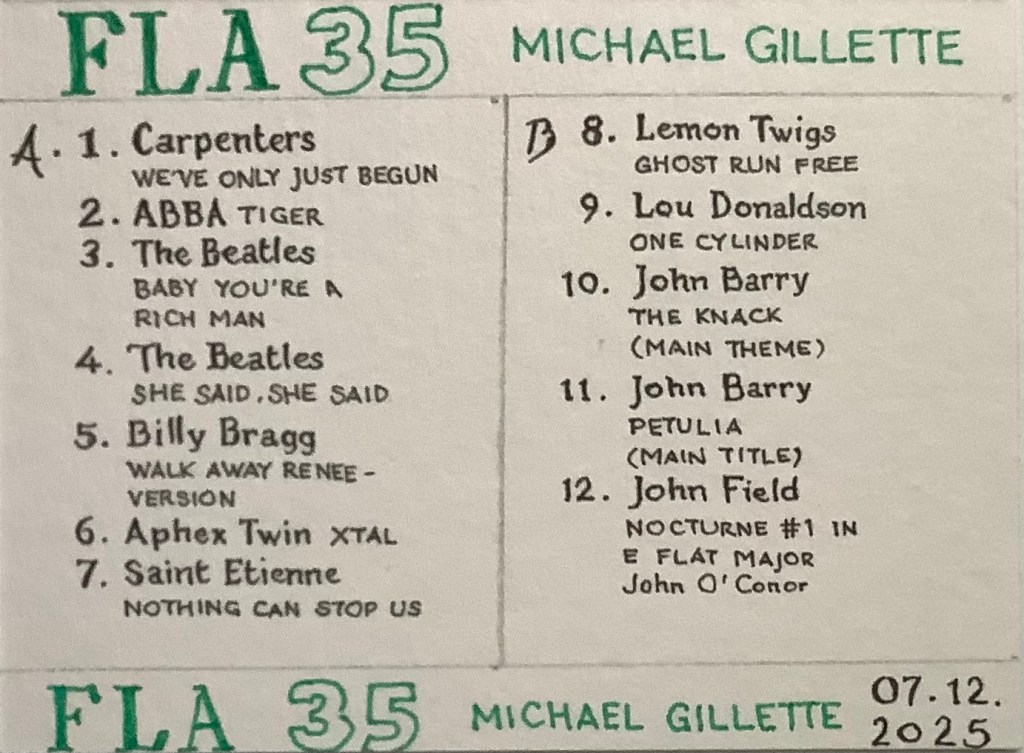
FLA Playlist 36

Jamie Muir

(For the time being, this site and project uses Spotify for the conversation playlists, but obviously I disapprove that Spotify doesn’t pay artists and composers properly, and other streaming platforms are available, as are sites to buy downloads and buy recordings. For consistency, you can also listen to the selections via YouTube (where available), and links are provided in each case, below.)

Thanks to Tune My Music, you can also transfer this playlist to the platform or site of your choice by using this link: https://www.tunemymusic.com/share/xj8YbZXFOI

Track 1:

PETER SELLERS: ‘So Little Time’:

https://www.youtube.com/watch?v=FacRB8U0xiI

Track 2:

ELVIS PRESLEY: ‘Wooden Heart’:

https://www.youtube.com/watch?v=k5RO_RSI8QM&list=RDk5RO_RSI8QM&start_radio=1

Track 3:

UNIT 4 PLUS 2: ‘Concrete and Clay’:

https://www.youtube.com/watch?v=1CEQ640sHr8&list=RD1CEQ640sHr8&start_radio=1

Track 4:

THE DOORS: ‘Strange Days’:

https://www.youtube.com/watch?v=tHOK87ozcho&list=RDtHOK87ozcho&start_radio=1

Track 5:

THE DOORS: ‘Horse Latitudes’:

https://www.youtube.com/watch?v=oVWNkW21BeA&list=RDoVWNkW21BeA&start_radio=1

Track 6:

THE DOORS: ‘Five to One’:

https://www.youtube.com/watch?v=oOzpncIHCLs&list=RDoOzpncIHCLs&start_radio=1

Track 7:

ANDREW LLOYD WEBBER: ‘Theme and Variations 1–4’ (based on Paganini’s 24th Caprice in A Minor):

https://www.youtube.com/watch?v=0WnX5zYznIc&list=RD0WnX5zYznIc&start_radio=1

Track 8:

THE TEARDROP EXPLODES: ‘Treason’:

https://www.youtube.com/watch?v=cn9zRk_2-GE&list=RDcn9zRk_2-GE&start_radio=1

Track 9:

JULIAN COPE: ‘Las Vegas Basement’:

https://www.youtube.com/watch?v=Sdeu37Focqc&list=RDSdeu37Focqc&start_radio=1

Track 10:

HOWARD SKEMPTON: ‘Small Change’:

https://www.youtube.com/watch?v=ZQIoW_iFPlE&list=RDZQIoW_iFPlE&start_radio=1

Track 11:

HOWARD SKEMPTON: ‘Lento’:

https://www.youtube.com/watch?v=BCGhH_N_Ovc&list=RDBCGhH_N_Ovc&start_radio=1

Track 12:

LAURA CANNELL: ‘The Cosmic Spheres of Being Human’:

https://www.youtube.com/watch?v=uCy6y8VKwYI&list=RDuCy6y8VKwYI&start_radio=1

Track 13:

LAURA CANNELL: ‘The Rituals of Hildegard’:

https://www.youtube.com/watch?v=Fb8GXhsDBRs&list=RDFb8GXhsDBRs&start_radio=1

Track 14:

SHIRLEY COLLINS: ‘Locked in Ice’:

https://www.youtube.com/watch?v=ekmpu0ippKY&list=RDekmpu0ippKY&start_radio=1

Track 15:

THE SKATALITES: ‘I Should Have Known Better’:

https://www.youtube.com/watch?v=p7SL5iO0x1c&list=RDp7SL5iO0x1c&start_radio=1

Track 16:

HARRY STYLES: ‘Golden’:

https://www.youtube.com/watch?v=enuYFtMHgfU&list=RDenuYFtMHgfU&start_radio=1

Track 17:

FLORENCE & THE MACHINE: ‘South London Forever’:

https://www.youtube.com/watch?v=lua-N4OrPKA&list=RDlua-N4OrPKA&start_radio=1

Track 18:

KING CRIMSON: Exiles:

https://www.youtube.com/watch?v=nMeFafKx7GI&list=RDnMeFafKx7GI&start_radio=1
FLA 35: Michael Gillette (07/12/2025)

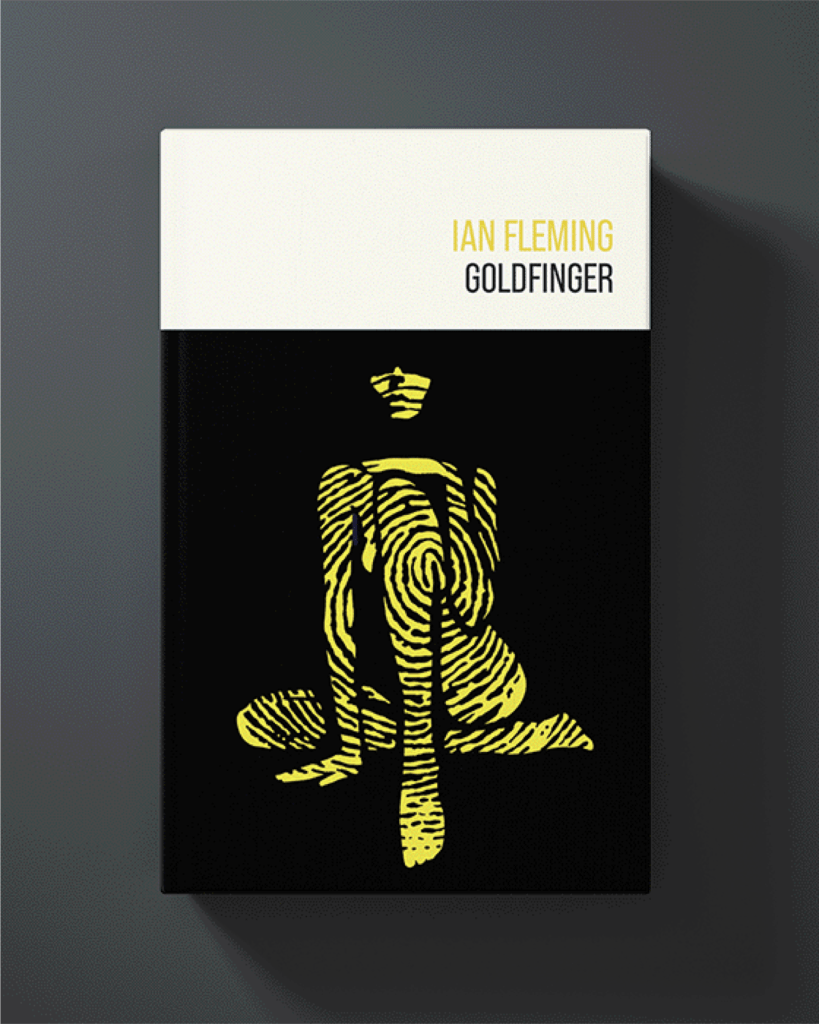
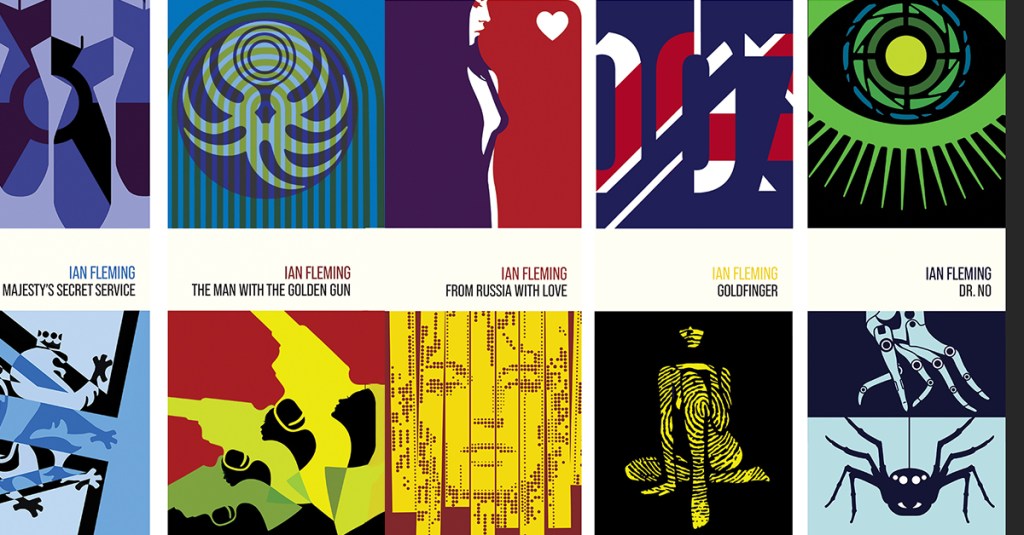
Michael Gillette is an artist, a true artist. Over the past thirty-five years or so, as a painter, illustrator, cartoonist, designer and creative mind, he has produced a boggling torrent of material – in range and volume – primarily inspired by pop music and pop culture. His clients over the years have included Saint Etienne, Elastica and the Beastie Boys, and his work has appeared in a wide range of newspapers and magazines ranging from Select and Q to The Observer and the New Yorker. If you’ve bought any or all of Ian Fleming’s James Bond novels since 2008, chances are Michael’s done the cover art. But it’s a challenge to summarise that kind of career in a single paragraph, so in the first instance, I urge you to check out his website, michaelgilletteart.com, and a book of some of his many highlights, Drawn in Stereo, published in 2015.

I always sensed Michael would flourish as an artist. The clues were there early on, when we were at junior school in Swansea. Just watching him draw anything was captivating. He was amusing and thoughtful. At the turn of the 1980s, just as the lure of pop history dragged me in, so he’d seen the BBC2 season of Beatles films, and connected profoundly with that pop history’s ultimate figureheads. From then on, for several years, we discussed pop a lot. I now realise this was one of the main reasons to go to school.

At sixteen, Michael moved to Somerset with his family, and then gravitated to Greater London, graduating from art school in the early 90s, and soon finding his skills, talents and wit in considerable demand. As an obsessive reader of the music press and broadsheet newspapers, I saw his work everywhere – and yet somehow still didn’t quite connect this with the talented friend I’d known early on. For reasons that will be explained in the conversation that follows.

The penny dropped when I found Michael’s website in the early 2000s. By then, he was living in San Francisco. We had a long catch-up chat on the phone, and have kept sporadically in touch ever since – and then finally, this year, we had a catch-up in person, in the pub. Which inspired me to ask him if he’d like to do First Last Anything. I was thrilled when he agreed, and so one day in November 2025, we spoke via Zoom: me in Swansea, Michael in St Louis, Missouri, where he now lives with his family. Coming up, amongst other things: what it’s like to house-share with Aphex Twin, the outcome of a commission for Paul McCartney (yes, Paul McCartney), and living and working as an artist and how to share that kind of experience as a teacher and educator.   

—-

JUSTIN LEWIS:

So, to begin at the beginning, what music do you remember early on in your home?

MICHAEL GILLETTE:

With mum and dad… Mum was listening to mostly classical music, Schubert’s The Trout, and Holst’s The Planets, I recall… and maybe a few pop albums. The Beatles ‘Red’ and ‘Blue’ albums, and the Greatest Hits of the Carpenters on repeat. Oh! And the The Beach Boys, 20 Golden Greats with an airbrushed painting of a surfer on the front. The musical equivalents of having a dictionary in the house.

Dad, I was not aware of his musical preferences. He saw Gene Vincent and Eddie Cochran play in Birmingham as a teen but in those days, you were only allowed to be a teenager for about fifteen minutes, right? He packed it away. He listened to Jimmy Young who would have been on Radio 2, or Radio 1…

JUSTIN LEWIS:

He was on Radio 1 in the mid-mornings when that started and then around 1973 moved to Radio 2.

MICHAEL GILLETTE:

So it would have been wall-to-wall Radio 2, that’s what I can remember.

JUSTIN LEWIS:

You’d have Terry Wogan on in the morning.

MICHAEL GILLETTE:

Oh yeah, for sure. And apart from that, it was just the homogeneity of the 1970s TV –  Top of the Pops for Goalposts.

JUSTIN LEWIS:

It keeps coming up in these conversations for those of us in that generation. And there wasn’t a lot else, really.

—–

FIRST: ABBA: Arrival (1976, Epic Records)

Extract: ‘Tiger’

JUSTIN LEWIS:

We had this album as well in the house, although I think my dad borrowed it off someone for a while. But we were playing it a lot. But I remember coming to your house at the time and you had this album, along with – if I remember correctly – the first Muppet Show album.

MICHAEL GILLETTE:

Yeah, that makes sense.

JUSTIN LEWIS:

Which we put on. So how did you come to Arrival, then?

MICHAEL GILLETTE:

I think I had it for my seventh birthday, so I must have asked for it. I just think it was in the culture: Look-In, posters on the wall etc.. I’m sure they were on Seaside Special and things like that. Unavoidable, right? Utterly fantastic. And immediately sticky [laughs].

JUSTIN LEWIS:

The people who are ten years older than us thought ABBA were ridiculous.

MICHAEL GILLETTE:

They must be deaf.

JUSTIN LEWIS:

Because, firstly, ‘it’s Europe’ and unless it was Kraftwerk, no pop from Europe was meant to be any good, apparently. And then punk rock happened in Britain, even though ABBA were already making brilliant singles, and the Sex Pistols liked ABBA, for instance. And subsequently, there was a critical revival with ABBA – I remember Elvis Costello saying of ‘Oliver’s Army’… I’m sure you know this…

MICHAEL GILLETTE:

You can hear it – the piano.

JUSTIN LEWIS:

He used to cover ‘Knowing Me Knowing You’, live.

—–

JUSTIN LEWIS:

Towards the end of junior school – so this is 1980, 1981 – I remember two or three massive Beatles fans in our year, and you were one of them, and I remember talking to you about it. So you had the ‘Red’ and the ‘Blue’ albums in your house, but what was the next step for you with Beatles fandom?

MICHAEL GILLETTE:

Aw – BBC, Christmas 1979 – they showed all the films. I remember the Shea Stadium one, and especially Magical Mystery Tour

JUSTIN LEWIS:

Which I don’t think had been on since the first showings [over Christmas 1967 – once on BBC1 which was still monochrome, and days later on BBC2 which had just begun broadcasting in colour].

MICHAEL GILLETTE:

I remember watching that in my grandparents’ house in my Cub Scout uniform [Friday 21 December 1979, BBC2, 6.10–7.00pm], and looking at it – because there’s a bit with a stripper in it which I was watching via a convex mirror because I thought ‘I can’t just turn around and watch this!’

That Christmas was the introduction, really.

JUSTIN LEWIS:

You having your Cub Scout uniform on suggests we must have been to some Cub event, because we were in the same pack. I’m trying to think what that might have been.

[The other showings of Beatles films that Christmas:

Sat 22/12/79, BBC2 1835–2000: Help!

Sun 23/12/79, BBC2, 1740–1830: The Beatles at Shea Stadium [first showing since 1966]

Mon 24/12/79, BBC2, 1740–1900: Yellow Submarine

Tue 25/12/79, BBC2, 1500–1625: A Hard Day’s Night

Wed 26/12/79, BBC2, 1750–1910: Let It Be]

MICHAEL GILLETTE:

They just made me never want to wear a uniform again. It sparked off something :‘What on Earth is this? How do people get to live like this?’ It was the whole package – to see the comedy and the style. I’ve always had these two things together – visual/musical – and seeing them [together] made a massive difference. No regular job plans after that.

JUSTIN LEWIS:

One of the themes of your career, really, is how you’ve channelled pop music into artwork, but with the Beatles, I feel as if you’ve particularly latched on to the fantasy and mythology over the reality of them. I’m not suggesting you haven’t studied the latter! But it’s about setting the imagination free, and Magical Mystery Tour certainly encourages that. As much as something like Get Back would show them making a record in real time, you get this other side to them which has them having adventures. Like they’re comic book characters.

MICHAEL GILLETTE:

Yeah. Perfect for children, as a gateway. It was the scarcity of it. Even though it was on at Christmas that year, after that, it was gone. Until John Lennon died.

Just before he died [December 1980], I remember you used to write the charts out every week, and I saw that John Lennon was in with ‘Starting Over’, [a brand-new single]. And I was like, ‘What do you mean, John Lennon’s got a new single out?’ When I heard it, I couldn’t equate it with The Beatles, it seemed like a dimmed bulb. So when he died, part of me felt, ‘Oh great, The Beatles are now everywhere!’ I was spending all my pocket money on everything I could get, all that merchandise that appeared!  It’s a terrible way to think about it really.

JUSTIN LEWIS:

But he’d also been away for five years, of course, prior to that single, which is a long time. And were you a John fan or a Paul fan?

MICHAEL GILLETTE:

I didn’t know who sang what until later. When I started buying their records, I would look for the albums with the least amount of music that I already knew, to get the best value out of it. The first one I bought was Revolver.

JUSTIN LEWIS:

Funnily enough, the critic David Quantick once pointed out [on the superlative Beatles podcast, Chris Shaw’s I Am the Eggpod] that Revolver (along with the ‘White Album’) is probably the least well represented album on ‘Red’ and ‘Blue’.

MICHAEL GILLETTE:

Yeah, that’s why I would have bought it. ‘She Said, She Said’ – that song really opened things up for me, it’s in my DNA. I don’t think Paul McCartney’s even on that song. 

JUSTIN LEWIS:

An enduring Beatles mystery, so many conflicting accounts and fragments of evidence.

MICHAEL GILLETTE:

I read a lot of philosophy and psychology. Partly it’s helped me understand and justify pop’s importance rather than its triviality. Pop’s taken up a lot of my bandwidth!

I learnt a lot from René Girard, who, as an anthropologist at Stanford in the eighties, coined theories around mimetic desire. We’re all porous to suggestions and mimic others. We desire what other people desire. We can also hate what other people desire. This causes tribalism and scapegoatism. Girard’s warnings are important because many Silicon Valley bros, including Peter Thiel, took his class. They saw his cautions as business models. Look at how that’s played out with social media… 

Anyhow, I thought, ‘oh, this is kind of what happened to me with the Beatles and pop music.’ The Sergeant Pepper cover – it’s a mimetic map of culture, religion, art, everything. Probably 90 per cent of my interests all connect back to the Beatles. Ultra mimetic.

We both grew up during the high watermark of youth cults [JL agrees]… music with distinct looks and styles…These are explained by mimetic theory too. We were kind of outside it in Wales – couldn’t get the right clothes [laughs], but it saturated those impressionable years for our generation, right?

JUSTIN LEWIS:

Yeah – you’d look at London or Manchester and you’d think, ‘How do you get to go there then, a city where it’s all happening?’ Because nice beaches that there are, amazing coastline, Swansea didn’t really have that kind of magic. Bands didn’t come very often, and it wasn’t easy to go and see people if you were under eighteen.

MICHAEL GILLETTE:

Billy Bragg I managed to see in Swansea, a miners benefit gig [7 April 1985 – Easter Sunday, in fact]. At the Penyrheol Leisure Centre. I saw The Alarm there too [16 November 1987].

JUSTIN LEWIS:

Just before we move on from The Beatles, though I’m sure we won’t move too far, can you tell the story about your Paul McCartney album sleeve commission? Because this is extraordinary.

MICHAEL GILLETTE:

I’d done some work for the Beastie Boys, an animation for their [To the 5 Boroughs] tour (2004/05). They were signed to Capitol Records. The lady I was dealing with there rang me one Friday afternoon, and said, ‘Paul McCartney is coming in on Monday and we’re going to do a “Greatest Love Hits” – for the first time, a compilation of his Beatles and post-Beatles work.’ They were very specific: ‘We want him doe-eyed and lovely, from ’67, ’68…’ I was like, ‘Can do.’ So I worked over that weekend, so confused at how this had happened. Anyway, I did it, and the next week they got back to me: ‘Oh he’s just come in, and no Love album for him, he’s getting divorced.’ So that was the end of it. They said, ‘Oh he says it’s really great, he really likes it!’ They tried to buy the artwork. That was the closest brush with my obsession.

JUSTIN LEWIS:

I knew you as a brilliant artist even at school, but what sort of sleeve art was inspiring you back then?

MICHAEL GILLETTE:

Well, anything to do with the Beatles!, so, Klaus Voorman, Peter Blake and then Richard Hamilton – there’s three. My mum would buy me bargain bin books from WHSmiths in Swansea. One of the first was a Rick Griffin monograph. He was one of the San Francisco psychedelic hippy poster artists – all imagery inspired by music. Another was by the artist David Oxtoby, Oxtoby’s Rockers. He was a contemporary of David Hockney, from Bradford. He did incredible paintings of rock stars. I was twelve and had chicken pox when I got it – after two weeks off school itchily looking at this book, this massive door had opened in my mind. I thought, ‘Oh, this is also possible’ [laughs].

When I eventually visited San Francisco for the first time in 1997, the posters of the ‘60s had acted as sirens. I ended up living just a couple of streets away from where Griffin made most of his famous work in the late sixties. I used to pass his old house every day. He was long gone by then. He died in a motorbike accident in the 1990s, he’d been doing covers for The Cult just previously. He became a born-again Christian in 1969 and moved down to Southern California and became a massive influence in that world. An amazing character.

—–

JUSTIN LEWIS:

I’m going to quote from your excellent collection of artwork, Drawn in Stereo. ‘Art wasn’t my first career choice. I wanted to be a pop star.’ Now, I knew you were a good guitarist, that’s what I remember, but I hadn’t quite realised you had that in mind, so I was quite surprised to read that.

MICHAEL GILLETTE:

Yeah, I wasn’t that good at music. When we moved to Somerset, I did my art foundation year in Taunton. The West Country had a good music scene. PJ Harvey came out of that time and place. In Taunton, bands were everywhere… When I got to Kingston Art School, no-one was interested in forming groups. Disappointing. The thing about getting into colleges that are ‘good’ is people are focused on the job at hand! I wasn’t. I was in a band for the first year… but I just knew: Nope – you don’t got it.

JUSTIN LEWIS:

The thing about being in a band – maybe even if you’re a solo artist – is there’s a career arc you’re expected to follow, and it’s all about compromise. Whereas if you’re an artist, you can surprise yourself. You’ve got the freedom to be inventive. And it seems to me, given what you’ve gone on to do, you’ve just kept changing. You’ve never stuck to one thing for too long.

MICHAEL GILLETTE:

I was reared on that Beatles or Bowie [arc] to keep changing and evolving. The visual side of music is such a rich seam to mine – you can tap into two completely disparate things like, say, two-tone and psychedelia and evolve something fresh. But yeah, you’re right. It’s a control thing, and you don’t have that in a band. I didn’t much enjoy being on stage. I got very nervous, I’d play real fast.

JUSTIN LEWIS:

Were you trying to write songs, by the way?

MICHAEL GILLETTE:

A bit, with bands, but I didn’t have that gift on my own. I thought I would join a successful band at art school. Instead, I graduated off a cliff. At the end of Kingston, in ’92, some student friends knew Richard – the Aphex Twin and we all moved to Islington together. I didn’t know his music at the time, but holy WOW!

JUSTIN LEWIS:

The first time I heard him, that first album [Selected Ambient Works 85–92, 1992]: ‘What the hell is that?’ I was listening to quite a lot of electronic music at the time, but that felt like a real departure from everything.

MICHAEL GILLETTE:

I knew he was groundbreaking – anyone with half a tin ear could tell that. I think the groups I was involved with, during Britpop, were fantastic fun, but there was already so much of the guitar pop canon established. Richard was off the maps making his own worlds.

JUSTIN LEWIS:

Yes, I love Blur, but… a lot of it was good pastiche, but pastiche nonetheless.

MICHAEL GILLETTE:

I can understand pastiche, I personally don’t re-invent the wheel, I just put new rims on.

Oasis… I never saw them as Beatles-like, more Slade in Cagoules.

JUSTIN LEWIS:

But they weren’t going to reinvent themselves with every record like the Beatles did. We’ll come back to Aphex Twin in a second, but I just wanted to ask you about something else that happened in summer ‘92 when you’d just graduated from Kingston. You stuff an envelope of your stuff through the letterbox of Saint Etienne’s house in north London. I know that you’d really enjoyed Foxbase Alpha, their first album, but what made you think of choosing them to approach?

MICHAEL GILLETTE:

When did that album come out?

JUSTIN LEWIS:

October ’91. I remember I bought it the day it came out.

MICHAEL GILLETTE:

Okay, I must have too. In late 1991, I was in Russia on a month-long student exchange, I had it on tape, and listened to it there. That album’s very atmospheric and kaleidoscopic – it fit Moscow. Back in London, I listened to it driving around, it fit there too. ‘Nothing Can Stop Us’, what a fantastic song. Bob Stanley told me they paid £1,000 to clear the Dusty Springfield sample. Money very well spent.

Meanwhile, I fell out of Kingston. I wasn’t ready to leave college, I’d been expecting to do an MA – at the Royal College of Art, but they passed. In that last month of Kingston, I realised I’d better start approaching people. It was almost a desperate thing. I knew Saint Etienne were working on another album. But there was some magic involved, definitely – Foxbase Alpha, finding their home address on the back of the ‘Join Our Club’ single, picking them to stalk … They understood my fandom.

JUSTIN LEWIS:

Yeah, that first album, in the booklet, you’ve got all these photographs of icons, so Micky Dolenz is there, Billy Fury, Marianne Faithfull… Eight or nine of them.

MICHAEL GILLETTE:

It’s another mimetic gateway. The glamour of formica caffs that’s open to all. It wasn’t like the eighties, where you needed a zillion dollars to go into the studio and make some shit, atmosphere-free record; all boxy drums and Next suits with padded shoulders. Instead, it was the longings of the fan, lost treasures and pop theories. That record has a dreamy hiraeth.

I stuffed that envelope through the letterbox, went back to Surbiton for the last couple of weeks college. Next, I went up to Heavenly, their record company, rang the bell. Martin Kelly, their manager, opened the door and said, ‘Oh, they told me about you. Come on up!’ I thought, ‘My god, it’s this easy?! This is great! Is this how it’s going to work?’ And of course it doesn’t often work like that. Magic was afoot. You have to knock though.

JUSTIN LEWIS:

They’ve always been very interested in the contemporary, but shot through with something of the past at the time.

MICHAEL GILLETTE:

Yeah. Reinterpreting the past, excavating and curating. Bob Stanley was like meeting an older cousin who knew everything about pop. So anyway, that’s what happened, and they paid me £2,000 which was a lot of money straight out of college. I didn’t see money like that again for a long time.

JUSTIN LEWIS:

And then you started to do bits for Select magazine, right? Which was a sort of indie-dance version of Q magazine, for those who may not remember.

MICHAEL GILLETTE:

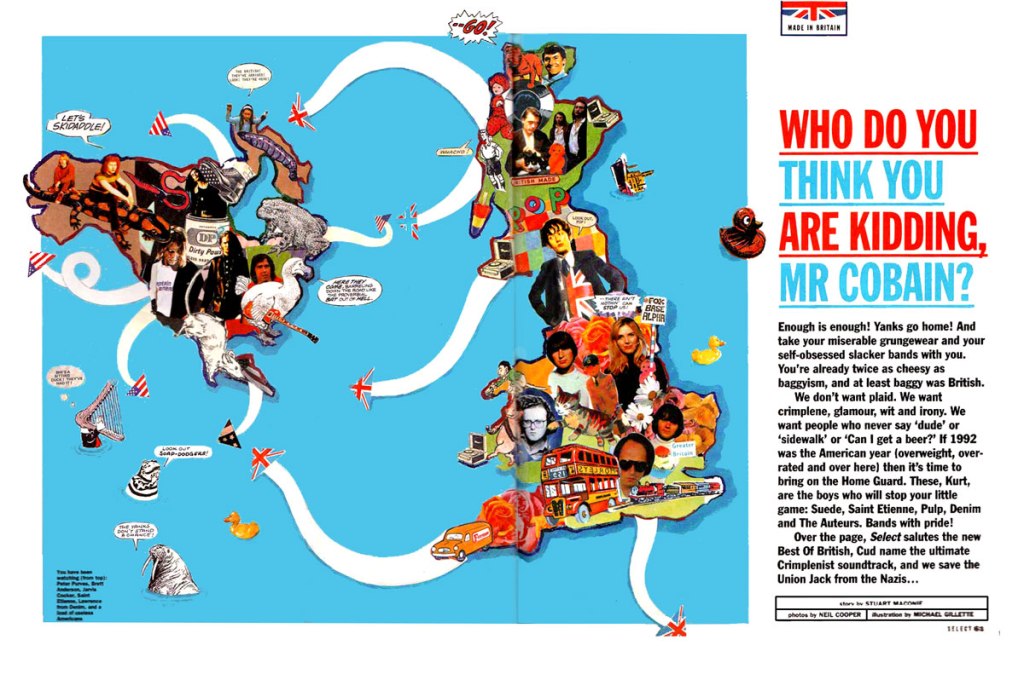
My flatmate Stu’s brother [Andrew Harrison] was the editor of Select. Andrew had a ‘no nepotism’ rule, he couldn’t be seen giving jobs for the boys. But when he found out I’d worked for Saint Etienne, he was like, ‘You must be bona fide.’ So that’s how I got the job doing the illustration for the Stuart Maconie article about Britpop [Select, April 1993 issue].

JUSTIN LEWIS:

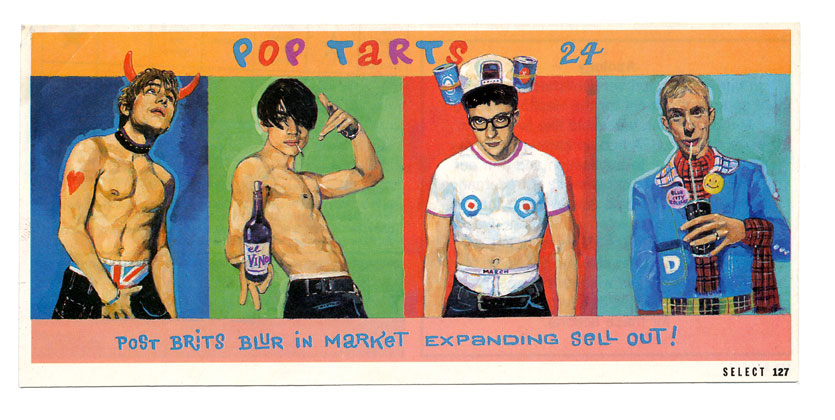
And then you did this regular feature called Pop Tarts, every month, and it’s reminded me how much you made me laugh in schooldays. Because you found room for humour and irreverence as well in many of these pieces.

MICHAEL GILLETTE:

Definitely. When I left college, I was a headless chicken, didn’t know what to do, and was thinking, ‘I’m only going to make serious work, try and do stuff for Faber & Faber’. Then I thought: ‘That’s not who I am – humour is really important.’  That’s yet another lesson from the Beatles – they could reach the highest rung of an artform and still be silly.  I can’t bear serious pretension – when the scene gets pretentious, I get really uncomfortable. I did fifty Pop Tarts. By ’96 I couldn’t take it anymore, but it was a good calling card for a while.

JUSTIN LEWIS:

That might be the longest-running thing you’ve ever done, then.

MICHAEL GILLETTE:

It probably is, yeah.

JUSTIN LEWIS:

And then you’re doing newspaper commissions, you’re in a lot of the broadsheets in the late nineties, doing accompanying illustrations for things. I found a thing in the Telegraph archive of all places, a culinary feature.

MICHAEL GILLETTE:

I did The Observer for a year, too. I did their back page column called ‘Americana’. Louis Theroux wrote many of the articles. I came back to London this last summer, went to Bar Italia, and there’s a drawing I did – maybe for the Telegraph – framed on the back wall! It was about Italian clothes culture, and I had decided to include Bar Italia. Not a work of genius, but when I saw it, I was thrilled [laughs]. I couldn’t think of a better place to hang!

JUSTIN LEWIS:

How do you feel in general now, seeing work you did thirty years ago or longer?

MICHAEL GILLETTE:

I’m just glad to be alive, and to have been able to make a creative living. Sometimes I have barely any recall of pieces – the Bar Italia picture for example. I’ve made so much stuff, it’s a rodeo schedule. I chose pop media – magazines, books, records, videos – rather than gallery art where ten people might see it. I wanted to be seen. It’s a really proletarian art form. Masses of art for the masses.

JUSTIN LEWIS:

Your stuff did get everywhere, and I saw a lot of it, although somehow I didn’t make the connection that it actually was you for some time. I should explain here that your surname has grown an extra ‘e’ at the end since we were at school.

MICHAEL GILLETTE:

Either Select added that to my name or maybe Saint Etienne.

JUSTIN LEWIS:

Was it in error?

MICHAEL GILLETTE:

It was, yeah. But I wasn’t going to argue with that. I just let it go. Everyone was dropping Es in the nineties. I picked one up.

JUSTIN LEWIS:

So what did you do for Saint Etienne’s So Tough album? You certainly came up with the logo, right? And you designed the cover?

MICHAEL GILLETTE:

I initially did a painting of the 1970s photo of Sarah, which her father took. They went with his photo for the cover, which was the right decision. I did paintings of Bob and Pete for the inner sleeve. I wasn’t match fit yet. I hadn’t advanced much at college. I comped together some logos and they went with one set in a font called Bunny Ears.

JUSTIN LEWIS:

And that was the logo they used when they first went on Top of the Pops, for ‘You’re in a Bad Way’.

MICHAEL GILLETTE:

I was so excited: ‘My logo is up there.’ A little bit of me is on TOTP.

JUSTIN LEWIS:

So, with Aphex Twin, you were living in the same house around this time, 1992–95, three years or so. Was that a creative environment, a chaotic one, or both?

MICHAEL GILLETTE:

Both, definitely. We lived in two different locations. In the first one, he and his girlfriend lived above us. So my introduction to him was through the floorboards, really. He was right above my bedroom, it would be very quiet for long periods of time, when he was listening through headphones making stuff, and then it would be uproariously loud and sometimes terrifying, sometimes beautiful.

Then we moved to Stoke Newington and he had a tiny studio in the midst of the flat, so there was no separation. There were a lot of people coming and going, hangers on, and basic early twenties bad behaviour from young creative types. We all wore each other out because we were so much in each other’s pockets. But everybody was interesting and funny. And for all that people think of Richard, he was not a pretentious human being.

JUSTIN LEWIS:

I always think there’s quite a lot of humour in what he does anyway.

MICHAEL GILLETTE:

Yeah, often puerile!

JUSTIN LEWIS:

How did his remix for Saint Etienne’s ‘Who Do You Think You Are?’ come about? Is it true you were a sort of messenger with that?

MICHAEL GILLETTE:

I asked him, yeah. I hadn’t known him for long – and I wouldn’t say I had the capability to sway him in any way, but he was open to doing stuff at that time. I think he did a good job.

JUSTIN LEWIS:

I find it quite funny he did it, given the choice of song. Because I can imagine him being offered ‘Avenue’ to remix, for instance, but ‘Who Do You Think You Are’ (nothing to do with the Spice Girls by the way, this was earlier!) was a cover version of a song recorded by the Opportunity Knocks-winning comedy showband Candlewick Green in 1974, and the Saint Etienne remake had the potential to be a huge hit. And it’s not a remix you’d expect from a commercial single at all. But then Saint Etienne were great at being leftfield pop stars.

MICHAEL GILLETTE:

I’m sure they were elated with that remix. I don’t think they were looking for a Fatboy Slim banging track.

JUSTIN LEWIS:

And you did some video work for Elastica too.

MICHAEL GILLETTE:

I did two animations for their videos, which was very stressful, and some sleeve work for them too.

JUSTIN LEWIS:

The ‘Connection’ single.

MICHAEL GILLETTE:

I did a painting for that, so I saw them from lift off to stratosphere. Justine [Frischmann] moved to Northern California in the noughties. We wound up living in the same neighbourhood – she helped us out to move there after we left San Francisco, so that was an enduring connection from that time.

JUSTIN LEWIS:

In 1997-ish, you finally got to visit San Francisco because, as I understand it, you had a show on at the Groucho Club in London and lots of wealthy people bought lots of your work, and so you could afford to go. Is that true?

MICHAEL GILLETTE:

Yes, that is exactly what happened. I had a show at the Groucho the same week that Labour were elected – a high watermark and possible end of Britpop – and I sold 14 out of 20 pictures.

JUSTIN LEWIS:

And Jarvis Cocker bought one?

MICHAEL GILLETTE:

Well, you know Ant Genn? He played with Elastica, he’d been in Pulp [and now writes scores for film and TV, including Peaky Blinders]. He bought three, one of which was for Jarvis, but Jarvis ended up paying for all three. I don’t know why. Who else bought one? Graham Linehan, who was then working at Select, Damon Hirst’s manager…’90s Soho.

JUSTIN LEWIS:

Do you ever miss Britain? You’ve been living in America a long time now.

MICHAEL GILLETTE:

Yeah, twenty-four years. Pound for pound, Britain punches harder than anywhere else. Music, comedy, history… I do love it. I feel a bit claustrophobic there now. I wish I’d spent more time visiting antiquity. I guess you always want what you haven’t got, right? Here, I want something pre-Victorian. I want to get my hands on something ancient!

—–

LAST: THE LEMON TWIGS: ‘Ghost Run Free’ [2023, from Everything Harmony album, Captured Tracks Records]

JUSTIN LEWIS:

Lemon Twigs have come up before on this series, and rightly so [FLA 24, Alison Eales]. What was it about ‘Ghost Run Free’ in particular?

MICHAEL GILLETTE:

Well, it’s like the offspring of The La’s and Big Star, isn’t it? I’d adopt that kid and bring them up as my own. Just instant ear candy, pressing all my buttons. I’ve played that song a lot – I like the rest of the album, but something about that song absolutely chimes. I was lucky to see them play here in St Louis – people tend to skip over the Midwest. I decided to wear a hat and stand at the back, not to spoil the kids’ fun. But the audience were all older than me! It was almost like a vampiric ritual… the band’s so young, what must it be like for them, looking out at the Night of the Living Gen Xers?

JUSTIN LEWIS:

It’s a breath of fresh air, this album, and while there’s lots of stuff I like at the moment, you don’t tend to get things that are big on chords, harmonies or melodies charting particularly highly. It’s unusually tuneful – the last time they got picked on this, I was referencing early seventies Beach Boys and Todd Rundgren, but now I can also hear Crosby Stills Nash and Young in it, even Roy Wood’s Wizzard.

MICHAEL GILLETTE:

They can all play, the band’s been together a while. They look like they were made in a pop culture laboratory. Live, they’re all swapping instruments. And then you’ve got the two D’Addario brothers, like the Everlys, Kinks or the Bee Gees. I’m going to quote Noel Gallagher here – ‘brothers singing is an instrument you can’t buy in a shop’. Like ABBA, where harmony and melody is absolutely everything. There’s always a chorus with multiple voices, so you feel like you’re included in the song. That’s one of Brian Eno’s pop observations/recipes.

Most songs I really love have got harmonies. Apart from The Smiths – I don’t know why they never had that.

JUSTIN LEWIS:

That’s a good point. I suppose with them, the harmonies are in the guitars.

MICHAEL GILLETTE:

Yeah, but Johnny Marr can sing – he’s got a good voice. Why did they never sing together? I suppose Morrissey won’t share his crisps.

—–

ANYTHING: JOHN O’CONOR: Nocturnes of John Field [1990, Telarc/Concord Records]

Extract: ‘Nocturne #1 in E flat Major’

MICHAEL GILLETTE:

I came to a point where pop music was just frazzling me. To quote that ‘Alfred Prufrock’ poem by TS Eliot: ‘I’ve measured my life out in coffee spoons’, whereas I’ve measured my life out in poppy tunes. There just came a time, especially working and reading, for [something else] and hearing these Nocturnes…

JUSTIN LEWIS:

What sort of age were you?

MICHAEL GILLETTE:

Oh, late forties. I’d always listened and worked to lots of soundtrack stuff, John Barry, Lalo Schifrin… But here, just the solo piano is so peaceful. Going from a world where I know everything about a musician, to this, where I didn’t know anything. I just listened without any baggage – a blank slate.

JUSTIN LEWIS:

Can you remember how you came across it, then?

MICHAEL GILLETTE:

I really don’t know. Maybe through YouTube’s algorithms… do you know anything about John Field? [Born in Dublin, 1782, lived till 1837] He had a riotous life. He was basically a rock star. His life would make a great film, Barry Lyndon-esque. Eventually I looked him up, but for years I knew nothing but the music.

JUSTIN LEWIS:

I knew the name, but it transpires he invented the nocturne form. Chopin was a fan. So he’s an innovator.

MICHAEL GILLETTE:

Yeah, I’m no connoisseur. I’ve listened to Chopin’s Nocturnes, I don’t enjoy them as much. Satie’s are good too, but Field’s are like an instant warm bath, reliably calming.

I’ve been thinking about the Aphex Twin this last couple of weeks because one of my students at college was drawing his logo over and over.

‘Oh, the Aphex Twin,’ I said.

‘Do you know that guy?’

‘Actually, yeah, I do know that guy.’

Then yesterday, my screen printer was wearing a homemade Aphex Twin T-shirt, with a picture of Richard in the Stoke Newington house studio. I’ve found folks want to keep the mystique of him intact. We are so overloaded with information. I think the mystery allows for purer engagement.

I feel like that about classical music. I won’t reach the point where I need to know what the third horn player had for his tea and how that affected anything. You know what I mean?

JUSTIN LEWIS:

When we were at school, the running joke about pop trivia knowing no bounds would be ‘What colour socks was Paul McCartney wearing when they recorded “Get Back”’?, and now the Get Back film exists, you can bloody well find out! It’s ridiculous really. I suppose thirty, forty years of reading the pop music press has created this frame of mind, and you can’t do that with everything. One of the nice things about new music now is I often come to things and I don’t know anything about them, who they are, nothing beyond the bare bones. It’s like being eight again.

MICHAEL GILLETTE:

It is. What I see with my children is they’re not interested in context, it’s all delivered scrolling on a phone. Recently, my daughter learnt to play ‘Love Grows Where My Rosemary Goes’ on the violin, and I asked:

‘How do you know that song?’ 

‘Instagram… How do you know it?’

‘It’s from the late 1960s.’

‘Oh I thought it was new.’

It’s trending audio… stuck behind reels. Folks use trending audio, and the algorithm boosts the post. It’s kinda greasy. My daughter was humming ‘Golden Brown’’, same thing – it’s used on medieval themed reels.

We were groomed [laughs] to be obsessed with pop minutiae. Now, it’s just another bit of content in the feed. They do introduce me to some new music though, Olivia Rodrigo I enjoy.

JUSTIN LEWIS:

Well, we were in the analogue age where knowledge was difficult to come by, so you’d collect fragments of information until you had far too much of it all. [Laughs] That’s what happened.

MICHAEL GILLETTE:

YES! – the scarcity back in the day. So maybe what I’m trying to do with jazz and classical music is to go back to pre-knowledge. I love Lou Donaldson, I love his music, but I wouldn’t know him from… Donald Duck. I know he’s Mr Shing-a-Ling. But I don’t really have any interest beyond listening and enjoying.

JUSTIN LEWIS:

And it makes it more random, you can make your own connections with it. For a long time, we got used to other people shaping music history, and now I guess you can create your own experience.

MICHAEL GILLETTE:

Totally. That’s the big difference. When you used to bring Smash Hits in to school, and we’d pore over it at lunchtime, Mark Ellen was the editor at the time. That Britpop illustration I mentioned earlier… Mark Ellen [by 1993, the Managing Editor of Select] was who I handed it over to. Did the obsession bring that to pass? I suppose what you give your attention to grows.

—- 

JUSTIN LEWIS:

You’ve designed [in 2008 and again in 2024] two very differently styled series of covers for Ian Fleming’s collection of James Bond books. Did you read the Bond books as a kid, or did you connect with the films first?

MICHAEL GILLETTE:

My dad had the books, Pan paperbacks from the sixties – great covers. They were stashed away in my bedroom in a little attic space. I read them when I was probably 12, 13… but the films… apart from occasional Bank Holidays, I don’t really remember them being on much. Do you?

JUSTIN LEWIS:

I don’t think they were on TV much before the eighties.

[Note: The first Bond film to be shown on British TV was Dr No, on ITV, on Tuesday 28 October 1975. In January 1980, the UK TV premiere of Live and Let Die attracted 23 million viewers on ITV, still unbeaten for a single showing of a film on British TV.]

JUSTIN LEWIS:

The main thing I remember with Bond was going with my dad and my brother to see a double bill at the Swansea Odeon on the Kingsway [don’t look for it, it’s not there anymore], this would have been Summer ’78. It was Live and Let Die and The Man With the Golden Gun, a double-bill. Two hours long, each of them, that’s a long afternoon. Especially when you’re eight years old. It’s actually a long time since I’ve seen a new Bond film. But I was also wondering to what extent the music of Bond films inspired those designs of yours. Were you thinking a lot about John Barry scores?

MICHAEL GILLETTE:

I do absolutely adore his music, yeah. Because I’m involved in the Bondiverse, I understand people are as passionate for 007 as we are for bands. I understand the draw of Bond. My job as a designer is to translate visually as a composer would do musically. The most enduring Bond thing for me is Barry’s scores, so sophisticated and timeless.

JUSTIN LEWIS:

They really hold up, as do the themes which generally hold up better than the films. Not many duds, surprisingly.

MICHAEL GILLETTE:

With John Barry, it’s the whole score… Things like Petulia from 1967, that’s a great soundtrack, or The Knack, and The Ipcress File. I listen to those more. I’m not an obsessive in the Bond world. And that possibly helps because you can get lost in detail. It helps to take a wider view.

JUSTIN LEWIS:

I was just thinking: have you ever tried to pastiche the Beatles’ album sleeves?

MICHAEL GILLETTE:

The only thing I remember doing, and it’s in Drawn in Stereo, is Oasis as the Yellow Submarine characters for Q.

JUSTIN LEWIS:

Of course, that’s right.

MICHAEL GILLETTE:

But otherwise, for years, I felt like I didn’t have enough skills to represent what they meant to me.

JUSTIN LEWIS:

You were too close to it!

MICHAEL GILLETTE:

But record sleeves remain the same and book covers keep changing. It’s interesting why that is.

JUSTIN LEWIS:

Why does that happen, I wonder? Even modern books do that – often the paperback edition six months later looks nothing like the hardback.

MICHAEL GILLETTE:

Music and visual culture are so locked together, I can’t disassociate them. I can’t imagine 2-Tone without that Walt Jabsco image. With a book, you don’t just stare at the cover for hours while you’re reading it. But a record… think of that bus journey between HMV in Swansea and home, where all you’ve got to look at is the sleeve.

Doing the Bond covers both times… immediately the reaction from some fans was that I’d performed an act of heresy. Changing record sleeves would cause a riot, unless you are Taylor Swift, but like many things about her, she defies logic and gravity.

JUSTIN LEWIS:

What’s your working routine like now? Do you sit at the desk every day, working on something, even if you’re just sketching?

MICHAEL GILLETTE:

Things have changed since COVID. My career has been mostly that of a rodeo illustrator: showing up every day, seven days a week, moving between clients, which went on for a quarter of a century plus. I don’t quite do that anymore. Now, I teach and do more selective commissions, because the world’s changed and I’ve changed. You know what it’s like with deadlines, right? For four years I worked for the New Yorker pretty regularly. I’d be about to clock off on Friday afternoon, and they’d e-mail and that’s the weekend done. For many years of my life, I leant in very hard.

JUSTIN LEWIS:

Are there things that surprise you about the young generation of new artists – in a good way, I mean?

MICHAEL GILLETTE:

I feel that we are fed a story that this generation is ‘hopeless and weak’. It’s been the same call since biblical times. By the end of teaching a class, or seeing my kids create, I have hope for us as a species. I believe in magic. I believe there’s an indomitable spirit of creativity that everyone’s got. We’re born with it, and we’re here to represent it the best way we can. I think that’s why people get unhappy when they don’t have outlets for their creative energy.

JUSTIN LEWIS:

It worries me in this country that young people are now supposed to only foster the talents that are going to get them a job or are going to get them a way of making money for other people rather than what they might actually be good at. And that’s really kicked in, in recent years. Obviously, education and passing exams is important, but what about the imagination?

MICHAEL GILLETTE:

Well, when you saddle people with debt in college, that puts an entirely different slant on it. The two grand from Saint Etienne paid off my student debt. I worked all the way through college to keep it low, but that’s the difference – I could afford a London life, albeit a tight one. Two thousand pounds at a time when my rent in Islington was £55 a week. That kind of maths wouldn’t work now with London housing. The pay for a similar gig in 2025 would be more or less the same, and cover about five weeks’ rent.

I’ve had a career, but it wasn’t encouraged, it was unlikely even then. Most folks who studied illustration didn’t become illustrators. Not saying that being an illustrator is the high bar of anything. We’ve saddled students with middle-aged debt and the anxieties that go with it. It’s unfair. As a teacher, I try to help as much as I can. My teachers were often art school bullies who’d give you a good kicking. Maybe that was the point; maybe if you survived that, you were strong enough for the outside world! But I try to do the opposite, I hope to encourage.

JUSTIN LEWIS:

What sort of age are your students?

MICHAEL GILLETTE:

19, 20, 21. They’re super-young, but the same impulses are inherent. There’s that beauty of openness and that’s why avoid telling them ‘it’s like this’ and ‘you have to do that’. You make it up [for yourself]. I made it up by knocking on Saint Etienne’s door. 

JUSTIN LEWIS:

You find a way.

MICHAEL GILLETTE:

You find a way, be creative. Where one person will walk into a room and see nothing but walls, another will find an open door. That’s why I believe in magic – it’s very mysterious how it all works. We’ve known that from all the music stuff we’ve read, the connections and the odd chances of luck.

JUSTIN LEWIS:

Nobody really knows where ideas come from.

MICHAEL GILLETTE:

Hundred per cent, yeah. Writer’s block, artist’s block… who’s doing the blocking? It’s not the universe, it’s the writer and the artist. You can shut it down really easily. [With creativity] it was never encouraged, but now it’s probably worse, it’s harder to freelance. But where there’s a will… I needed a period of time to be able to make mistakes, be slack, be lost and not worry about finances. Talent will out, but it needs support.

JUSTIN LEWIS:

Yes, particularly the process of trying out things and making mistakes. Unless you have particularly wealthy parents now, it’s difficult to do that. And especially when you’re young, you have the energy – you can stay up till three in the morning doing creative things.

MICHAEL GILLETTE:

You get an era where you can batter yourself almost to death and continue working and somewhat thriving. I’ve lived in two of the most expensive cities in the world – London and San Francisco – and managed to survive making artwork. It’s a bloody miracle. For younger people, maybe they’ll think in a different way, and it’s not about London or San Francisco, because those are overrun with investment bankers and tech workers… St Louis, where I’m living now, is different, it’s a post-industrial city, there are opportunities to live creatively.

In London, the generation before us had studios in Covent Garden. Our generation… my studio was in Hoxton Square. Now… Pushing out people who are regular human beings, let alone artists from a metropolis like London – that’s tragic. It’s everyone’s loss. But the fundamental soul of creativity that I see in young people is exactly the same. It’s like a timeless river. That spirit always makes me feel hopeful.

————-

All images in this piece (apart from my usual FLA header and cassette inlay) are (c) Michael Gillette. Thanks so much to him for allowing FLA to include them.

Much more on Michael Gillette at his website: https://michaelgilletteart.com

You can order the book directly from his website, here: https://michaelgilletteart.com/products/drawn-in-stereo-book

You can also order art prints for Michael’s James Bond book cover designs (pictured here): https://michaelgilletteart.com/collections/prints

You can follow Michael on Instagram at https://www.instagram.com/michaelgilletteart/

——

FLA Playlist 35

Michael Gillette

(For the time being, this site and project uses Spotify for the conversation playlists, but obviously I disapprove that Spotify doesn’t pay artists and composers properly, and other streaming platforms are available, as are sites to buy downloads and buy recordings. For consistency, you can also listen to the selections via YouTube (where available), and links are provided in each case, below.)

Thanks to Tune My Music, you can also transfer this playlist to the platform or site of your choice by using this link: https://www.tunemymusic.com/share/5yuhEgpQ6o

Track 1:

CARPENTERS: ‘We’ve Only Just Begun’:

https://www.youtube.com/watch?v=xeBoRF5tgDo&list=RDxeBoRF5tgDo&start_radio=1

Track 2:

ABBA: ‘Tiger’:

https://www.youtube.com/watch?v=htziQt0pCAQ&list=RDhtziQt0pCAQ&start_radio=1

Track 3:

THE BEATLES: ‘Baby You’re a Rich Man’:

https://www.youtube.com/watch?v=i5m-sgtwFck&list=RDi5m-sgtwFck&start_radio=1

Track 4:

THE BEATLES: ‘She Said, She Said’:

https://www.youtube.com/watch?v=NZOBWYHgZjw&list=RDNZOBWYHgZjw&start_radio=1

Track 5:

BILLY BRAGG: ‘Walk Away Renee (Version)’:

https://www.youtube.com/watch?v=iHrFkSeLukA&list=RDiHrFkSeLukA&start_radio=1

Track 6:

APHEX TWIN: ‘Xtal’:

https://www.youtube.com/watch?v=2tOutF8B3f8&list=RD2tOutF8B3f8&start_radio=1

Track 7:

SAINT ETIENNE: ‘Nothing Can Stop Us’:

https://www.youtube.com/watch?v=RAZUwvYqhpg&list=RDRAZUwvYqhpg&start_radio=1

Track 8:

LEMON TWIGS: ‘Ghost Run Free’:

https://www.youtube.com/watch?v=ewKdcUl3J7c&list=RDewKdcUl3J7c&start_radio=1

Track 9:

LOU DONALDSON: ‘One Cylinder’:

https://www.youtube.com/watch?v=F8RCGr8FEt0&list=RDF8RCGr8FEt0&start_radio=1

Track 10:

JOHN BARRY: ‘The Knack (Main Theme)’:

https://www.youtube.com/watch?v=k3utY_mJjK8&list=RDk3utY_mJjK8&start_radio=1

Track 11:

JOHN BARRY: ‘Petulia (Main Title)’:

https://www.youtube.com/watch?v=qhKQ1UT-MjE&list=RDqhKQ1UT-MjE&start_radio=1

Track 12:

JOHN FIELD: ‘Nocturne #1 in E Flat Major’

John O’Conor:

https://www.youtube.com/watch?v=2YJXgmLXTew&list=RD2YJXgmLXTew&start_radio=1

FLA 34: Emma Anderson (23/11/2025)

As a first-year university student, one of the first songs of the 1990s I cherished was ‘De-Luxe’ by the London-based quartet Lush, who were signed to the independent record label 4AD. I was in the habit of taping Annie Nightingale’s Sunday night programme on BBC Radio 1 at the time, and I’m pretty sure that’s where I first heard it. It opened their first EP, Mad Love, and I quickly bought that on CD. I wasn’t a particularly big follower of indie-rock at the time, though I liked The Sundays and Pixies and the Cocteau Twins, but there was something about the sound of Lush that drew me in.

Lush – co-founded by Emma Anderson and Miki Berenyi, and completed by bass guitarist Steve Rippon (succeeded by Phil King from 1992) and drummer Chris Acland – had already released a mini-album called Scar (1989), and they went on to issue a compilation of their early EPs (Gala, 1990), and three full-length albums: Spooky (1992), Split (1994) and Lovelife (1996). A relentless touring schedule, and especially the unexpected and devastating suicide of Chris Acland in October 1996, hastened the end of the group. Emma Anderson formed a new duo in the late 1990s, Sing-Sing, with singer Lisa O’Neill, and made two (in my opinion) undervalued albums. But in the past few years, Emma has re-emerged in her own right with the terrific album Pearlies (2023).

Emma and I connected via social media a while back, and I had wanted to talk to her for this series for some time, especially after I heard Pearlies. I was thrilled when she accepted my invitation. A new reissue of Lush’s Gala in November 2025 seemed an opportune time for us to chat at length on Zoom one Sunday about first, last and wildcard recordings, and it was in that same month that 4AD uploaded Phil King’s film of Lush footage, Lush: A Far from Home Movie, to YouTube. The 35-minute film is fondly dedicated to Chris Acland’s memory.

—–

JUSTIN LEWIS:

I always start with this question. I’m aware you had a slightly unusual upbringing, which we’ll come to, but what music did you have in your home early on?

EMMA ANDERSON:

This was probably before we owned a record player, but I had one of those mono tape recorders with the buttons at the front which were probably really meant for recording speech, and I used to tape stuff off the telly.

JUSTIN LEWIS:

Oh, I used to do this.

EMMA ANDERSON:

I think a lot of people did!

JUSTIN LEWIS:

Before there were video recorders.

EMMA ANDERSON:

And your parents would walk in and start talking over it, and you’d go, [loud whisper] “Be quiet!”. But I used to tape stuff mainly off Top of the Pops and the Eurovision Song Contest.

JUSTIN LEWIS:

The Eurovision Song Contest, prior to things like Live Aid, was the most amount of music you’d see on TV in one go, really. You’d get three hours once a year. And it was also television from another country, quite often, there didn’t seem to be a house style for Eurovision like you tend to get for it now.

EMMA ANDERSON:

I also liked Eurovision because as a kid I loved geography, maps and stamp collecting and the rest of it [laughs] so Eurovision kind of fed into that. I collected all these cassettes of Eurovision which I used to listen to repeatedly.

JUSTIN LEWIS:

I had a black and white TV in my room, from about the age of eight – an extravagance, I soon discovered – and am I right in saying you did too?

EMMA ANDERSON:

Yes, and the reason for that was, my dad was the secretary of a gentleman’s forces club in Mayfair and the flat we lived in was part of the building. Needless to say, it was a strange place for a child to grow up. We moved there when I was about three and we left when I was about fifteen so that’s quite a big chunk of my childhood. The flat came with the job and in the same building were hotel-like rooms which members could stay in, and all these rooms had rental TVs in them. So, my parents didn’t pay for the two rental TVs in our flat, they were paid for by the club as part of a deal, I guess.

JUSTIN LEWIS:

The reason I asked about a TV in your room was because of the possible relationship with the technology. The reason I had one… we weren’t rich, but I was a complete TV obsessive in those days, and it was a window on the world, and I did learn a lot from it.

EMMA ANDERSON:

I did watch a lot of TV and I was an only child as well so I consumed a lot of not just pop music but culture and films… I was quite unsupervised too so was even able used to sit up late and watch horror films which were on quite a lot in the 1970s!

The other thing was, because we lived in the club, and a lot of the members didn’t live in London, they’d come in from the Home Counties and they’d visit our flat and sit and a have a drink in the living room with my parents. So another reason to keep me occupied in my room was because there were constantly guests around and my parents wanted to keep me away from ‘the adults’.

It was an unusual, atypical upbringing. I didn’t live in a normal house in a normal street in somewhere like Dorking, if you see what I mean.

—–

EMMA ANDERSON:

Going back to ‘tech’(or lack of it!), I do remember having a toy record player when I was quite small, I think an aunt might have given it to me. It only took 78s and it came with its own records and the two I remember were ‘Tea for Two’ and ‘Doing the Lambeth Walk’! [Laughs]. It was not a technological marvel; it had one of those massive needles. But then, we got a ‘real’ record player (sort of) – my mother was quite a heavy smoker, she smoked Embassy cigarettes, which came with these little vouchers in the pack. She saved all these up in a jar, and there was a catalogue you could from and ‘pay’ with the vouchers so we got the record player like that. I must have been about ten.

To be honest, my parents weren’t massively into music; they were from a different era. My dad was born in 1919 [laughs], and my mum was born in 1928. He was forty-eight and she was thirty-eight when I was born both of which, of course, these days doesn’t seem that old…….

JUSTIN LEWIS:

…But in those days, it would have been.

EMMA ANDERSON:

Yes, and I was adopted too (that’s another story for another time). Both my parents had been married before they were with each other and their heydays were from a time before popular music as we know it now, I suppose. I think there’s a watershed time where people’s teenage years and twenties were before the Sixties and The Beatles and so on.

JUSTIN LEWIS:

Well, in your dad’s case, it would have been before the word ‘teenager’ even existed. That wasn’t a thing.

EMMA ANDERSON:

Exactly. They did buy some records when we got this record player, though: my dad bought some Edith Piaf. He liked classical too classical but popular classical – eg A Little Night Music by Mozart…

JUSTIN LEWIS:

I mean, Radio 2 in the Seventies – and Radio 4, actually – would play popular classical music.

EMMA ANDERSON:

Yes, obviously they catered to a different demographic then. My mother also bought some records, She loved Frankie Vaughan but also The Ink Spots and Nat ‘King’ Cole’… Those are the ones I really remember.

—–

FIRST: LA BELLE EPOQUE: ‘Black is Black’ (1977, single, Harvest Records)

JUSTIN LEWIS:

It’s occurred to me there was this period in the mid-to-late 70s when there are these disco remakes of 60s hits. That version of ‘Don’t Let Me Be Misunderstood’ by Santa Esmeralda, and ‘Painter Man’ and ‘Sunny’ by Boney M, and even ‘Macarthur Park’ by Donna Summer, like quite a European disco take on 60s music. And then there’s this.

EMMA ANDERSON:

I didn’t know, until I was going to do this interview, that ‘Black is Black’ was a cover. And the song was only about ten years old at the time – you know if you had someone today doing a cover from something in 2015, it wouldn’t feel that long ago.

JUSTIN LEWIS:

Yes, They were Spanish, Los Bravos who did the original of ‘Black is Black’ – although it was Johnny Hallyday who had the big hit in France with it, so maybe La Belle Epoque took their cue from that version.

EMMA ANDERSON:

There was a record shop near where I lived, and I bought this there. What else from that time? Baccara, ‘Yes Sir I Can Boogie’, ‘Silver Lady’ by David Soul.

JUSTIN LEWIS:

This is all literally from the same few weeks, autumn ’77.

EMMA ANDERSON:

Oh ha – maybe I bought them all at the same time. And then – slightly later I remember buying ‘Northern Lights’ by Renaissance and we had the Grease soundtrack album. This feels like quite a strange thing for a ten- or eleven-year-old child to have, but I bought a Gladys Knight and the Pips album, Still Together.

JUSTIN LEWIS:

She’s quite underrated, I think, she’s got a brilliant voice. Sifting through all the interviews you’ve done over the years, I was reading how you started reading Smash Hits, around the same time I did, in the very early 80s. And it feels odd to think now that, in those days, they had a section on indie, the independent charts, they’d write about people like Crass.

EMMA ANDERSON:

Yes, the first one I bought [25 June 1981] had Kirsty MacColl on the cover and it had a feature on Crass, a review of Cabaret Voltaire. I was obviously into pop, but I was fascinated by the indie page as well. I am planning on seeing Cabaret Voltaire live next year, funnily enough.

JUSTIN LEWIS:

I inherited my first several issues of Smash Hits from my cousin Philip, who’s five years older than me, he happened to be getting rid of them, and I asked if I could have them. I think the earliest issue had the Undertones on the cover [26 June 1980], and there were all these references in it to Joy Division, because Ian Curtis had just died, but it took a while to work that out because I wasn’t a John Peel listener or anything like that.

EMMA ANDERSON:

It’s funny you mention The Undertones because in 1981, getting into more ‘alternative’ music (though still in the Top 40) really started for me and  I bought ‘It’s Going to Happen!’ by The Undertones, ‘Treason’ by The Teardrop Explodes, ‘Sound of the Crowd’ by The Human League, and ‘Everything’s Gone Green’ by New Order. And I can tell you where I got ‘Everything’s Gone Green’ from – we lived on Half Moon Street, just off Piccadilly, and at the Curzon Street end there was a newsagent’s which sold ex-jukebox singles really cheaply – you could tell because the middle was knocked out. I had no idea who New Order or Joy Division were at this point in time. I had just heard the song in the Top 40.

JUSTIN LEWIS:

At what point did you start to think, ‘Maybe I could do this? Maybe I could be in bands?’ Because you were going to gigs, right?

EMMA ANDERSON:

The first gig I went to was Japan, supported by Blancmange [Hammersmith Odeon, 23 December 1981], and then The Teardrop Explodes…

JUSTIN LEWIS:

Was that when the Ravishing Beauties were supporting?

EMMA ANDERSON:

That’s right, with Virginia Astley – and I remember Julian Cope poured honey all over his body in the encore. There was also Soft Cell. Echo and the Bunnymen – but I also saw Haircut One Hundred and Duran Duran, the more poppy end. ABC, I saw. My friends went to see Spandau Ballet, I had a ticket for that, but I was ill and I couldn’t go and I was gutted.

JUSTIN LEWIS:

And this is still early 1980s, before these groups are playing arenas. They’re playing theatres.

EMMA ANDERSON:

I saw Duran Duran, Japan, ABC and Haircut One Hundred at the Hammersmith Odeon. Teardrop Explodes, Soft Cell, Bunnymen, U2, were all at the Hammersmith Palais.. I saw Simple Minds at the Lyceum… these were fairly sizeable venues but compared to where some of them they went on to play… quite small, yes.

JUSTIN LEWIS:

I can’t bear arena gigs, for the most part.

EMMA ANDERSON:

No, I can’t. At these gigs, we’d run down to the front of the venue when the doors opened and so we’d watch the whole of the support band. But you were asking ‘What made you think you could do this?’ Later on, I started to go to a lot more gigs in the back of pubs – and that’s when I started to think about that. Because it was a more DIY/post-punk environment, and you started to get to know people, especially in London when you’d get used to going to a huge number of gigs. Because it wasn’t glossy, the stage might only be a few inches off the floor. There was quite a community and in that era of late 80s London, people were squatting, a lot of people in bands were signing on – you could live in London cheaply. Camden and Notting Hill even were full of squats – hard to believe now, obviously. East London too – Hackney, Stoke Newington – and Brixton as well. But in that environment, you could pick up a guitar, bass or drumkit, and have a go. It’s a lot harder now.

JUSTIN LEWIS:

Oh god yeah. I don’t know how anyone gets started now.

—-

JUSTIN LEWIS:

Before you and Miki Berenyi formed Lush, around 1987 you were both in separate bands playing bass, right?

EMMA ANDERSON:

Yeah, they were both kind of rockabilly/garage groups (before what ‘garage’ means now!). I was asked to join The Rover Girls. They’d done a lot of gigs without a bass player already then I think they thought, ‘actually, I think we need one’. We did a few covers in that band (actually it all bordered on cabaret a little) – we did things like ‘Folsom Prison Blues’ and ‘These Boots Are Made for Walkin’’. One of our original songs was called ‘I Fell in Love with a Kebab Man’ – which I had no hand in writing, I should add! It was a bit of fun really.

When we formed Lush originally, we were a five-piece. As you probably know, there was another singer, Meriel [Barham, who later joined Pale Saints]. We played a lot of gigs on the London circuit, supporting a lot of people, and then after Meriel left, the songwriting changed a bit.

JUSTIN LEWIS:

It feels like things started to happen quite quickly after ’88, you get signed to 4AD, you get to make a mini-album [Scar] in ‘89.

EMMA ANDERSON:

Personally, I don’t think it happened particularly quickly. I mean, you heard of bands like Flowered Up who played two gigs or whatever who ended up on the cover of Melody Maker. I do consider that we did pay our dues. We played in a lot of pubs supporting a lot of bands!

JUSTIN LEWIS:

I suppose I was just thinking in terms of how the priorities of the independent sector change completely during the career span of Lush (1988–96) because the definition of ‘indie guitar music’ changed. And it must have been a thrill to sign to 4AD because I know you were a fan of a lot of the bands.

EMMA ANDERSON:

Oh, I was a massive fan. It’s not a secret!

JUSTIN LEWIS:

And the sleeve art for 4AD releases just looked so special. I’ve never quite understood when people say, ‘As long as the music’s great, that’s all that matters’ because something on 4AD – or Factory come to that – always looked so special. It looked like something you wanted to own.

EMMA ANDERSON:

Yes, they were pieces of art.

JUSTIN LEWIS:

Were the Lush sleeves all Vaughan Oliver’s work?

EMMA ANDERSON:

Yeah, there was no collaboration with the band. You didn’t collaborate with Vaughan Oliver! It was fine to let him get on with it [Laughs]

JUSTIN LEWIS:

So did he design the sleeve not knowing what the record would sound like?

EMMA ANDERSON:

No, he was definitely inspired by the music because I remember that the scratches on the Scar sleeve were there because of the kind of raw abrasiveness in the guitar sounds. And then later, Spooky, which Robin Guthrie produced, was a much rounder, softer sound. And the sleeves reflect all that. Lovelife, Chris Bigg did that one (I don’t know if Vaughan liked Lovelife much).

JUSTIN LEWIS:

Looking back now, you and Miki did write certain songs together, but most of the songs are credited either to you or Miki as solo compositions. How did you get started as a songwriter?

EMMA ANDERSON:

When Meriel was in the band, we did a demo which we used solely to get gig at that time.. I wrote a song, Miki wrote a song, Meriel wrote a song, and I think the last one on the tape was ‘Sunbathing’ which was the only one that then made it on to a later Lush release.

JUSTIN LEWIS:

The Sweetness and Light EP, right?

EMMA ANDERSON:

Yeah, I remember when we were making that [1990], ‘Oh god, we need another B-side!’ [Laughs] So we went back to that demo tape, and since then, you know… Jenny Hval has covered it, it was used in a Canadian TV series a couple of years ago…  Of the other songs on that first demo, Meriel’s was actually the best! After she left, I did start writing differently. I don’t really know what happened, but something clicked where I did start writing better melodies and structures. How and why, I don’t know.

JUSTIN LEWIS:

When you look at the back catalogue of Lush, do you have a favourite album, one that you’re most proud of?

EMMA ANDERSON:

I can tell you the one I’m least proud of is the last one [Lovelife, 1996]. I don’t like being negative about our work, really, but I don’t think that one’s stood the test of time as well as the others. I think it lost something in that whole [mindset] of ‘Let’s go back to basics and get rid of the effects pedals.’ And obviously that whole Britpop influence was going on at that time. The only track I can listen to really off that album is ‘Last Night’, but that had a completely different approach as I was into trip-hop at the time and it shows there. Steve Osborne, who worked with Paul Oakenfold, mixed it so it has more of the dance, trip-hop vibe. I do love the outro of that song, actually.

JUSTIN LEWIS:

Quite apart from the terrible tragedy that happened with the loss of Chris shortly afterwards, I wonder if one problem Lush faced after the shoegazing scene was you never seemed to be considered part of subsequent scenes, which always puts established bands at a slight disadvantage. Because the music press had this idea of what category everything should be in. And also because 4AD put out two singles on the same day (‘Hypocrite’ and ‘Desire Lines’ in 1994)…

EMMA ANDERSON:

Oh yeah, that wasn’t our idea.

JUSTIN LEWIS:

…which may have seemed like an inspired idea when they’d done it with Colourbox [‘The Official Colourbox World Cup Theme’ and ‘Baby I Love You So’, both released on the same day in 1986], but the indie world was entirely different back in the eighties.

EMMA ANDERSON:

That idea came from our American A&R man, Tim Carr, and 4AD ran with it; there was a feeling that we weren’t going to get into the top 40 anyway, so it was, ‘Let’s do something a bit weird and sabotage things’ – why?!! But we had been in the Top 40 (‘For Love’, January 1992) but it charted quite low, and while ‘For Love’’s a great song, it was released on 30 December [1991], and it was a very quiet week.

But the other thing [by ‘94] was that almost everyone in the industry around the band was so obsessed with the idea of breaking America.

JUSTIN LEWIS:

Did you have a profile in America particularly? I know you had records coming out there, and ‘De-Luxe’ had got on the alternative rock radio playlists over there. Maybe it’s my age, but I feel very tired when I read about bands touring America for months on end for not particularly enthusiastic audiences.

EMMA ANDERSON:

We were signed to 4AD for the world and they had a licensing deal with Warners/Reprise. It was great that Warners were behind us there, and we toured a lot, and did things like Lollapalooza which, actually, I really loved. I had a great time. But, alas, I do think America took its toll on the band mentally and physically. Having said that, the audiences were actually very enthusiastic and we did build up a very good fanbase there, which exists to this day. But we didn’t sell a million albums, much to the disappointment of management/labels etc.

JUSTIN LEWIS:

I was quite surprised to find out quite how much touring in America you did.

EMMA ANDERSON:

Part of the problem, I think, was the band members had different ways of approaching this. We all enjoyed different aspects of touring (and to be honest of the whole business and being in a band anyway). I personally wasn’t particularly into these long tours and endless weeks away from home. One tour was OK but then not long after came number two and then number three. Miki had spent a lot of time in America, her mother lived there, so she was much more used to being in the US. I think Phil quite liked it; he had never been to America before being in Lush. I didn’t hate it but, I have to be honest, it was gruelling. On the last album, we were doing this tour of shows put on by local radio stations, all these gigs where the punters got in for free. They were throwing bottles and shoes at the stage and when I told management that morale in the band was low, they said, ‘You’re only here so we can get the radio station to play your record.’ But you’re just thinking, ‘Is this really why I wanted to do music?’

JUSTIN LEWIS:

You were doing a lot of TV back in the UK, round about Lovelife time. Is it true you did Live and Kicking one Saturday morning?

EMMA ANDERSON:

That was one of the better ones! We had a very good TV plugger, the late Scott Piering. We did Top of the Pops [for both ‘Single Girl’ and ‘Ladykillers’] … Big Breakfast with Zig and Zag, twice. This Morning with Richard and Judy, we went up to Liverpool to do that. Then there was Pyjama Party [co-hosted by Katie Puckrik and a young Claudia Winkleman], Hotel Babylon with Dani Behr, Dear Davina… We did some quite trashy stuff around the Lovelife time.

JUSTIN LEWIS:

I’m surprised I don’t remember seeing you on these, I used to watch quite a lot of night-time TV back then.

EMMA ANDERSON:

We did All Rise for Julian Clary [courtroom mock-up variety show for BBC2]… him and Captain Peacock [Frank Thornton] from Are You Being Served? That was Phil’s moment of ‘How low can we get with this?’, that show. So embarrassing.

JUSTIN LEWIS:

In what capacity were you doing that?

EMMA ANDERSON:

Basically, there was this young girl – about 12 years old. She’d collected a load of NMEs, a few hundred probably, and somebody had chucked them out by mistake. She was so upset that either she or somebody else wrote to this programme who obviously then contacted the NME who got together all these [replacement issues]… And our role was to come on and present this girl with all these NMEs. That was it.

—–

LAST: TAYLOR SWIFT: ‘The Fate of Ophelia’ (2025, single, Republic Records)

 JUSTIN LEWIS:

You mentioned this as something you wanted to bring up.

EMMA ANDERSON:

I’m going to make a massive admission here: I don’t really consume a lot of new music. My finger is not on the pulse of new releases. But this obviously came to my attention because you can’t really get away from it. I don’t really have an opinion on Taylor Swift – I never understood why she was so massive, but I’ve also been intrigued by why she’s so massive. But I do think this single is alarmingly good. I cannot get it out of my head. I go to bed singing it, and I wake up singing it. The video is amazing, and then of course on Instagram when you look at one thing – in this case ‘the dance’ – the algorithm sends you all these clips, so I’ve now watched about fifty different people all doing ‘the dance’. And I’ve realised this really is quite a phenomenon.

So then I looked into the background of it, because I’m always interested in the production side, and it’s Max Martin and Shellback who’ve both worked with Britney Spears amongst others. And then, I started breaking down the actual song in my head. So there’s a chorus, but then as I said to my daughter, ‘It’s like there’s a post-chorus.’ And she said, ‘Of course there’s a post-chorus.’ My daughter’s been getting into K-Pop and that’s got post-choruses. I thought I knew about pre-choruses. But then I realised, actually, that there’s a song I’ve got on my Pearlies album called ‘The Presence’ and that’s got a post-chorus on it!

So I think I brought this Taylor Swift song up because it’s just made my brain ticking about lots of things. It’s quite fascinating, and so I am starting to understand why she’s so massive.

JUSTIN LEWIS:

There’s another thing I was going to say about Taylor Swift which I find a bit off-putting. With her previous album, two hours after that ‘dropped’, there was another album that came out immediately.

EMMA ANDERSON:

Oh, I was vaguely aware of that, yes.

JUSTIN LEWIS:

So what they said this time was: With the new album, no extra songs after it comes out, this is the album – only to then bring out lots of limited edition formats, each with one extra alternative version and demo of the existing songs on the album, which technically means there were no new extra songs, but it did mean that all the fans felt obliged to shell out for all these extra formats – and especially given her fans are often really young… I find it all a bit cynical.

EMMA ANDERSON:

Yeah, as much as I think aspects of her are great… that whole re-recording her back catalogue. You can slag off your original record company, but they put the work in in the early period. Is that taken into account? Without the work they put in, would you be able to do this now? But I get the idea that the fact they own your material is obviously quite an anathema to a lot of people, especially if you become huge (as she has done).

—–

JUSTIN LEWIS:

I wanted to ask you about Sing-Sing, the duo you formed after Lush broke up. Was this a way of trying to do something totally different from Lush?

EMMA ANDERSON:

After Chris’s death [Oct 1996], that whole year was just… awful. Even before Chris died, it’s not a secret, I wanted to leave the band. My way of coping after, in a way, was carrying on, and quite quickly start writing some more songs. But at that stage, I didn’t have a singer and I didn’t think I could sing.

JUSTIN LEWIS:

I mean, obviously, you were singing on the original Lush records.

EMMA ANDERSON:

Backing vocals, yes, which is completely different from doing lead which I had never really done at all. In fact, around 1997 I did some demos which 4AD paid for as they were interested in hearing new material and Pete Bartlett – our soundman who’d produced Lovelife – produced them in his flat. I gave them to [4AD founder] Ivo, and he said to me [laughs], ‘You can’t sing, Emma’. (Looking back, though, this is funny because Ivo actually really loves Pearlies, my solo album, and he absolutely thinks I can sing now. This actually means a lot to me as I have really obviously always valued his judgement.) Anyway, then myself and the remaining Lush members got dropped so I went looking for other singers. I found Lisa [O’Neill] via a couple of ways. She worked at an animation company called Bermuda Shorts with a really old friend of mine, Bunny, who I knew from school, but she also went out a guy who shared a flat in Camden with a guy that I was going out with. PLUS she’d also sung on the hidden track on a record by Mark Van Hoen’s project, Locust, an excellent album called Morning Light (1997). PLUS another connection: my friend Polly worked at a PR company called Savage and Best – they did Pulp, Elastica, Curve etc. John Best gave me a promo cassette of Morning Light. So, I thought, ‘Maybe this is meant to be’ – and we started working together.

The other thing about Mark Van Hoen was that he was an electronic musician and a whizz-kid programmer. After being in a traditional band set-up with a drummer and a bass player etc, for me, that was so refreshing. All the records I had made before, everything recorded had been recorded on to tape but this way you could just sit around the computer and it was BANG – it all got done very quickly and smoothly. But I still wrote songs in exactly the same way, and Lisa wrote songs too.

JUSTIN LEWIS:

Did you write together in Sing-Sing, or were these songs separately written compositions?

EMMA ANDERSON:

It was slightly different. Lisa couldn’t play an instrument, so she’d come up with melodies. Sometimes I’d flesh them out a bit, eg ‘I’ll Be’, and sometimes Mark would put chords to her melodies. But they were still her songs, and obviously her lyrics. But the whole process was just so different because it was of the computer-centric process. I’d never really done it like that before, and Mark’s such a excellent programmer. There were a few samples on the record, which were a nightmare to clear, legally [laughs]. But just watching him do it all was amazing, because he’d just pull out a record and say, ‘This would make a good drum sample’. And it would fit perfectly! It was a real eyeopener, and I enjoyed it immensely.

But then the problems weren’t about making the records, it was about getting them out there. I wasn’t on 4AD anymore…

JUSTIN LEWIS:

What was it released on in the end?

EMMA ANDERSON:

‘Feels Like Summer’ [the first version, 1998] came out on Bella Union but that was never going to be a permanent label. After that we actually became signed by Sanctuary and made the album with them but there were internal shenanigans and we got dropped and we were able to take the album with us, so I went to Alan McGee, who’d just started Poptones [his label founded after the end of Creation Records]. I knew Alan because I’d worked for Jeff Barrett (who owns Heavenly Records now but had been a PR) in the late 80s which was in the Creation Offices at Clerkenwell. And Alan said ‘yes’.

It’s funny now, because Lush are really celebrated – there’s all these reissues – and everyone loves shoegazing, and Slowdive and Ride and My Bloody Valentine. But in the late 90s, Lush were not seen as a particularly cool band. I was in my thirties when I was doing Sing-Sing and it’s hard to believe this now this, but ‘older’ women in music weren’t particularly respected back then. Now you’ve got PJ Harvey, and Björk, and Alison Goldfrapp, Kim Deal, all in their fifties, early sixties, you know? And it’s fine. But back then, people would literally say to me, ‘Emma, you’re over thirty, no-one’s interested’, even though the music was good, it was really good. But I think it didn’t really fit in with the early noughties time, The Strokes and The Gossip and Kaiser Chiefs and all that.

JUSTIN LEWIS:

Not really my thing either, that. I had just turned thirty, in 2000, and I find that period of guitar music in the early noughties even harder to listen to than Britpop. I mean, I like some Britpop – I was suspicious of the tag, but most of the bands made at least one record I liked. But I find the noughties a very strange period to revisit now. I wanted to listen to something else. But the other thing about this period – you got a ‘proper job’ as it were, right?

EMMA ANDERSON:

I’d worked before Lush, As I said, I worked for Jeff for a while, and after that then obviously Lush was my job. But by 2000 I had to go back into the world of day jobs. My first job was working for Duran Duran, I was their PA, 2000–02 and it was when the line-up was Nick, Simon and Warren Cucurrullo. Now obviously they’re back with John and Roger and they’re playing arenas, but when I worked with them wasn’t their most memorable period, although the album I worked on at the time, Pop Trash, was actually pretty decent. The single that came off that, ‘Someone Else, Not Me’, was really good. So I did that for a couple of years, and Sing-Sing were going at the same time. Then I worked as a management assistant at the company that managed Goldfrapp, Ladytron and a band called The Shortwave Set. I did that for two or three years, and then worked for the PR company Hall or Nothing who did Oasis and the Manics, as office manager. After that I moved to Brighton and got a job at 13 Artists, which is the booking agency for Arctic Monkeys, Suede and Radiohead amongst others.

JUSTIN LEWIS:

One thing I often think about, with being in a band: there must come a point when you start thinking, ‘Where are we today?’ You know your role is to do a gig and then travel to the next gig, but when you have an ‘ordinary’ job, you at least have a sense of place.

EMMA ANDERSON:

There’s a lot to be said for actually living a relatively normal life, you know?! Not knocking being in a band, but the weird thing is, Justin, I was only actually in Lush for about eight years. I’m fifty-eight but people associate me solely with being in Lush though it took up a relatively small portion of my working life. I’ve actually been an office worker way longer than I was a professional musician! It’s true!

JUSTIN LEWIS:

I’ve got a quote, which I’m going to read back to you, and you said this in 1992, so I appreciate you might think differently now, but I’ll mention it because it ties in with what you just said. To Simon Reynolds, in The Observer newspaper: ‘It’s weird to hear people talking about us as pop stars. When we were young, I used to be mesmerised by them, and even now I think we still can’t help seeing ourselves as part of the audience.’

EMMA ANDERSON:

Even now sometimes people say to me, ‘You’re a pop star’ and I baulk at it to be honest… I suppose I consider pop stars to be Prince or Beyoncé or Taylor Swift. I do remember that quote, and I was a little criticised for saying it, actually, I seem to remember.

JUSTIN LEWIS:

There’s a lot of sense in it.

EMMA ANDERSON:

There was that whole Madchester thing at the time… there was a lot of swagger going around.

JUSTIN LEWIS:

‘We’re the best band in the world’ type of thing.

EMMA ANDERSON:

Yes. And journalists kind of liked that. Of course they did. To me, being in a band was just something I did. I was never particularly ambitious. I always felt that I just picked up a guitar, wrote some songs, got signed, and we toured, we were able to do that.

JUSTIN LEWIS:

With your solo album, Pearlies, which I can’t quite believe already came out two years ago: I gather some of these songs date back to the Lush reunion from about a decade ago.

EMMA ANDERSON:

I had one or two songs, and some bits left over from the reunion (as I thought we were going to make an album. Or three). But that’s how I write anyway, in bits and pieces and I assemble them into whole songs sometimes. And I thought, I’d quite like to carry on. Originally, I thought I’d find another singer, again, like I had done with Sing-Sing. I did some demos with Audrey Riley [great cellist, many credits], and we did three tracks, but even with that, I said, ‘I’m not singing’, and she said, ‘Emma, you can sing! Just do it!’ She got in one of her students, a Norwegian girl called Anna, who sang the songs very beautifully, but I didn’t end up doing much with those demos. And then when I spoke with Robin Guthrie about doing some more demos, he said, ‘I will only do them if you sing. Forget it otherwise’ And that made me think, ‘Maybe I should do this.’

Then COVID happened, and Robin lives in France… but I realised there’d been all these people telling me I couldn’t sing all that time. Even when I was at school, I was quite into music, I did like singing, and there was a choir which I so wanted to get into. Every term I auditioned for it, and he’d say, ‘I’ll put you on the reserve list’ – as he felt a bit sorry for me.

JUSTIN LEWIS:

I’m really glad you did do it for Pearlies. Because it’s all about having personality in your voice anyway.

EMMA ANDERSON:

I don’t think it’s just about the voice, though. The thought of standing at the front of the stage in the middle, being the focus, petrified me [laughs].

JUSTIN LEWIS:

Oh I can understand that.

EMMA ANDERSON:

I don’t have that personality. I don’t really enjoy being the centre of attention. I was perfectly happy being at the side with Lush and Sing-Sing – in fact, I found it preferable.

JUSTIN LEWIS:

Thinking about it, when you see a band on TV, the camera tends to focus on the singer, they only cut away to someone else when the singer isn’t singing. You haven’t been touring the record, but I know there are good reasons for that.

EMMA ANDERSON:

The main reason is that I’m a single mother of a school-age child so going on tour is – well, nigh on impossible. I also work (I am a bookkeeper) and there are some financial constraints to touring too, especially as I am a solo musician now.

Some people have suggested, ‘Oh, just do it with you and a laptop.’ But I don’t want to do it like that, I’d want a proper band – and if it was just me and a laptop and a guitar, and it was a bit rubbish, you get people filming things and putting them on YouTube. So there’s an element of caution with it as well.

JUSTIN LEWIS:

Speaking of YouTube, I note that the Lush film, Lush: A Far From Home Movie – which was quite hard to see here, but was on the Criterion streaming site in America – is on YouTube now.

EMMA ANDERSON:

It’s Phil’s film, and we did some live showings of it. It was great, actually. It’s a sweet film.

JUSTIN LEWIS:

It’s nice and prescient that someone thought to capture that footage at the time. We’re used to doing that now on a camera or phone, but in the 90s, people weren’t thinking like that so much. So even to just have some bits filmed, you weren’t necessarily going to do anything with them.

EMMA ANDERSON:

Yeah, Phil had a Super-8 camera, so black and white, no audio. You could only film literally a few minutes at a time. So it’s very evocative. Even though it was filmed in the 90s, because of the quality it looks like it could have been filmed in the 50s. And there’s lots of Chris in it as he was so good in front of the camera.

—–

ANYTHING: GAVIN BRYARS: ‘Jesus’ Blood Never Failed Me Yet’ (1975, Obscure/Island Records)

JUSTIN LEWIS:

I always have to take a deep breath before listening to this because I find it so overwhelming.

EMMA ANDERSON:

In a way, I chose it because you asked for something that made you think about music differently. I did my degree at what was then Ealing College of Higher Education but it is now, after many name changes, the University of West London. The degree was called Humanities – you did six subjects in the first year, and then you majored in one and minored in two. My major subject was History of Art but one of the minor ones was Music, and there was a teacher and lecturer there called Allan Moore, who’s a musicologist. He used to play us things like Karlheinz Stockhausen’s Stimmung, and also this by Gavin Bryars. I just remember sitting in this lecture room, in this college, and him putting this on, and being completely transfixed, as in ‘What am I listening to here?’ This obviously old recording, of this old guy singing, outside, looped over and over, with these strings that built and built… It’s a very emotional experience.

But it’s quite important to me that I actually heard this at college, rather than on the telly or at a mate’s house. And I’ve got the record now.

JUSTIN LEWIS:

Which version is this, because there are several?

EMMA ANDERSON:

The other side is ‘The Sinking of the Titanic’.

JUSTIN LEWIS:

Ah, the original record, that came out in the 70s.

EMMA ANDERSON:

And I noticed, when I knew I was going to do this interview, that Tom Waits has also appeared on a recording. Which makes total sense. And Audrey Riley who I mentioned earlier – she’s played with Gavin Bryars as well, she knows him quite well. So I’m not an afficionado of modern classical music or whatever, but this has meant a lot to me and made me see things in a different way. And it was interesting working in Lush with Audrey on string arrangements… I mean, when I was a child, I really wanted to learn music, the piano specifically. I begged and begged to have piano lessons, but I wasn’t allowed, basically. So I do sometimes wonder, had I had piano lessons and got into that world, my life might have been a bit different.

JUSTIN LEWIS:

That’s a real shame you never got that opportunity then. Is ‘Jesus’ Blood’ classical music or not, then, I wonder? Because it lies somewhere between lots of things. I have a feeling I first heard this in the early 1990s, because incredibly, this was on the Mercury Prize nominations list [the 1993 list, and a three-minute edit of the Tom Waits recording which you mentioned was included on a Mercury sampler album alongside PJ Harvey, Suede, Apache Indian and the Stereo MCs]. They used to put out a sampler every year of the Mercury nominations, not sure they do this anymore, but at the end there’d always be the token classical record, which would never win, and you wish it would sometimes.

But the thing about an extract of something like this – it doesn’t really work. You have to have the whole thing. [EA agrees] Because it takes about five minutes for the strings even to start.

EMMA ANDERSON:

It’s very gradual which adds to the emotional weight of it.

JUSTIN LEWIS:

And then the effect of having the strings start to drown out the man’s voice – and at times, you only hear the man’s voice whenever the strings pause, before starting again. I have to ration it because it’s one of those pieces I wouldn’t want to get too used to. It’s a record that’ll stay with me for ever.

This is the kind of record I was thinking of, with wildcard choices for this textcast. I couldn’t get my head round repetition when I was very young, and what shook me out of that was firstly modern classical music, and then also dance music. Because that was also about minimalism and loops. I suddenly realised I’d have to listen to music differently. Because I was 17, 18 when acid house came in.

EMMA ANDERSON:

I was actually really into dance music – I used to go clubbing quite a lot in the late 80s/early 90s and I’ve got a few records from that period.

JUSTIN LEWIS:

What would be an example of an acid house ‘anthem’ that would evoke that time for you?

EMMA ANDERSON:

‘Strings of Life’ by Rhythm is Rhythm… I loved that. ‘The Real Life’ by Corporation of One, which has got samples from Simple Minds’ ‘Theme from Great Cities’ and then it cuts in with Queen’s ‘Bohemian Rhapsody’. What else? ‘Where Love Lives’ by Alison Limerick was always a favourite. ‘Sweet Harmony’ by Liquid. Sometimes I’d hear things at the time but wouldn’t know what they were. But I was quite into this stuff, because I worked for Jeff and there was that whole club scene… I went to the Hacienda a few times, Shoom, Milk Bar with Danny Rampling…

I expect people maybe assume I must only be into My Bloody Valentine and Cocteau Twins… but I’ve got quite a broad taste (I like to think so anyway!).

—-

Lush’s Gala compilation was reissued on 4AD on 14 November 2025, marking its 35th anniversary, and completing the label’s reissues of the group’s back catalogue. More information here: https://4ad.com/news/22/9/2025/35thanniversaryeditionofgala

Phil King’s film, Lush: A Far from Home Movie, can now be seen in full on 4AD’s YouTube channel: https://www.youtube.com/watch?v=ow3jEIV0s74&list=RDow3jEIV0s74&start_radio=1

Emma Anderson’s 2023 solo album Pearlies is out on Sonic Cathedral Records, as is its 2024 remixed version Spiralée (Pearlies Rearranged). Further information at her Bandcamp page: https://emmaanderson.bandcamp.com/music

You can follow Emma on Bluesky at @emmaandersonmusic.bsky.social, and on Instagram and Facebook at @emmaandersonmusic.

—–

FLA Playlist 34

Emma Anderson

(For the time being, this site and project uses Spotify for the conversation playlists, but obviously I disapprove that Spotify doesn’t pay artists and composers properly, and other streaming platforms are available, as are sites to buy downloads and buy recordings. For consistency, you can also listen to the selections via YouTube (where available), and links are provided in each case, below.)

Thanks to Tune My Music, you can also transfer this playlist to the platform or site of your choice by using this link: https://www.tunemymusic.com/share/4z65FUBy0X

Track 1:

LA BELLE EPOQUE: ‘Black is Black’:

https://www.youtube.com/watch?v=v3nf4UsEdlA&list=RDv3nf4UsEdlA&start_radio=1

Track 2:

EDITH PIAF: ‘Je ne regrette rien’:

https://www.youtube.com/watch?v=4r454dad7tc&list=RD4r454dad7tc&start_radio=1

Track 3:

RENAISSANCE: ‘Northern Lights’:

https://www.youtube.com/watch?v=HKBJqHvQvjg&list=RDHKBJqHvQvjg&start_radio=1

Track 4:

CABARET VOLTAIRE: ‘Nag, Nag, Nag’:

https://www.youtube.com/watch?v=pWGZWYrR5Nw&list=RDpWGZWYrR5Nw&start_radio=1

Track 5:

THE UNDERTONES: ‘It’s Going to Happen!’:

https://www.youtube.com/watch?v=aQtaqgW6MXg&list=RDaQtaqgW6MXg&start_radio=1

Track 6:

THE TEARDROP EXPLODES: ‘Treason’:

https://www.youtube.com/watch?v=rV8cEIsFX-A&list=RDrV8cEIsFX-A&start_radio=1

Track 7:

ABC: ‘Date Stamp’:

https://www.youtube.com/watch?v=434lTbIZsJ0&list=RD434lTbIZsJ0&start_radio=1

Track 8:

NEW ORDER: ‘Everything’s Gone Green’:

https://www.youtube.com/watch?v=4v5ivB7bM1k&list=RD4v5ivB7bM1k&start_radio=1

Track 9:

JAPAN: ‘Gentlemen Take Polaroids’:

https://www.youtube.com/watch?v=SlyI2isjAas&list=RDSlyI2isjAas&start_radio=1

Track 10:

LUSH: ‘Thoughtforms’ (2nd version):

https://www.youtube.com/watch?v=gWYXR78pf7k&list=RDgWYXR78pf7k&start_radio=1

Track 11:

LUSH: ‘Last Night’:

https://www.youtube.com/watch?v=bHngGUzLkD4&list=RDbHngGUzLkD4&start_radio=1

Track 12:

TAYLOR SWIFT: ‘The Fate of Ophelia’:

https://www.youtube.com/watch?v=ko70cExuzZM&list=RDko70cExuzZM&start_radio=1

Track 13:

SING-SING: ‘Far Away from Love’:

https://www.youtube.com/watch?v=_cuOr2TCcQw&list=RD_cuOr2TCcQw&start_radio=1

Track 14:

SING-SING: ‘I’ll Be’:

https://www.youtube.com/watch?v=rLhsWXlCmUo&list=RDrLhsWXlCmUo&start_radio=1

Track 15:

DURAN DURAN: ‘Someone Else Not Me’:

https://www.youtube.com/watch?v=RyThuzD1vUo&list=RDRyThuzD1vUo&start_radio=1

Track 16:

EMMA ANDERSON: ‘The Presence’:

https://www.youtube.com/watch?v=rCyo6Dq6Dvg&list=RDrCyo6Dq6Dvg&start_radio=1

Track 17:

EMMA ANDERSON: ‘Inter Light’ (MEMORIALS Mix):

https://www.youtube.com/watch?v=x3At7nRpepY&list=RDx3At7nRpepY&start_radio=1

Track 18:

GAVIN BRYARS: ‘Jesus’ Blood Never Failed Me Yet’ [1975 original]:

https://www.youtube.com/watch?v=rfJXXOFLzfQ&list=RDrfJXXOFLzfQ&start_radio=1&t=82s

Track 19:

CORPORATION OF ONE: ‘The Real Life’:

https://www.youtube.com/watch?v=9AEp9-BOGOw&list=RD9AEp9-BOGOw&start_radio=1

Track 20:

RHYTHM IS RHYTHM: ‘Strings of Life’:

https://www.youtube.com/watch?v=vGFw2qeUp0s&list=RDvGFw2qeUp0s&start_radio=1

Track 21:

ALISON LIMERICK: ‘Where Love Lives’:

https://www.youtube.com/watch?v=wGYdeSnux68&list=RDwGYdeSnux68&start_radio=1

FLA 33: Mark Watson (16/11/2025)

For over twenty years now, the writer-performer Mark Watson has sustained two parallel careers. In one of them, he has pursued stand-up comedy to great acclaim, both in live settings and via broadcast vehicles like BBC Radio 4’s Mark Watson Makes the World Substantially Better, BBC4’s We Need Answers and Mark Watson Talks a Bit About Life, a third series of which premiered on Radio 4 in 2025. Simultaneously, he has written a total of eight novels (including 2020’s Contacts, and 2025’s One Minute Away), plus a non-fiction book, a graphic novel, and a memoir published in 2023 called Mortification.

Mark was kind enough a while back to tell me how much he had enjoyed reading various instalments of First Last Anything, and so – as I am an admirer of his work – it seemed logical to ask if he’d be interested in taking part himself. To my delight, he agreed. We spoke over Zoom for 90 minutes or so, one day in late October 2025, and I was particularly interested to find out how his enthusiasm for music helped to shape and inform his own attitudes to performing and writing. We hope you enjoy our chat.

—–

JUSTIN LEWIS:

So what records did you have in your house growing up before you started buying your own, before you started making your own choices?

MARK WATSON:

My mum didn’t particularly listen to music around the house, but my dad was quite a serious music fan, a serious pop music fan, at least – he wasn’t what you’d now call a muso. We’d watch Top of the Pops, we’d listen to the charts on a Sunday, that top 40 countdown with Bruno Brookes was quite a big ritual. And my dad would buy records – singles and LPs – fairly often. There are certain things that it’s pointless being nostalgic about, but the download era has unfortunately made the charts a meaningless exercise really. The idea of the nation holding its breath to see what’s come in at number one feels like a thing we won’t get again. I used to enjoy the suspense of that.

JUSTIN LEWIS:

The charts are for the music industry only now, I think.

MARK WATSON:

When I was very young, we lived in Canada for a year. In Alberta, in the middle of nowhere.

JUSTIN LEWIS:

Oh! I went there when I was about eleven, for about a month – our base was Calgary.

MARK WATSON:

We flew into Calgary, I believe. I’m too young to remember most of this, I was four, but my earliest childhood memories are from that period. My dad was a teacher and he did a job swap with a teacher over there, so slightly rashly, he took his young family to the rural wilds. And in that period, his brother, my uncle, used to tape the charts from the radio and send them on cassettes.

My dad also used to have, you probably had them yourself, the Guinness Hit Singles books.

JUSTIN LEWIS:

I very much did!

MARK WATSON:

If I saw an act on Top of the Pops, I was the sort of kid who would flick through that book to see a rundown of their hits. Nonetheless, I was still limited to what my dad had in his collection, which was extensive, but if you were that 10-year-old now, you could literally listen to any song in the world. There are many reasons to lament the way the digital age has impacted the way we buy music, but it’s also true that it’s a wonderland: everything that’s ever been recorded is pretty much freely available for anyone to explore.

I remember when someone showed me Napster, in my early twenties. I simply couldn’t believe it. I remember just typing all sorts of different songs in to test it, it just didn’t seem possible. Just as when Amazon launched, rather than a sort of sinister mega corporation, for a while it seemed like this magic machine where you could put in any book you’d ever read in your life, and it would just send it to you. An innocent age.

When I was thinking of the First, Last and Anything categories for this, it dawned on me that technically, the first record I bought was ‘Dancing in the Dark’ by Bruce Springsteen, because while we were in Canada, my dad took me to a record shop and I have an early memory of him lifting me up so I could hand the money over and buy this. And seeing the lyrics on the back of the sleeve.

So I could have gone for that, but it’s stretching a point to say that was my record purchase, really.

JUSTIN LEWIS:

So, instead, let’s talk about this…

—-

FIRST: THE CRANBERRIES: Everybody Else is Doing It, So Why Can’t We? (Island Records, 1993)

Extract: ‘Linger’

JUSTIN LEWIS:

I was working at HMV in Cardiff when this went really big in early 1994. Because it came out for a while in this country, before any of the tracks had been hit singles. Then they had a massive hit in America with ‘Linger’ and they deleted the album in the UK, you could only get it as a US import, which we were playing in the store every day, even then. And then once ‘Linger’ finally became a hit here, they reissued the album. So I heard this a lot at the time. But I don’t think I’d heard this in full since about 1995.

MARK WATSON:

Well – I revisited it yesterday because of this chat, and again, it was a long time since I listened to any of it apart from the famous songs. This was my first album purchase, and it was on cassette. It’s sort of arbitrary that it was the first, in a way, just to do with the timing of where I was in my life – I was, I suppose, second or third year of secondary school. It was the first time I had tiny bits of money, pocket money and this and that.

JUSTIN LEWIS:

How old would you have been? Thirteen, fourteen?

MARK WATSON:

Probably thirteen when it came out. I was just starting to listen to commercial radio off my own back, basically. We’d have GWR FM, the commercial station in Bristol, on the drive to school. My dad was a teacher, of course, so I had a lift, and in that 20-minute drive, you’d get maybe two songs around all of the chatter. But I’d be listening to other stuff on the same station when I’d be doing my homework, and I had no real idea how the station’s playlists worked or anything, so there’d be stuff I absolutely didn’t want to listen to at all, but occasionally you’d get a gem. And they played ‘Linger’ with, as far as I remember, no fanfare at all, but I just caught the band’s name.

I’d listened to a lot of R.E.M., my first proper band as a young teenager, so I liked that kind of folky pop sound, but I hadn’t really heard anything like this. Strings in pop songs would become ubiquitous later – The Verve, and Embrace and so on – and I’m still a real sucker for well-done strings in music, but there was a period in the 90s when you just couldn’t get away from it.

JUSTIN LEWIS:

And of course, Top of the Pops would have ‘the string section’ in the studio and you’d wonder, ‘Are they the string section on the record?’

MARK WATSON:

That’s right. It’d weird to look back on, but ‘string section’ was almost like a drum machine [setting] for a period – and I really took against ‘Bittersweet Symphony’ by The Verve later on…

JUSTIN LEWIS:

Although that one is a sample, isn’t it?

MARK WATSON:

That’s true actually – but also I think by the end of the 90s, that Irish folk tradition as pop music thing became slightly degraded by what I regard as lesser imitations of the Cranberries.

JUSTIN LEWIS:

When the Cranberries first emerged, they reminded me of the Cocteau Twins ‘but you could hear the words’, and I don’t mean they did that cynically. I’m trying not to use the word ‘ethereal’ but I just have.

MARK WATSON:

I had never heard anything quite like ‘Linger’ on first listen and, because of the way music was then, I remember wondering when I’d hear it again. There was no way of making it happen, necessarily. I didn’t know if it was even out. It’s very odd to look back on how random it was. Like, now, you can listen to any song that you want, any day, any moment, of your life. It’s funny to think of a time when you’d listen to the radio, wondering whether or not a song would come up.

JUSTIN LEWIS:

I used to listen to the Annie Nightingale Request Show on Radio 1 on Sunday nights in my teens, and that show was such a lifeline in terms of playing unexpected records. With request shows, now, people tend to request things that the station plays anyway, or the station chooses the requests that match what they already play. Or seems to, anyway. But on that show, it was completely up for grabs – you seemed to be allowed to choose anything, and that really freed things up.

MARK WATSON:

Yeah, I really like how BBC 6Music replicates the spirit of that by doing things like the People’s Playlist and the Cloudbusters. And I think Lauren Laverne is a sort of natural heir to Annie – among many other accolades I’d bestow on Laverne. But still, in the modern age, the request show is a strange concept because we all know there’s a much easier way to hear the song.

JUSTIN LEWIS:

True, although only if you know the song already. Annie’s way of doing it, which is fantastic, was apparently when people would send in lists of songs, she’d often investigate the ones she didn’t already know.

MARK WATSON:

That’s a bygone era in mainstream terms – even for 6Music, that would be pretty daring.

JUSTIN LEWIS:

Yeah, I really liked the idea that the audience could educate the broadcaster as well as vice versa.

MARK WATSON:

But because this was commercial radio, it was a case of waiting for ‘Linger’ to come along again. Once I’d heard it two or three times, I definitely felt I needed to know more about this band. I don’t think I’d quite started reading the NME or anything, I had no resources at all, so I just went to a music shop and see what was there. I went to Woolworths. I saw the album cover, I read the track listing, I saw ‘Linger’ was on it. I obviously didn’t know any of the other music on it, and I remember it felt like a substantial investment, £12.99 or whatever it would have been.

By that point, I had a little stereo of my own that I’d got as a birthday present and a pair of headphones, and so I was listening to music in quite a secretive, teenage kind of way. I still did listen to stuff with my dad, but I was also starting to get to that age where you wanted to discover stuff for yourself. I was aware of my taste starting to form separately. I remember around the same time hearing ‘Cornflake Girl’ by Tori Amos, one of the first moments of thinking, ‘I love this, but I don’t think my dad would be into this.’ Actually, in the end, he did quite like it, but then he did like Kate Bush, and I didn’t know about Kate Bush at the time, so I was wrong about that. But R.E.M. – albums like Out of Time and Automatic for the People – had come through him… and I knew he would like The Cranberries, but I also wanted to be the guy who discovered it.

JUSTIN LEWIS:

Oh, you’ve got to find this stuff for yourself, that’s how it works.

MARK WATSON:

Yeah, I remember listening to the album, thinking, ‘No-one knows about this yet. I’ve never heard anyone mention this band, apart from that time they got that fluke play on the radio.’ And then, not long after that, ‘Dreams’ was a very big radio hit. It would come on in the car [in the drive to school], and I would feel this pride that, for the first time in my life, I’d put my dad on to something musically. Before that, everything had come through him… or a couple of clued-up mates at school.

And it was a bonus that the Cranberries had such a distinctive female singer, Dolores O’Riordan. And then Stephen Street’s production – I found out years later (weirdly, after listening to the Smiths), I went back and realised it was the same guy who produced both, with that slick, jangly guitar sound.

JUSTIN LEWIS:

And straight after this Cranberries record, he went on to make Parklife with Blur.

MARK WATSON:

Yeah. I didn’t know his name, but I loved the sound of it. Even listening back yesterday, it’s very tightly produced, the drums sound great, and they’re very satisfying pop songs, but Dolores’ voice is the drawcard, obviously. She used to get compared to Sinead O’Connor, but I think that’s purely because it’s two fiery Irish women. There’s this lilting, hypnotic quality, but it can turn so quickly… there’s such melancholy in the voice in a song like ‘Linger’, but elsewhere the vocal is quite ferocious. And that in the end became the sound of ‘Zombie’, and when the sound got punkier, I started to part ways with the Cranberries. I think I had that classic teenage snob thing where once everyone at school knew ‘Zombie’, I was like, ‘Well, you guys don’t understand the Cranberries!’

JUSTIN LEWIS:

I must admit, when I heard the second album, I was thinking, ‘Yeah, I might be out, here’ – but I liked this first one a lot at the time.

MARK WATSON:

It did seem like diminishing returns.

JUSTIN LEWIS:

They were massive though. I note that on streaming, ‘Linger’ has passed one billion plays now. And ‘Dreams’ is not too far off that.

MARK WATSON:

Remarkable, yeah.

JUSTIN LEWIS:

But – I always find this kind of thing interesting – do you know who they supported live before they became big in their own right? Suede – not a massive surprise – but also Duran Duran on their US tour.

MARK WATSON:

That’s a strange partnership.

JUSTIN LEWIS:

And Dolores married Duran Duran’s tour manager, that’s how they met on that US tour. And I realised that’s partly how they got so big over there. Suede didn’t mean that much over there, but Duran Duran would have done.

MARK WATSON:

That’s fascinating – and also ‘Dreams’ became one of those songs that are in adverts. Like ‘Walk Away’ by Cast, which suddenly had a life of its own. And then there were songs that sound almost deliberately written like that, like ‘Going for Gold’ by Shed Seven. But in this case, with ‘Dreams’, it was just a fairly eccentric song tapping into the mainstream. Again, so much of it was her voice. Like there’s that weird wordless chorus where she’s just sort of howling, which is so different from the pop sensibility of something like ‘Linger’. You start to get a real palette, but also the songwriting and the melodies are so good. And I know that Dolores struggled with all sorts of aspects of being a globally famous pop star…

JUSTIN LEWIS:

Oh sure, I don’t think I could have coped with anything like that at all. That trajectory was dramatic, wasn’t it.

MARK WATSON:

Absolutely wild, but what’s nice – it’s still a very good listen, I think.

—-

JUSTIN LEWIS:

I’ve heard you mention in a few interviews how, perhaps unusually for a stand-up, you were driven more by music than comedy when you were in your teenage years. How did your music obsession grow, and how did you start to think you could do comedy? Was it becoming established as a performer?

MARK WATSON:

The pieces didn’t all fall together smoothly. I went to see a lot of bands live in my teens and well into my twenties. But the formative period for gig-going, in terms of my ambitions, was from about fourteen to twenty. Part of why I was much more into music than stand-up was there was nowhere near as much of a comedy scene in those days, or at least not one that anyone would know about. I would see the odd comedian at Bristol Hippodrome or the Old Vic. But even going to university, I could only have named about a dozen comedians, the same ones everyone knew – Victoria Wood, Lenny Henry, you know.

JUSTIN LEWIS:

And were you watching TV comedy at all?

MARK WATSON:

Yeah, although most of the comedy I watched was things like The Fast Show, The Simpsons, Harry Enfield… As with music, it was [an attempt to discover things] that my dad didn’t watch. The Fast Show was not something he’d have watched – that was my generation’s thing that we found for ourselves, I suppose.

JUSTIN LEWIS:

That was your Monty Python.

MARK WATSON:

That was our Monty Python, for sure. You’d go into school and recite the catchphrases… it was Friday nights and you’d look forward to it all day. But I had very little notion of what stand-ups were, I couldn’t picture in my head a comedy circuit, but then there was less of a circuit then. There were nowhere near as many touring comedians or clubs where I was – Bristol was quite well served for live entertainment, but I’d never seen someone just get up and do stand-up in a club environment, whereas I’d seen dozens of bands in these grungy rooms… I wasn’t musical myself – I played the drums a little bit, to no real avail, but something about watching the live music experience really did work for me. I couldn’t even drink legally when I was first going to gigs, but even though everywhere stank of smoke, I remember that environment really fondly. The anticipation building as the band’s arrival got closer… that feeling of the first song… and what used to be the stampede to the front when they played the big hit. I found all those things really intoxicating, not just the music but the whole live experience.

JUSTIN LEWIS:

Was there a particular group that you really associate with that formative time, that you’d have seen live around then?

MARK WATSON:

The Super Furry Animals were the big ones for me. My brother and I were big funs. I was fifteen or sixteen when Fuzzy Logic came out, and then Radiator, in fairly quick succession. We’d been into the early days of Britpop. Like we were not huge Oasis fans, liked Blur, liked Radiohead, Pulp, Pulp in particular. Like everyone who was fifteen at that point, though my brother was significantly younger, we were swept along by that Britpop wave.

But then Super Furry Animals just represented something different. The first time I came across them was when they were on Later with Jools Holland [BBC2, 01/06/1996]. They played ‘If You Don’t Want Me to Destroy You’ and I think ‘Hometown Unicorn’. I just remember I loved the band name, loved the names of the tracks, loved the look of Gruff Rhys and his air as a frontman. There was the fact that we had Welsh family and we grew up very near the Welsh border. We hadn’t seen a big Welsh band before… I mean, there’d been the Manics.

JUSTIN LEWIS:

When I was in my teens, it was a bit like that. The Alarm were quite big but they were from North Wales, the other end of the country from where I was. There seemed to be nobody from South Wales, and the ones who were from there, seemed to move away. Like Green Gartside – I didn’t know he was from Cardiff.

MARK WATSON:

I mean, the Manics went on to wear their Welshness quite proudly but it wasn’t what you thought of… you thought of them in army uniforms and stuff on Top of the Pops. I was basically quite scared of them, and of the people at school who were their fans. Whereas the Super Furries were in this perfect spot at that stage. It was just brilliant, hooky, catchy pop music – but also quite anarchic and strange.

JUSTIN LEWIS:

Yeah, I was from Wales already and there was a real mystery about them. I used to wonder, ‘Where’s this coming from?’

MARK WATSON:

There were lots of elements, not least the fact that I’ve read many interviews with Gruff. I remember him saying when they recorded Fuzzy Logic that he was basically singing in English almost for the first time. So a lot of how his vocal and his tone are so inimitable comes from the fact that it’s almost like someone’s singing in a foreign language or not quite singing in English or Welsh. And also the left-handed guitar, and the excesses of Dafydd the drummer, and it was like wild, druggy glam pop, but coming from guys from down the road.

JUSTIN LEWIS:

And to have a bilingual pop group in the first place – that had rarely happened before, really.

MARK WATSON:

It was exhilarating. Even by the second album, there were songs in Welsh. There were references in the album art, which contained references to photos of things like signs for Brains faggots, and stuff like that, and landmarks from Cardiff that we recognised living in Bristol. But at the same time, the songs were teeming with references to stuff that we didn’t have a fucking clue about. So they were just in that perfect space – it both spoke to me, and it was also from another planet.

But then, specifically, the reason they influenced me, and were so exciting live: they understood the show as a spectacle. They’d be in weird animal costumes, there’d be strange stuff on the stage, they experimented with surround sound and lights. And you went to see them lots and lots of times, every time, we’d travel all over the place to see them. You’d love the songs, but you always also felt it was going to be an hour and a half of absolute bedlam.

Fast-forwarding a bit, once I was at university, I still didn’t know anything about stand-up. I was just doing sketch comedy, I suppose trying to do the sort of stuff I’d seen in The Fast Show.

JUSTIN LEWIS:

Was this in Footlights?

MARK WATSON:

I was at Cambridge, but I was barely involved in Footlights because I was sort of intimidated by that heritage and mystique. I did some very small-scale stuff for Footlights, like the occasional one-off night they might put on, but I wasn’t part of the main body of it until right at the end. I had a mate, and we did sketches in college things, and we’d put informal nights on.

Gradually, I started to get interested in the idea of stand-up. The breakthrough for me, not professionally but mentally, was going to the Edinburgh Fringe in 2000, with a college society and a play that I’d written. Then in 2001, I went with the Footlights. And in both of those years, I went to see absolutely everything. I saw an enormous number of shows. It was a comedy education for me. Suddenly, I was seeing lots of stand-ups who were not yet household names, but in that Fringe way, a lot of them were quite heavily talked about.

JUSTIN LEWIS:

So in this period when you’re doing sketch comedy but also starting to write, you wrote a play with Tim Key which played in London, is that right?

MARK WATSON:

Yeah, it was 2002. It was called A Few Idiots Who Spoil it for Everyone Else. That was a two-hander. We were both getting into doing our own things. Tim went on to do all sorts of sketch stuff, but by now I had got a taste for stand-up, and I think sitting in those dark rooms in Edinburgh, there was that same feeling of anticipation, waiting for a comic to come onstage and being [positioned] so close to them. That shared live experience reminded me of the same thing I’d felt five years earlier when I first started going to see live music. And by now, I felt I was watching something which I could possibly aspire to do myself because I could talk.

So something happened in my brain around then, 2001, 2002. I liked the art form, I liked the idea of being able to do something unlike a sketch show – you could just pop up on stage and do exactly what came into your head. All that was attractive to me, but without a doubt, part of me was also thinking, ‘This is like a rock show in a way.’ Even now, I still get a kick out of it when I’m playing a venue which I remember being on a poster on my wall from the NME, like the Sheffield Leadmill, you know… there’s been a handful of venues I’ve played that once would have been on bands’ touring posters. That is nice.

JUSTIN LEWIS:

It’s striking to me how your first novel [Bullet Points] came out when you were 23, 24, the sort of age when a musician might release a debut album. Quite young, really.

MARK WATSON:

Yeah, and that’s because writing had been my real ambition – stand-up was something that kind of ambushed me. Writing books was what I wanted to do, even at university, I was quite serious about that. Again, I was influenced by musicians – as you say, I had an awareness that many musicians did bring out their work very early. Of course, it’s quite a different trajectory for a lot of authors; a lot of authors don’t peak till their sixties. ‘Enfant terrible’ is not quite the right phrase, but I wanted to be the equivalent of a band bringing out albums at 22. Some of the bands Britpop brought up were, with hindsight, unbelievably young. Supergrass were basically teenagers – and Ash of course. That’s funny, looking back, because that first Ash album [1977] was full of nostalgic songs about young love, like ‘Oh Yeah’ and ‘Goldfinger’… but they were only, like, eighteen themselves. From my vantage point of my mid-forties, it’s very funny to hear, and there are some really good songs on that first album, but it’s funny that they could barely have experienced any of that.

But yeah, I wanted to be, like, a young sensation. I don’t think I consciously framed the thought that way, but I wanted to be the next big thing. Which worked for me as a stand-up, but it worked against me as an author, a bit, because that first novel didn’t really do anything, and it wasn’t great. It had come a bit too early.

JUSTIN LEWIS:

Got some very good press at the time! I was really interested to revisit some of that.

MARK WATSON:

There was certainly quite a bit of hype but for whatever reason, it never really took off – and once you’ve had that kind of false start, it’s very difficult. You don’t get to be ‘the first novelist’ again, for sure. I always say to people when they’re struggling to get published and it feels impossible in a way, ‘Be careful what you wish for’, because being ‘the new thing’ can only happen once. At least with stand-up, I had a longer grace period because it just so happened that stand-up was becoming really vogueish at exactly the time that I was getting into it. It’s a bit of a crude parallel but being a stand-up in the 2000s was a bit like being Britpop in the nineties. Loads of press…

JUSTIN LEWIS:

Probably a comedy club in every town…

MARK WATSON:

There were clubs everywhere… Edinburgh Fringe felt a bit like a rock festival, so things really conspired in my favour, stand-up wise. But I came to realise over time that many artists I admire have had longevity rather than being hyped in their twenties. R.E.M. are not active anymore, but they produced a body of work over thirty years.

JUSTIN LEWIS:

And they’re still individually doing things, musical projects, not in a high-profile way, admittedly.

MARK WATSON:

Same with Gruff Rhys… still enormously productive, and the Super Furries are touring again next year to my disbelief. But what I didn’t appreciate in my early twenties, with that NME culture, and the hype around ‘the new thing’, both as a consumer of art and as someone trying to make stuff, you come to appreciate the long game.

JUSTIN LEWIS:

Another parallel with music, it occurred to me, are those 24-hour shows you used to do at Edinburgh. I think you even did a 36-hour one at one point. Is it about using that space, having that kind of atmosphere, creating a kind of event?

MARK WATSON:

I mean, when I did the first 24-hour show [2004], I had no profile as a comedian at all, not even in Edinburgh. So it was quite a hubristic thing to do. But I had been thinking, What can I make that would be a special experience for people? And I remember saying, ‘Why has no-one ever done a 24-hour long show?’ And of course, there’s loads of good reasons, but once you’ve thought of it, you sort of have to do it. But once it had become a talked-about thing, the ones I did in subsequent years, it was a bit more like being an indie sensation. I relished that people were, like, ‘Oh – is he going to do another long show? What’s it going to be like this time?’ Again, I suppose the more you mythologise yourself as a pop star, the easier, the more parallels you can find. But my career in Edinburgh, throughout the second half of my twenties was quite a lot like making a second, third, fourth album… your following’s growing, but you’re starting to be forced to put out more work than you can ensure the quality of. I was doing TV shows I didn’t necessarily feel comfortable in. I wasn’t Pulp suddenly finding themselves in front of 40,000 people at Glastonbury, but I did feel wildly excited by the upward trajectory, and at a certain point realising I wasn’t really in control of this. And the integrity I started out with was in danger of being lost, because I had ambitious management, I was saying yes to everything, out of curiosity as much as anything.

But what I really like about my career now is I only really do things that I believe in and want to do as projects. Twenty years in, and again, I’ve learned this largely from musicians: you still have to make a living, but you start to think, ‘I’m not around forever, what would I like my body of work to be?’

JUSTIN LEWIS:

Reading your memoir, Mortification, I was struck by how you’ve realised there’s no point comparing yourself to other people. Partly because they will often have a completely different agenda to you anyway.

MARK WATSON:

Yeah, you never know what’s going on with them. If you are relatively happy and content, then you are doing better than a lot of people, whether you think so or not.

—–

LAST: JONATHAN RICHMAN & THE MODERN LOVERS: Jonathan Sings! (1983, Sire Records)

Extract: ‘The Neighbors’

JUSTIN LEWIS:

Not something I would have expected as a recent record!

MARK WATSON:

Well, no. What happened was Jonathan Richman passed me by for most of my life, although I remember seeing him on Later with Jools Holland as well in the 90s. Jools was a real resource in those days – you could rely on seeing something nearly every week that you wanted to explore. The story with this is simply that I was in a venue earlier this year, and I heard ‘I Was Dancing in the Lesbian Bar’ [from I, Jonathan, 1992] – almost the only Jonathan Richman song I knew, I think. And I was reminded of how fun it is, what an exuberant, silly song it is. It put me in a very good mood, and in an idle moment, I thought I should really look into Jonathan Richman a bit more.

Like a lot of artists, he’d been on the periphery of my awareness… in the 90s I used to listen to a band called Hefner, and they covered the Jonathan Richman song ‘To Hide a Little Thought’. So every few years, his name somehow came up but I realised I’d never done any serious work on this guy, so I googled his body of work, looked at what were regarded as the essential albums (in fact I actually asked Darren Hayman from Hefner on Bluesky), and downloaded the Modern Lovers album, Jonathan Sings! – and straight away was hooked.

What I love about it is, this is music I could never have got into when it was first out – I’m a bit young for a start, but also I don’t know if I’d have gone near this kind of rock’n’roll sound in the 90s. There’s a lack of irony about it, a glee in the music.

JUSTIN LEWIS:

There’s an innocence to it.

MARK WATSON:

Yeah. I think I would have found it very uncool as a teenager. But the thing is, it is uncool – that’s the beauty. Even if I’d seen that now-famous clip of him playing ‘I Was Dancing in the Lesbian Bar’ on Late Night with Conan O’Brien… [NBC, 16/09/1993] in my twenties, it was very far from the sort of thig I liked. Now, I think it’s a perfect, pure example of performance. It’s just him and the audience – he’s just messing around, but like every clip I’ve ever seen of him, he just looks like he’s delighted to be on stage. And he’s always interjecting, interrupting his own songs, Mark E. Smith’s another one who did that. There’s a real freshness to it.

But on this particular album, Jonathan Sings!, there are two or three really silly songs, like playground anthems, and then the third track, ‘The Neighbors’, is a really funny, ambiguous example of something like ‘Baby It’s Cold Outside’, that sub-genre of songs about whether or not someone should stay the night. I love the way he keeps muttering ‘You see what I mean?’ – and ‘Of course not’. The song is almost a conversation, but it’s got these beautiful female vocal parts, the melody itself – across the album, there’s this goofy rock’n’roll but also these unexpectedly delicate arrangements.

JUSTIN LEWIS:

With all the interruptions he does to his own songs, he does remind me of a stand-up, funnily enough. I was thinking of someone like Emo Phillips.

MARK WATSON:

That’s quite a good comparison – maybe Emo Phillips was inspired by Jonathan Richman. Emo Phillips is someone I saw, early doors, at the Edinburgh Fringe, and as much as anyone inspired me to think, ‘Wow, so you can just do this, can you?’ I remember Jonathan Richman saying, ‘I don’t really write the songs, I kind of make things up.’ Even in that Conan clip, he prefaces it by saying, ‘I’m going to tell you a story which happened to me recently, and then just goes into the song. Performance-wise, it feels like where spoken word meets music. A lot of artists aspire to that sort of cosiness with the audience, but it’s quite hard to be as unaffected as he is.

But the more I delve into the back catalogue, as well as the whimsy, there’s also some really beautiful love songs. ‘Somebody To Hold Me’ on this album is quite naïve and borderline saccharine, but the music’s beautiful and the lyrics are full of unexpected reflections. It really lands in the sweet spot for me, between the kind of playfulness I like and these moments that pierce you when you’re not expecting it.

JUSTIN LEWIS:

He has said that he likes appealing to all ages. Though I don’t think he’s actually made a kids’ album like, say, They Might Be Giants did, he’s definitely got that sort of approach. I found a great quote – he got reviewed once with the words: ‘It’s great that Jonathan Richman wants to be rock’s great innocent, but does that mean he has to sound like he hasn’t been toilet-trained yet? Somebody point this guy towards Sesame Street!’ [MW laughs] Now, the thing is, he absolutely loved that review. When it was suggested, ‘But you’re not very mature’, he replied something like, ‘No, I’d prefer to be regarded as infantile in a way’ – I suppose because as a kid, you are liberated, you can make up your own stuff before you have to start to conform.

MARK WATSON:

Yeah, that’s right, a lot of his songs do sound like that. It can be too much at times, for example, the song on this album from the point of view of a three-year-old… that’s probably too much for me. It’s still quite a nice tune, it’s a clever conceit for a song, but I don’t really want to hear a grown man singing as a toddler. But I love that he’s still doing it, he put an album out this year, I think. By the look of it, he’s never stopped. He had that ‘young rocker’ era, the ‘weird cult figure’ audience.

JUSTIN LEWIS:

I think acquiring the There’s Something About Mary audience probably helped as well.

MARK WATSON:

I’m sure, yeah. So he’s lived a life, but there’s something really edifying about seeing a guy in his seventies still making a record every couple of years and touring America, purely because he wants to. But what’s rewarding for me with his stuff is, so much new music is coming at you the whole time, like you said earlier, and sometimes it feels impossible to keep pace with it… so now and again, it’s really refreshing to encounter something from the 70s or 80s which you also never knew. It just re-sets you, it reminds you that you can never be across all the music anyway.

—-

ANYTHING: NEW PORNOGRAPHERS: Twin Cinema (2005, Mint/Matador Records)

Extract: ‘The Bleeding Heart Show’

MARK WATSON:

This brings together some of the themes of this conversation. I discovered this band in my mid-twenties, when they were on this third album, Twin Cinema. It was another random recommendation, a ‘you might also like’ type of situation, because I was listening to some other power pop-style bands at the time, things like Death Cab for Cutie. There was a glowing review of this album in Pitchfork, and at that age, 26, 27, I had a very high regard for Pitchfork. I was exactly the sort of person who would only have listened to them at that stage of my life, I was thinking, ‘Well they were right about Grizzly Bear’.

So I downloaded this album, knowing nothing about the band, and almost instantly, I loved it. I went on to listen to the previous two albums, I became a huge fan, and I’ve listened to them a lot over the past 18 years or so. The music is exactly in my ideal zone – this sort of melodic pop sensibility, the craftsmanship of the music, the lyrics, all of it. And they are popular among a certain type of music fan, and are a well-respected name, but you don’t often meet many people who’ve listened to them.

Carl Newman – or AC Newman as he’s often known – talks really interestingly about some of the things we’ve been talking about. What it was like to be part of a wave of hype and popularity twenty years ago and how now… they’re still making records, he makes loads of music…  by any measure, he’s a very successful musician with a devoted fanbase of people like me. But it’s a relatively niche form of famous, so I’ve learned a lot of lessons from that. There are times when I feel as if – as I talk about in Mortification – I’ve not made the impact that I would like, or I’ve put out a book that doesn’t sell many copies. And then I’ll think of a band like New Pornographers and think that often, to somebody like me, that’s their favourite work, the thing they get the most out of.

I mean, Super Furries were always sort of a niche concern, as well, I suppose, although by the time they called it a day, I was watching them in big spaces, they’d be headlining at festivals. I was a big Radiohead fan – I am a big Radiohead fan – I’ve watched them become global icons. I’ve followed Tame Impala from the fringy, Aussie weirdo days to a bizarre level of fame. But with New Pornographers, this is an example of a band that, in my head, have got bigger and bigger and bigger because with every album they’ve put out, I’ve loved them that bit more – although that isn’t matched by the real world, though they continue to be very critically successful and still tour the US and Canada extensively.

JUSTIN LEWIS:

And all the members seem to be in lots of side projects, don’t they?

MARK WATSON:

It’s another thing I find attractive about it. Most bands that I grew up listening were very much traditional four-piece outfit, but because New Pornographers originated as a so-called supergroup, they’ve always had a flexible line-up. So there are different songwriters, different vocalists, something else the Super Furries had. A lot of my favourite acts have had different voices in the mix. But this is an extreme example of that because you had Neko Case and Carl Newman, and then Dan Bejar, this kind of maverick who dives in when he feels like it. I couldn’t remember hearing an album like this before where you have three different vocalists.

Nowadays, it’s more Newman’s project, I suppose because he’s the consistent force, but even when they tour, you don’t know exactly which members will be there, which I suppose has its frustrations, but it’s part of the reason why the music’s so good because there’s a sort of egolessness to it. That said, there’ve been bands where the line-ups have changed so much that it’s a kind of Ship of Theseus situation where it doesn’t really mean anything anymore. But because you’ve always got Carl Newman, you’ve always got a frontman, and sometimes he’ll slot in a saxophonist, or on the album before last, a string quartet. It’s like the sound of the album is driven by what musicians are available to play at that moment.

JUSTIN LEWIS:

It’s interesting when you see people working in lots of different spaces and collaborating like that. Oddly, you get a lot of that at the most commercial end of pop now: Famous Artist teams up with Famous Artists, featuring Other Famous Artist for a new single. That seems to happen all the time. But it also made me think of a figure like Jenny Lewis – her discography is just bewildering because she seems to have done so many things. It’s like being an actor or something.

MARK WATSON:

Yeah, that’s right. A good example of that is how the first incarnation of Tame Impala I came across was this guy [Kevin Parker] fronting a psychedelic rock band, and that same guy is now the producer for people like Dua Lipa. It feels like we live in an age, including for lots of reasons to do with the Internet, where collaboration seems like a complete free for all. And going back to Carl Newman, like Gruff Rhys, Michael Stipe as well… I’ve always loved musicians who seem to tinker for the fun of it, who just put stuff out that you might not even notice. We lived through a period where bands would have enormous record deals and were under contract to make a certain number of albums. We don’t live in that landscape anymore.

That said, I have a lot of respect for people like Portishead, who I’m a big fan of, who take years to perfect a project, but I’ve always loved people who are just firing a lot of stuff out there, taking chances, making unexpected projects.

JUSTIN LEWIS:

There are some groups where it’s easier to be a completist.

MARK WATSON:

It’s fairly easy to be a Portishead completist.

JUSTIN LEWIS:

It’s pretty easy to be a Blue Nile completist. With other people, it’s harder.

MARK WATSON:

Because with the New Pornographers, you’ve got their eight or nine studio albums, but then Newman’s released three of his own, Neko Case has loads of her solo stuff, Dan Bejar’s main group is Destroyer and that’s a whole separate canon of work. This kind of thing is either a music junkie’s dream or it’s a nightmare because while it’s great to keep discovering new stuff, you simply cannot get on top of all of it. There’s only so much time in the day.

JUSTIN LEWIS:

Would Twin Cinema be a good starting point for New Pornographers newcomers?

MARK WATSON:

Yeah, it’s a brilliant, accessible pop album, drenched in hooks. The first album is often seen as the definitive one – the song ‘Letter from an Occupant’ was as close as they’ve come to a big hit – that and ‘Use It’ from this album. But for me, the whole body of work stands up fantastically which I’d recommend to anyone that likes guitar music, basically.

JUSTIN LEWIS:

I’ve been really enjoying your new novel, called One Minute Away, about a delivery rider in London and how he connects with one particular customer. The last novel you had out, Contacts, was about a desperate man messaging everyone in his contacts book and their various reactions. These are really interesting scenarios for stories, which a lot of people could relate to, but I’m struck by how they have a very different voice to your stand-up work. And I was wondering how you decide between whether something is a show or a routine, or whether it’s a long-form novel. Do you have false starts when you’re trying to decide that?

MARK WATSON:

Sometimes. In the end it works itself out because there can be territory that I try and explore on stage, and I just can’t work out how to make it funny, or it’s just too complex or dense. With One Minute Away, I’d been wanting write a novel about the gig economy and the food delivery business for years, because I had the odd joke about it, but I hadn’t been able to explore that before. The shortest explanation, probably, is that novels are what happens when there is something nagging away, and I can’t make it funny in a sustainable enough way. Or it gets into territory which is too dark for a stand-up show. As a stand-up, I do feel that responsibility to entertain all the way along.

It’s also quite important to me that the books do sound different from my stand-up – a lot of comedians write books which are more or less an extension of their stage work. But I see the two things as different disciplines, and I guess I want people to read the books without necessarily knowing that I’m a comedian. But the novel I’m working on at the moment is probably closer to my stand-up voice than anything I’ve done before.

JUSTIN LEWIS:

I discovered you did a daily show at the Edinburgh Festival in 2006 called Mark Watson and His Audience Write a Novel. Was it like a workshop?

MARK WATSON:

Yeah, that was an unworkable idea, but it was quite a fun show. We’d get together and brainstorm. We’d work together on it for an hour, then I’d go away, write the next chapter, come back to the next audience.

JUSTIN LEWIS:

It’s a bit like that game, Consequences, isn’t it?

MARK WATSON:

Yeah. I could just about keep up with the workload, and it worked quite well as a gimmick, but it’s not a recommended way of writing an actual good novel, obviously.

JUSTIN LEWIS:

And it’s a hell of a lot of work in between each show.

MARK WATSON:

It was. Twenty years ago, I had an absolutely unquenchable appetite for that sort of work. But the irregularities of the plot became impossible to tame because people were throwing in more elements which didn’t make sense. Because it was still me writing up every chapter, I could keep some sort of central narrative. But by about halfway through the run, I realised, This will never actually be a novel because this is not how you write a book.

JUSTIN LEWIS:

It’s interesting for the audience to have that insight into working methods, I would think. Although how would you deal with royalties, had it been finished and come out?

MARK WATSON:

Well, that’s the thing. There were lots of good reasons why it couldn’t have been a published novel. Among them: 500 people have collaborated on it.

JUSTIN LEWIS:

Who’s going to get the PLR royalties there?

MARK WATSON:

As we know, there’s barely enough to go round for one person.

—–

Mark Watson’s One Minute Away is out now, published by HarperCollins.

His latest live stand-up show, Mark Watson: Before It Overtakes Us, continues touring well into 2026, and you can find further details and ticket links on his website: https://www.markwatsonthecomedian.com

You can follow Mark on Bluesky at @watsoncomedian.bsky.social.

—–

FLA 33 PLAYLIST

Mark Watson

NB: Track 10: Hefner’s cover version of Jonathan Richman’s ‘To Hide a Little Thought’ is currently unavailable on streaming services, but will be added to the playlists should the situation change in the future. The YouTube link will be included in the list of tracks below.

(For the time being, this site and project uses Spotify for the conversation playlists, but obviously I disapprove that Spotify doesn’t pay artists and composers properly, and other streaming platforms are available, as are sites to buy downloads and buy recordings. For consistency, you can also listen to the selections via YouTube (where available), and links are provided in each case, below.)

Thanks to Tune My Music, you can also transfer this playlist to the platform or site of your choice by using this link: https://www.tunemymusic.com/share/wGiYXXFESQ

Track 1:

BRUCE SPRINGSTEEN: ‘Dancing in the Dark’:

https://www.youtube.com/watch?v=129kuDCQtHs&list=RD129kuDCQtHs&start_radio=1

Track 2:

THE CRANBERRIES: ‘Linger’:

https://www.youtube.com/watch?v=G6Kspj3OO0s&list=RDG6Kspj3OO0s&start_radio=1

Track 3:

THE CRANBERRIES: ‘Dreams’:

https://www.youtube.com/watch?v=Yam5uK6e-bQ&list=RDYam5uK6e-bQ&start_radio=1

Track 4:

TORI AMOS: ‘Cornflake Girl’:

https://www.youtube.com/watch?v=tfC0-pVpQWw&list=RDtfC0-pVpQWw&start_radio=1

Track 5:

R.E.M.: ‘The Sidewinder Sleeps Tonite’:

https://www.youtube.com/watch?v=mgiCechWNCo&list=RDmgiCechWNCo&start_radio=1

Track 6:

SUPER FURRY ANIMALS: ‘Hometown Unicorn’:

https://www.youtube.com/watch?v=_zxXF0B_SyM&list=RD_zxXF0B_SyM&start_radio=1

Track 7:

ASH: ‘Goldfinger’:

https://www.youtube.com/watch?v=VEKp-nvVn6I&list=RDVEKp-nvVn6I&start_radio=1

Track 8:

JONATHAN RICHMAN: ‘I Was Dancing in the Lesbian Bar’:

https://www.youtube.com/watch?v=qTLsfZk-FpE&list=RDqTLsfZk-FpE&start_radio=1
Track 9:

JONATHAN RICHMAN & THE MODERN LOVERS: ‘The Neighbors’:

https://www.youtube.com/watch?v=IU7MkgF5IwU&list=RDIU7MkgF5IwU&start_radio=1

Track 10:

HEFNER: ‘To Hide a Little Thought’:

https://www.youtube.com/watch?v=mO7c6OphdnY&list=RDmO7c6OphdnY&start_radio=1
Track 11:

NEW PORNOGRAPHERS: ‘The Bleeding Heart Show’:

https://www.youtube.com/watch?v=yXi56azb6b4&list=RDyXi56azb6b4&start_radio=1

Track 12:

NEW PORNOGRAPHERS: ‘Letter from an Occupant’:

https://www.youtube.com/watch?v=wCc_8HuWlQo&list=RDwCc_8HuWlQo&start_radio=1

Track 13:

RADIOHEAD: ‘Airbag’:

https://www.youtube.com/watch?v=jNY_wLukVW0&list=RDjNY_wLukVW0&start_radio=1
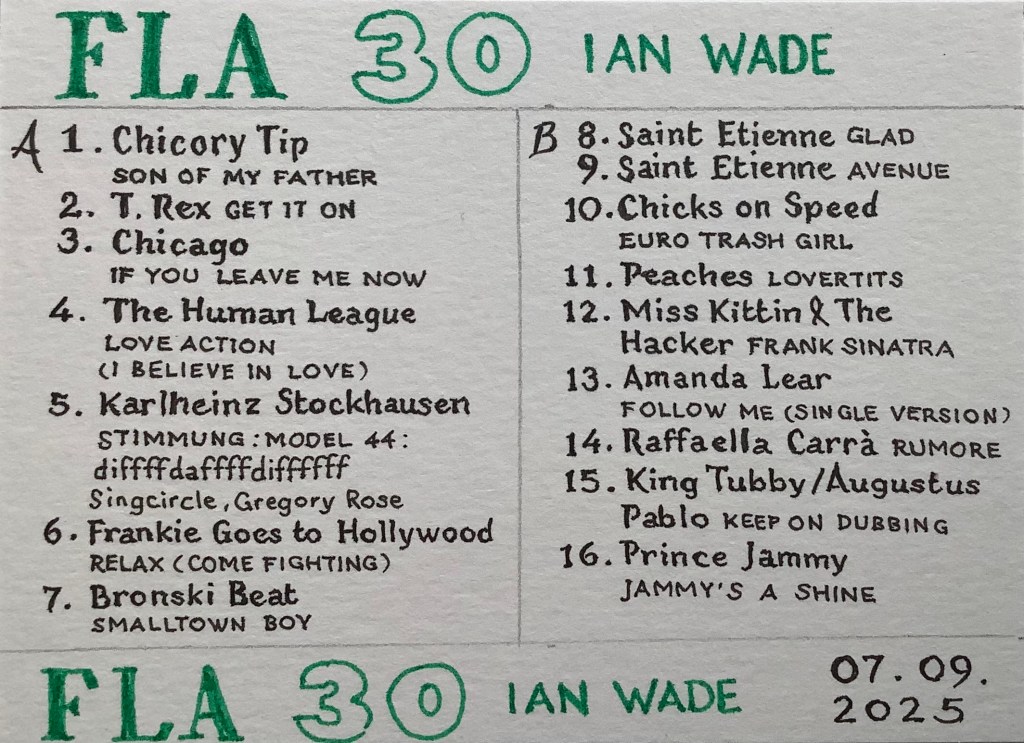
Track 14:

TAME IMPALA: ‘Feels Like We Only Go Backwards’:

https://www.youtube.com/watch?v=wycjnCCgUes&list=RDwycjnCCgUes&start_radio=1

FLA 32: Joanna Wyld (09/11/2025)

Of all the guests I’ve had on First Last Anything so far, Kent-born Joanna Wyld might have worn the most musical hats. Writer, musician, composer, librettist, teacher and administrator, she’s played in orchestras, concert bands and pop groups, she has a passion for everything from bellringing to soul music, and has been a prolific writer of articles, liner notes and concert programme notes for many years. Her writing is always so perceptive, thoughtful, colourful, nuanced and (underrated quality, this) informative.

In conversation, Joanna is no different. What follows, the highlights from a couple of hours on Zoom one afternoon in October 2025, could easily have run twice as long. I love it when a conversation with a guest introduces me to many new pieces, and this is certainly one of those occasions. We both hope you enjoy reading it, and sampling Joanna’s wide-ranging listening choices – not only her First, Last and wildcard selections, but all her other suggestions too.

—-

JUSTIN LEWIS:

So to begin with, what music do you first remember hearing in your home? Because I know you have a very eclectic taste – was that always there?

JOANNA WYLD:

Yes, I think ‘eclectic’ is a really good reflection of my home growing up. I didn’t grow up in what you would describe as a musical household. Everyone loved music, but my parents weren’t classically trained – my dad can’t read music but loves it, my mum can read music, and plays the piano and the organ.

We were never told that a particular genre was better than others. We had a good eclectic range of records that we enjoyed playing. I think the first record I learned to put on the record player independently was The Beatles’ ‘I Want to Hold Your Hand’. And there were quite a few Beatles singles, but also my brothers and I would use music to capture our imaginations a bit. Because we’d hear ‘Oxygene’ by Jean-Michel Jarre when we’d go to the London Planetarium, it would be on if you were waiting to go in. So [at home] we’d use those kinds of experiences – we’d use a reel-to-reel tape recorder, and – I mean, we were very little, it was very silly – we’d write a type of sci-fi script with ‘Oxygene’ playing in the background as our soundtrack.

My relationship with sound was affected by certain things growing up. My grandad and my dad were – and my dad still is – bellringers, which I think is a hugely underrated discipline. We rightly praise the Aurora Orchestra playing things by heart – I went to see them do The Rite of Spring by heart [at Saffron Hall in 2023] and it was absolutely mindblowing, they deserve all the credit for that – but bellringers do that every weekend, three hours or more of memorised mathematical permutations while handling these unwieldly bells. If we’re going to be patriotic about something, I feel like that’s something to be proud about, because it’s unusual and it’s such a skill.  

With bellringing, there are these interesting patterns, but also these slight irregularities because it’s not mechanised – there are people doing this, and there are also these spatial qualities of sound that you get when you hear it resonating in a ringing chamber. With the tunings, you get these harmonics, these overtones, and sometimes they seem to vibrate or clash.

JUSTIN LEWIS:

There’s that way that bells can sound slightly off-key, which you sometimes get with distance and echo. Do you have perfect pitch, then?

JOANNA WYLD:

No, and actually, I suspect my relationship with tuning is a little bit strange because I grew up with this sense of music being a little more fluid, not necessarily fitting within these strict parameters we’re used to thinking about in terms of pitch. And I suspect that then influenced my love for composition and contemporary and 20th century music later, made me open to it, because I’d grown up with this variety of sounds, without that sense of hierarchy about it.

JUSTIN LEWIS:

And did you do some bellringing yourself?

JOANNA WYLD:

I did learn for a short while, but then I had an experience where a rope hit me – it is quite dangerous. My dad was there, and he grabbed it and it was fine… but I was a bit put off by that. Also, I don’t think I’ve got the mathematical brain to do all the actual methods, but I love the sound of it. It could almost be rebranded as mindfulness. If you listen, it’s got enough patterns to keep your brain interested – but it’s also quite mesmerising. I think, I hope, there is a new generation of people coming through who can do it. It’s in the category of things like dry-stone walling… almost like folk traditions. These things deserve to be continued in the least jingoistic way, just because they are interesting and skilful.

I have a CD called Church Bells of England, which is an incredibly sexy thing to own, and it has all these examples of ringing in various places. None of them are perfect in terms of the ringing or the sound quality, but they give a sense of what’s hypnotic about it. The example from St Giles, Cripplegate launches straight into these complex patterns, it’s so absorbing. And then you have composers who’ve drawn on this, from William Byrd’s emulation of change-ringing in keyboard music, to Jonathan Harvey’s wonderful Mortuous Plango, Vivos Voco, which samples the tenor bell at Winchester Cathedral. I heard it played during a London Sinfonietta concert and you felt like you were surrounded by the recording of the bell, it was a visceral experience.

——

JOANNA WYLD:

Classical music came in when we were in the car, we’d put cassettes on, and I did discover then that I really loved this music. This would have been from the age of about eight onwards… that’s when I started to play the flute.

JUSTIN LEWIS:

The exact age I started too, actually. Why did you pick the flute, then?

JOANNA WYLD:

Well, it was slightly by default, because in my primary school, which was very tiny, you could learn the piano, the violin or the flute. There were three teachers who came in, and I had more of a yearning to learn the clarinet, but it wasn’t really possible. It just wasn’t very practical – this is before we got our piano. My older brother had been learning to play the violin, so I kind of ended up on the flute because that was what was available. I mean, it took ages to get a note out of it, but it wasn’t a burning ambition to learn that particular instrument.

JUSTIN LEWIS:

Yeah, I think I wanted to play the violin, but I have a feeling my parents couldn’t have coped with the idea there’d be at least three years of scraping. I seem to remember we were watching something on TV, there was someone playing the violin absolutely brilliantly, and I recall saying something like, ‘Oh I’d love to be able to do that’, and it all went very quiet in the room. So maybe that was a clue. I think with the flute, I think I liked it as a colour in an ensemble, rather than as a solo instrument. I did enjoy playing but I found solo playing quite stressful – and also I felt a bit alienated in my teens because I did want to be in bands, but I had no idea how you went about that. I learned the saxophone for a while, and that got me into bands a bit. But I told this story on a podcast recently – when I got into university, I did a music degree for a year, but obviously in the college orchestra you could only really have three flautists in there. You couldn’t really have fifteen.

JOANNA WYLD:

Yes, if you’ve got too many flutes, what do you do? I was really lucky because I grew up near the Bromley Youth Music Trust, a music hub that offers affordable music ensembles, so I grew up in a concert band system, and that’s how they deal with instruments where there are too many for a standard orchestra. That was quite a discipline in terms of ensemble playing. And so I ended up in this concert band where we’d tour and do competitions and it was quite high level, but it was a brilliant exercise in eclectic music, because in concerts you’d have stuff written for it specifically, often quite contemporary and imaginative. And then you’ve got arrangements of pop, film and classical – so a lovely kind of cross section. Music for concert band and brass band is another genre that’s oddly underrated I think. I love the ‘Overture’ from Björk’s Selma Songs (don’t watch Dancer in the Dark, it’s traumatising, but listen to the soundtrack), it’s a lovely example of rich brass writing. And the song that pairs with it, ‘New World’, is gorgeous, very powerful.

And then in the sixth form, I got into the BYMT symphony orchestra having sort of worked my way through. That was a huge experience, and I was just so lucky, because we were playing quite high-level repertoire: Britten’s ‘Four Sea Interludes’, and Bernstein’s ‘On the Waterfront’, and Dvořák symphonies, Sibelius symphonies… We played Mahler, you know! I became immersed in all this. And our teachers were phenomenal because they expected these really high standards of us, and we were living up to them. This was a lot of state-school educated people, and we were so lucky to have this affordable opportunity to make music like that. Then at university, I was exposed to more 20th century and contemporary and started to play things like the Berio ‘Sequenza’ and Messiaen’s ‘Le merle noir’, stuff which uses more kind of percussive and unusual sounds on the flute.

JUSTIN LEWIS:

Tell me about Richard Strauss, who you mentioned to me was a particularly important composer you heard at a formative age.

JOANNA WYLD:

It’s his ‘Four Last Songs’ [composed in 1948] in particular. I think, for GCSE or A level music, I had heard his ‘Morgen!’ [‘Tomorrow!’]. Back in the day, CDs were quite expensive and I wasn’t buying them lots. My birthday or Christmas was coming up and so I asked my parents for Strauss’s ‘Morgen!’. They couldn’t find that on record in our local record shop so they gave me this instead – a happy accident.

I love all of the music on that record for different reasons – you’ve also got ‘Death and Transfiguration’, [a tone poem written in 1888–89] when Strauss was quite a young man, and which in many ways is not really about death but is more life-affirming, though it’s dramatic. Whereas with the ‘Four Last Songs’ everything’s stripped back, because he did tend towards bombast and vulgarity at times, and these were written when he was really facing death. They’re just four of the most beautiful things ever written. The third one in particular [‘When Falling Asleep’] just has this incredible climactic moment and wonderful violin solo. And in the final song [‘At Sunset’], you get this pair of piccolos which are the birds representing the two souls of him and his wife, off into the ether – it’s just so beautiful.

JUSTIN LEWIS:

And ‘At Sunset’ quotes a little motif from ‘Death and Transfiguration’, doesn’t it, at one point?

JOANNA WYLD:

Yes, and there’s a horn solo at the end of [the second song] ‘September’ – his father was a very celebrated horn player. And through him, he’d been to hear lots of premieres of Wagner operas because his father was playing in them, and his father tried to discourage his interest in Wagner! [laughs] Anyway, so you feel as though that horn solo might have been just a nice little valedictory kind of farewell to that memory of his father as well.

JUSTIN LEWIS:

I know you particularly love this specific recording of the ‘Four Last Songs’, with Gundula Janowitz singing and Herbert von Karajan conducting [first released in 1974], but I take it you know who else was a fan of it as well?

JOANNA WYLD:

David Bowie [which inspired him to write four songs for his Heathen album]. Yes, I love this fact. I’m kind of thrilled that it’s that specific recording, with Janowitz – because people are divided as to which is the best. Strauss is one of those people, like Mahler, where I have different recordings of their works because I do think people can bring something different in. But yeah, I just love the fact that Bowie loved the same recording as I do!

JUSTIN LEWIS:

Bowie’s influences just seem to come from so many places. We’re back to eclectic again, as with you.

JOANNA WYLD:

I think I’m discerning about quality, but there isn’t a hierarchy of genres. Obviously, classical is my speciality, and I’m passionate about it, but it’s all there to be enjoyed, we’re complex human beings, and Bowie obviously recognised that. I understand why people specialise, but I love to embrace variety.

——

FIRST: QUEEN: ‘Bohemian Rhapsody’/ These Are the Days of Our Lives’ (EMI Records, cassette single, 1991)

JUSTIN LEWIS:

‘Bohemian Rhapsody’ was first released in 1975 when I was five, and I vividly remember the video on Top of the Pops. It’s hard to remember what the world was like before this record, because it is one of the first that’s seared into my mind.

JOANNA WYLD:

And this reissue was the first record that I can remember wanting to buy. I was eleven. I heard it on the radio. It was just unlike anything else I’d ever heard. But it’s got that context of originally coming out in the mid-seventies when there was the mainstream three-minute pop song and at the same time there was prog: people yodelling or a synth solo, sometimes quite self-indulgent. But here you’ve got something that’s both: it’s mainstream adjacent and also proggy – it’s an extended idea and a concept. I just thought it was really fun, kind of dramatic and extraordinary. And that appealed.

It wasn’t that long afterwards that Wayne’s World (1992) cemented it as well. But for me it also represents a couple of things I generally find interesting about music. One: it’s the victim of its own success – as you said, you can’t imagine it not being there. Even those who don’t like it, couldn’t imagine it not being there. That’s an extraordinary achievement. And that can lead to it becoming ubiquitous and taken for granted, almost an irritant.

A parallel for me would be Holst’s Planets suite. I fell into the same trap with that – I’d just heard it so many times. And then at university, I finally got to play in it. And I realised: this is so well written, so well orchestrated, and this would have been incredibly original at the time. And it has been emulated a lot since, but I hadn’t given it enough credit for what it was, when it was written.

The other aspect of ‘Bohemian Rhapsody’ I find interesting: it’s so of the person who wrote it. Some composers have that instantly recognisable fingerprint. Holst is one, Messiaen, Stravinsky, Copland, more recently Louis Cole and Genevieve Artadi, both separately and together as Knower, – and I think Freddie Mercury is another, in this song. It’s him, just going, ‘I’m not going to worry about what anyone else thinks, I’m not going to draw on lots of other influences, this is what I want to write.’ I admire anyone who can do that.

JUSTIN LEWIS:

There are aspects of it that remain mysterious, like nobody has ever quite nailed what it is really about. Brilliantly, someone has put up clips of Kenny Everett actually playing ‘Bohemian Rhapsody’ for the first time, on his weekend lunchtime show on Capital Radio in 1975 – have you heard this?

JOANNA WYLD:

No, but he championed it, didn’t he? I haven’t done a deep dive, I have to admit.

JUSTIN LEWIS:

I only found it the other day. Seems he had been playing extracts from it, and then he plays the whole thing.

Kenny Everett, Capital Radio, c. October 1975

We had this song in our house because it’s on their album A Night at the Opera, which has this ambitious mix of quite whimsical, almost music-hall songs, and then out-and-out rock tracks. I still think it’s probably their best record. I like to hear it as part of the album. As you just said with The Planets, it’s good to go back and play it in context.

But even with Kenny Everett’s support, it’s still really weird they put this out as the single, in a way. And obviously, you bought this re-release after Freddie Mercury had just died [24 November 1991]. How aware were you of that event?

JOANNA WYLD:

I think this was the first experience I had of a celebrity death having an impact, and of feeling incredibly sad. The AA side, ‘These Are the Days of Our Lives’, is just incredibly poignant. I can’t watch the video where he sort of says ‘I love you’ at the end. It’s just so, so heartbreaking. I think for a lot of people, it really brought home the reality of the HIV and AIDS pandemic. That this wonderful larger-than-life figure, famous and well-off and all the rest of it, had been hit by it. I don’t remember the extent to which I understood everything at that point in my life, but it definitely stayed with me. It felt like such a horrible shock and a horrible loss. 

JUSTIN LEWIS:

Until I was doing the research for this, I’d forgotten it was a charity single, for the Terrence Higgins Trust. Since when it’s been in so many other things – Wayne’s World as you mentioned, but just this summer, in September, at the Last Night of the Proms.

JOANNA WYLD:

The Prom was a lot of fun. I know it divided opinion a little bit, but it’s nice to celebrate people while they’re alive. I think Brian May and Roger Taylor deserve that moment. While I’m not the biggest Queen fan, and I don’t listen to the music loads, they do all seem fundamentally decent, and those remaining members have really championed Freddie’s memory and always mention him. There’s something quite loving there.

——

JUSTIN LEWIS:

I wanted to talk to you about writing liner notes for CD releases and programme notes for concerts, because that’s something you’ve been doing for many years. How did you first get into this sort of work?

JOANNA WYLD:

The first clue lies back in my childhood. We’d play classical music in the car, and one cassette we had was Saint-Saëns’ Carnival of the Animals suite [composed 1886, but only published posthumously in 1922], featuring lots of quite kid-friendly stuff. And when I went to secondary school, my first music assignment was to write the description of a piece of music. I remember spending ages on this, being so enthused by it. I went home, read the sleevenotes of Carnival of the Animals, got my little dictionary of music, did a bit of research and wrote it up. It was like a prototype for what I’d do later. It was just a Year 7 essay, I was about eleven, it wasn’t hugely in-depth, but it’s interesting that’s stuck with me as a memory – an early enjoyment of writing about music showed up.

But how I got into it professionally… I was working at a record company, originally called ASV, which also had some peripheral labels: Gaudeamus was an early music label, Black Box was a contemporary music label, everything on White Line was sort of middle of the road, like light music, and then Living Era was the nostalgia label. This was my first job after university, and I was the editorial assistant.

For Living Era, we used to get these liner notes written on a typewriter by these lovely old gents who were jazz experts, some of them virtually contemporary with the songs they were writing about! They were delightful to work with, but one day we were missing a liner note, and my boss said, ‘This person just forgot to file this copy and we really need it now. Can you cobble something together?’ And this was in the days before there was a huge amount on the Internet about these things. I think I used early Wikipedia. But because I’d edited and proofread so many of these notes already, I knew the style. So I was able to emulate that slightly chatty nostalgic style, as well as getting the information in. I knocked this out quite quickly and my boss was quite impressed, which was nice, and then asked me to do more and more bits of writing.

And then ASV got bought out by Sanctuary Records, which had all these associated metal artists – so you’d go into the canteen and Bruce Dickinson of Iron Maiden would be there, and they’d have Kerrang! TV on. We had a meeting interrupted because Robert Plant was in reception. It was very glamorous, quite fun – I loved it, and I got to meet some really interesting people.

But all this meant that later, still in the heyday of CD production, particularly in classical music, I was hired to do a lot of freelance writing. There was a lot of repackaging – essentially getting older recordings and repackaging them as ‘The Best of Poulenc’ or whoever it was – and new labels were being set up. So I was asked to churn out quite a lot of essays for them, and quite quickly built up a body of work. The hardest commission was when my daughter was only a couple of months old, when I was asked to do 17 liner notes in two and a half weeks, so I was a machine for that period. It was something like one essay a day. And obviously I was looking after a small child!

Then I started to get emails from various people – the BBC, Royal Liverpool Philharmonic, and others: ‘We’ve noticed your writing, we like it, would you like to send me some examples.’ And it’s slowly built from there.

I would say I’m a generalist. I’m not someone who’s done a PhD in a specific area, I always treat myself as someone who’s not really an expert, but I will do the research when I’m writing a programme note, as thoroughly as possible, as is relevant for that programme note, but I’m always kind of standing on the shoulders of people who’ve done that in-depth research. But equally, I’m trying to bring my perspective, and the way I hear it and write about it, hopefully I can bring some joy to people’s listening experience. 

JUSTIN LEWIS:

And you got to write about new commissions as well, is that right?

JOANNA WYLD:

One that was really nice – it was a premiere performance – was Mark-Anthony Turnage’s ‘Owl Songs’ as a tribute to Oliver Knussen (1952–2018). It was a real privilege to write about that because I’d met Oliver Knussen a couple of times, an absolute gem of a man and composer. His music is just these crystalline jewels of orchestral beauty, and I’d recommend something like ‘Flourish with Fireworks’ (1988) to anyone who thinks contemporary music’s a bit alienating. So he mentored Mark-Anthony Turnage who I’ve also since interviewed, and Olly was known affectionately as Big Owl – particularly Mark referred to him in that affectionate way. So the Owl Songs are these wonderful tributes.

JUSTIN LEWIS:

Are you adhering to house style with these things, or do they tend to leave you alone?

JOANNA WYLD:

There’s very little editorial interference, actually, which is lovely. And I’ve built up trust with a number of commissioners, which is great. What has changed in the style of writing for these sorts of things is it used to be much more academic, much closer to my university essays. The expectation would be that your audience would be aficionados – but it was a lot drier. Actually it’s much more fun now, because the emphasis is on something more inviting and accessible that could be read by anyone, and if you do something more technical, you just explain it in passing. You try and make it as enjoyable as possible to read and that has been fun because I can bring out my own personality a bit more, and feel freer to illuminate what’s exciting about the music.

I feel very strongly that we tend to present classical music as very polite, elegant and smooth, and it can be all of those things, but it can also be… terrifying, for example. Like with Stravinsky’s Rite of Spring, I get palpitations – it’s visceral, it’s filthy. Or Richard Strauss, which can be, to be blunt, very sexual – and I think people almost need permission to hear it in that way because they think classical is ‘all very nice’, and actually… he was a bit of a perv, you know? And if that sort of thing’s there, it’s pointless to not draw people towards that way of listening or bringing out the enjoyment of it.

JUSTIN LEWIS:

Why do you think then that happened to classical music, that the politeness of it became paramount? Is it because of how it was taught, or presented?

JOANNA WYLD:

Every possible experience you have had is all there in classical music somewhere. These are very complex people writing it, and often that’s what I enjoy exploring – their personality, their quirks, their flaws, and the rest of it.

I mean, this is a huge topic – people have done PhDs on this – but in terms of how we receive it… the Victorians have a fair bit to answer for. You know, the idea of the Opera House: people had previously been there as an everyday experience, and then it became this hierarchy of ‘who sits where’, and then obviously with different genres, you have this shift – music that was contemporary becoming historical, and then becoming classical, so it’s no longer immediate. Whereas pop music is obviously reflecting people now. So with anything historical, you can end up with this sheen of respectability and this sense of it being a museum piece, something that you have to treat with reverence.

It’s really complicated but yes, definitely the way it’s taught, even the way it’s marketed… the way even people who love classical music sometimes talk about it… it can be quite reverential, and there are bits of it that are of course sublime. But there’s plenty else in there, and it’s almost just encouraging people to go and hear it.

JUSTIN LEWIS:

So how do you strike a balance between musicology and biography when you’re writing these?

JOANNA WYLD:

There used to be more of an emphasis on musicology – perhaps the structure of a piece of music could go into a bit of detail – whereas now I tend to start with biography and history and set the scene. I try and give a bit of historical context and wherever possible bring out the interesting details about that composer that are relevant to that piece. And if possible, quotes – direct quotes are really interesting. If I can find them, if they’re reliable, just from letters or whatever, because that just tells you so much about them.

We were told at university: You mustn’t let the biography of a composer influence the way the music is interpreted too heavily. I think that’s fair, particularly from an academic perspective – that you are not there to try and tell a story through every single score. And if you’re trying to look at it on its own terms, musically, you do need to separate the two, but for a concert-going or a CD-listening experience, it brings the music to life, stops it being a museum piece. Because you realise these human beings were just as complicated as we are, and often just funny, or grumpy or whatever. Then I might go into some musical detail, and if I’ve got space, try and do a bit of a listening guide, try and draw out some highlights, some things to listen out for.

Occasionally I’ll do a deep dive, find something that isn’t widely known, or almost gives people permission to think of those composers in a slightly different way. For example, JS Bach’s ‘Musical Offering’ (1747). With Bach, he’s so revered we tend to deify him, and talk about him in reverential tones. But the story behind that piece is so fascinating. I did a lot of research from a non-classical perspective, like reading a bit of Gödel, Escher, Bach [by the US scientist Douglas Hofstadter, published 1979], and stuff about mathematical patterns. But with that piece, you also had family dynamics going on – his son [CPE Bach] was working for Frederick [the Great, King Frederick II of Prussia] who commissioned this piece, but they laid down the gauntlet in the most provocative way by saying, ‘Oh, improvise a fugue in six parts’ and no-one had ever really done that. He managed a three-part improvisation and then went away – and it was as though he had a fit of pique, producing this ridiculously vast response to this challenge, creating something out of this deliberately difficult and angular theme. And none of this that I included was new, but it was quite nice to bring out those aspects. Especially with someone like Bach who obviously had great faith and appears to be very holy… that composition came from a bit of anger and irritation.

JUSTIN LEWIS:

Yes, bringing composers to life as human beings without overemphasising to the detriment of the work. I’m sure it’s changed in school-teaching now, back stories are brought up more. I had good music teachers at school, but I don’t ever remember being taught about these composers’ lives, which now feels really weird. Or even the wider history of the time.

JOANNA WYLD:

It’s like Beethoven was a young carer, effectively. His dad descended into alcoholism after his mother’s death, so he was caring for his siblings, which prevented him from staying in Vienna to study with Mozart, which he really wanted to do. Information like that is really humanising, especially as Beethoven was perhaps the first in the 19th century to be regarded as ‘in touch with the divine’, and really cast that long shadow.

I would probably say I’m not a musicologist like, say, Leah Broad [FLA 28], but I’d call myself a music historian. The history of it is fascinating, and it helps people to get closer to the music because they realise these were normal people who might have been incredibly gifted but also worked really hard. Again, Bach was one of those people, who said, Anyone who works as hard as me can do the same thing. Which is not entirely true, but nor was he sitting there on a cloud, you know, being a genius.

JUSTIN LEWIS:

I mentioned this in the Leah Broad chat, about hearing Radio 3 say in passing about how Felix Mendelssohn essentially revived JS Bach’s music around 1830 – it had hardly been played for about eighty years after Bach’s death.

JOANNA WYLD:

It had really gone out of fashion, it’s sort of staggering. Although Mozart and Beethoven had studied Bach, and actually the sort of contrapuntal depth they learnt from him is one thing that elevates their music above the more lightweight stuff of the time. So his influence was still there at key moments, although in terms of performance it wasn’t until Mendelssohn revived it.

——

JUSTIN LEWIS:

Something else I discovered from your website: you’ve been a librettist. Can you tell me about your work with Robert Hugill?

JOANNA WYLD:

That was a wonderful opportunity. A friend put us in touch. It was called ‘The Gardeners’. Robert had read this article about a family of gardeners in the Middle East, tending war graves, and it was intergenerational. So he had this idea, it was his conception, of how the generations relate to each other, and the old man of the three generations could hear the dead. So there was that metaphysical aspect to it, and so we had a chorus of the dead, and the youngest is quite a rebellious character. All of this was fictionalised – this isn’t based on the article – and it was a chamber opera, so it’s not huge scale, but it unfolded as a sort of family drama. Ultimately, the old man dies, whereupon the youngest man inherits his ability to hear the dead. Meantime, you’ve got the women of the family trying to keep the peace. So it’s a family drama with a metaphysical aspect. We performed it a couple of times, which was amazing, firstly at the Conway Hall and then at the Garden Museum with a wonderful cast.

JUSTIN LEWIS:

Is it about trying to find words that sound good as well as have meaning? When you’re writing something like that, does it become clear what doesn’t belong? Do you have a working method for something like that?

JOANNA WYLD:

I definitely think it helps that my Masters was in Composition. And I’ve set a lot of words myself. So I know the kind of thing I would set, and it’s not always the choice you might expect. It has to be something where the words lend themselves to musical treatment. Which often means there’s a rhythmic lilt to them – you’re thinking of the words rhythmically, but also making sure they don’t obstruct the music. So if it’s really overly polysyllabic and flowery, that’s going to get in the way, and it becomes about the words, not the music. But there’s also how the words sit next to each other – I remember reading a wonderful letter from Ted Hughes to Sylvia Plath about the choice of two words in one of her poems. It was two quite punchy words next to each other, and I think he suggested weighting them differently but also talking about them as if they were physical objects. I relate to that. So when I’m writing something like that, and I’m not saying it’s on that level, I try and think in terms of the weight of the words, and how they’ll then sit in someone’s mouth.

JUSTIN LEWIS:

Because just as there’s a musicality in music itself, there’s a musicality in words too, so you’ve got to match the two up. Do you still write music yourself, as well?

JOANNA WYLD:

I’ve written a couple of songs with bands I’ve been in, I enjoyed that. I had a really lovely teacher at university, Robert Saxton, but you really have to pursue it, you have to be so obsessed with it, and I also realised I’m probably better at writing about music than writing music.

JUSTIN LEWIS:

What sort of music were you writing for the bands you’ve been in?

JOANNA WYLD:

One song started out as a sort of Hot Chip parody really, almost like a joke – and then I added some influences from LCD Soundsystem; it’s quite a fun track, which we once played at a wedding, and a conga formed, which was one of the biggest compliments.

JUSTIN LEWIS:

That’s brilliant.

JOANNA WYLD:

And then I’ve written a sort of cathartic song called ‘Prufrock’, where I drew on TS Eliot’s ‘Love Song of J. Alfred Prufrock’.

JUSTIN LEWIS:

So you were singing these?

JOANNA WYLD:

Yeah. Another one was called ‘The Air’ which was my attempt at layering stuff together in a sort of Brian Wilson fashion.

JUSTIN LEWIS:

And what were your bands called? Were you gigging?

JOANNA WYLD:

One was called Fake Teak, and we recorded ‘Prufrock’. It’s my brother’s band, named after the equipment that our dad had when we were growing up. That’s now evolved into something called Music Research Unit, which is a similar line-up, but more fluid and with new songs. We had our first rehearsal just yesterday! Then I’m in another band called Dawn of the Squid, and I don’t write for them, and they’re hard to describe, but they’re kind of… indie-folk, and there’s comedy in there.

JUSTIN LEWIS:

Is this out there to hear?

JOANNA WYLD:

There’s a new Dawn of the Squid album, which I didn’t play on, I can’t take any credit, but that’s out. There’s quite a bit of Fake Teak on Spotify. I play synthesisers and flute in these groups, and to go back to what we were discussing earlier – about sounds not being strictly in tune – what I find lovely about some synthesisers is they feel much closer to acoustic instruments; they can go out of tune, and you can make unpleasant as well as pleasant noises on them. I play this instrument sometimes called an ARP Odyssey [analogue synthesiser introduced in 1972] and it can go out of tune on stage, it’s a real rarity, and it’s been used in loads of pop like Ultravox. But I have had gigs where it’s gone a bit out of tune, and in a weird way I kind of enjoyed that more than digital instruments where it’s got presets and everything’s tidy, because it feels much closer to my experience of other instruments.

—–

LAST: THE UNTHANKS: Diversions, Vol. 4: The Songs and Poems of Molly Drake (2017, RabbleRouser Music)

Extract: ‘What Can a Song Do to You?’

JOANNA WYLD:

I’m not a folk expert, I’m getting into it more, but like a lot of people, I came to this because I heard Unthanks do the ‘Magpie’ song on Detectorists. Then I went to a concert, locally, on the strength of that, and that’s where they performed some of these Molly Drake songs. I loved the whole concert – one of my prevailing memories of it is my crying my contact lens out during one of the Molly Drake songs, and just having to sit there with it in my palm, kind of half-blind.

JUSTIN LEWIS:

These songs are amazing to hear because we know so much, or at least we think we do, about Nick Drake’s life, but obviously the Molly Drake archive hasn’t been pored over by scholars too much. I think most of these songs are from the Fifties, and the Unthanks have covered them, apparently, because they wanted to make better quality recordings. And the Molly Drake versions are out there too. But there’s something about these songs that are both public creativity – as in the Drake family being aware of these songs – and private creativity too as it wasn’t out in the public domain for years. And you keep having to remind yourself that these songs were written before Nick Drake got into music himself, not afterwards. 

JOANNA WYLD:

Yes, so many women composers are talked of in relation to their male relative, but you’re right that she was doing this first. It clearly influenced Nick Drake, and the almost painful shyness is a clear link, so it illuminates his music, which I also love, but I think on its own terms Molly’s music is phenomenal and yet, incredible that she was so shy that I think her husband bought her a reel-to-reel and set her up in a room on her own with it. He recognised her talent so there was this idea of ‘Let’s get this down for posterity’, but there was no concept in her mind that anyone would ever hear it, which seems really alien to us now, but there’s a real beauty to that.

JUSTIN LEWIS:

I think there can be a pressure when you’re writing something that you know is going to be for public consumption in some way. But I found a great Rachel Unthank quote:

‘Her work shares her son’s dark introspection, but in Molly we get a clearer sense of how those who understand depths of despair can do so only by understanding happiness and joy too. Through Molly’s work, we see the soulful, enigmatic lonesomeness as a person who is also a member of a loving and fun-loving family.’

I think that’s really important because Nick Drake – and his work – tends to be defined by what happened to him, and not all of him and his work is like that. I mean, the Molly song that feels like it could have been written in response to his early death – ‘Do You Ever Remember?’ – was written much earlier.

JOANNA WYLD:

You mentioned family, but obviously on the Unthanks recording, you’ve also got Gabrielle Drake reciting the poetry. I went to the Nick Drake Prom, with the Unthanks performing with Gabrielle Drake, which was phenomenally moving – and brave of her as well, I thought. And it’s a rich combination to listen to – you’ve got the sugared almond sound of the Unthanks’ voices, and the woodier timbre of her delivery. The whole thing really cuts to your heart, similar to Nick Drake, but it’s even less crowded in metaphor, it cuts to the heart with a deceptive simplicity. The first track, ‘What Can a Song Do to You?’, has one of those melodies that feels like it’s always existed, and then this tremendous bit of poetry. I really admire people who can pick and use very few words to convey something. I was lucky enough to interview Michael Morpurgo many years ago, and he blew my mind in terms of how to write. He used to say, ‘We don’t need to teach kids lots of florid words, but to be direct.’ That lyrical and nuanced but straightforward vocabulary can be more powerful and it’s something I aspire to, [but] I don’t always find it easy.

JUSTIN LEWIS:

I feel the same way. As an editor and sometime writer, I find that writing a simple sentence is actually quite hard.

JOANNA WYLD:

The poem I was going to mention at the end of ‘What Can a Song Do to You?’: ‘Does it remind you of a time when you were sad? (So in other words, why? Why is this person crying?) Does it remind you of the time when you were sad? Ah, no. But it reminds me of a time when I could be. It reminds me of a time when I could be…

And I sort of think that’s… mindblowing.

JUSTIN LEWIS:

That particular song has been going around my head for the last few days. Going back to what you were saying with Detectorists making you aware of Unthanks, film and TV does seem to be a major way for people to connect with people now. I sometimes look at the streaming stats for tracks at random, wonder how that’s become the biggest thing, and it’s nearly always some film or TV programme I wasn’t aware of.

JOANNA WYLD:

I guess it’s a route in. I recognise this with classical music as well – I’m lucky enough to have grown up with enough that I’ve absorbed bits and learned about it, done my degrees in it. If I hadn’t done that, that might be my way in as well. And as I don’t have that background with folk song – I like the genre in a broad sense, but I wouldn’t know where to start looking. There’s too much out there, and there are playlists but they can be a bit too rambling.

——

ANYTHING: THE CARDINALL’S MUSICK / ANDREW CARWOOD / DAVID SKINNER: Cornysh, Turges, Prentes: Latin Church Music (1997, Gaudeamus/ASV Records)

Extract: William Cornysh: ‘Salve Regina’

JOANNA WYLD:

This ties a few things together. This is the William Cornysh recording of ‘Salve Regina’, which is my favourite work on that album, but it’s on the Gaudeamus label which I mentioned earlier. I worked with some of the people on that label, but I also know about this repertoire because I was lucky enough at university to study early music with David Skinner, who’s one of the two founders of The Cardinall’s Musick [the other being Andrew Carwood]. They’ve since gone in different directions and David now conducts [a consort] called Alamire. So this is going back a bit, but it was through that university experience that I got to hear this. It’s funny – we were talking about church music earlier but this is English Catholic music of the Tudor era and it’s sad to me that the Catholic Church in this country doesn’t have that kind of choral tradition because we’ve got these riches but for some reason it’s not performed in that church context very often, but nor is it often sung in the concert hall either. Slightly later you get Thomas Tallis and William Byrd, in the Elizbaethan era, that gets mentioned a bit more. But for some reason the Eton Choir Book doesn’t get as much attention and I think it deserves it, so I thought it might be quite fun to bring that in. Because particularly with the Cornysh ‘Salve Regina’, it’s incredible.

JUSTIN LEWIS:

In fact, I’ve got a quote from David Skinner here, from the 1990s: Henry VIII had destroyed most of the musical manuscripts and he says ‘there are literally only two of the choir books I worked from when originally there would have been hundreds.’

JOANNA WYLD:

Yes, Lambeth is the other one, I think?

JUSTIN LEWIS:

He mentions the Eton Choir Book, and the other was Caius?

JOANNA WYLD:

I will have to check my facts because the history of this area is so complex!

JUSTIN LEWIS:

I’m glad you said that! I merely skimmed this, and it felt quite complicated!

JOANNA WYLD:

Really complicated, and I’m sure some of the complexities of how it was written have gone out of the window for me… I learned them a long time ago. I do, very geekily, have a facsimile copy of the Eton Choir Book. I occasionally try and follow along, and it’s quite tricky to follow because instead of it being arranged in score, you’ve got the four parts written separately.

But when I heard the ‘Salve Regina’ at university, it stuck out for me. It’s incredibly beautiful, it takes a bit of time to get into the language and it’s interesting to me that a lot of people who love early music and love contemporary music overlap because early music predates a lot of ‘the rules’ that dominate so much of Western music. With this piece, it’s like you’re walking through a cathedral, meandering, just wandering, but then you get these cadences or these chords, very vivid moments, that feel like light coming through stained glass. And it’s quite a long piece, but right at the end, it just builds and builds up to that high note, which then drops down, and then you have these glorious last two chords. At that point, it’s almost like you’re at the rose window… Even if you’re not religious, music does reflect every facet of who we are, and spirituality is one facet of who we are as human beings. So it’s powerful even if we don’t specifically believe in something. It’s a sense of time travel. It takes you out of yourself and takes you back, but it also kind of elevates as well.

———–

JOANNA WYLD:

At school, I don’t recall learning much pop at all. It wasn’t that I wasn’t exposed to it, but in terms of my actual education, the emphasis was on the history of Western music, classical and symphonic music and so on. My daughter did have to analyse pop – I remember Fleetwood Mac’s ‘The Chain’ being one example. I’ve been a primary school teacher, and I do remember teaching some Stevie Wonder because any excuse, I absolutely love Stevie Wonder, but it was Black History Month and so I brought in his songs about social history, and they all knew ‘Happy Birthday’ but we could talk about how that brought in Martin Luther King Day, which was a lovely way of giving the pupils a sense of the impact music can have.

JUSTIN LEWIS:

Interesting that they knew the song, it’s not one of his you hear that often now.

JOANNA WYLD:

They all knew the chorus, when I sang that bit, they knew that, but they didn’t know the verses or the lyrics so they just thought of it as generic. It’s not my favourite Stevie song – I’ve got so many – but it’s an example of how powerful music can be.

———

You can find out more about Joanna, and her work, at her website, Notes Upon Notes: https://www.notes-upon-notes.com

You can follow her on Bluesky at @joannawyld.bsky.social.

Also, find out more about Dawn of the Squid at their website: https://dawnofthesquid.co.uk

—–

FLA PLAYLIST 32

Joanna Wyld

For the time being, this site and project uses Spotify for the conversation playlists, but obviously I disapprove that Spotify doesn’t pay artists and composers properly, and other streaming platforms are available, as are sites to buy downloads and buy recordings. For consistency, you can also listen to the selections via YouTube (where available), and links are provided in each case, below.)

Thanks to Tune My Music, you can also transfer this playlist to the platform or site of your choice by using this link: https://www.tunemymusic.com/share/QWjXV28T8E

Track 1:

THE BEATLES: ‘I Want to Hold Your Hand’:

https://www.youtube.com/watch?v=XT4pwRi2JmY&list=RDXT4pwRi2JmY&start_radio=1

Track 2:

JEAN-MICHEL JARRE: ‘Oxygène, Part IV’:

https://www.youtube.com/watch?v=_PycXs9LpEM&list=RD_PycXs9LpEM&start_radio=1
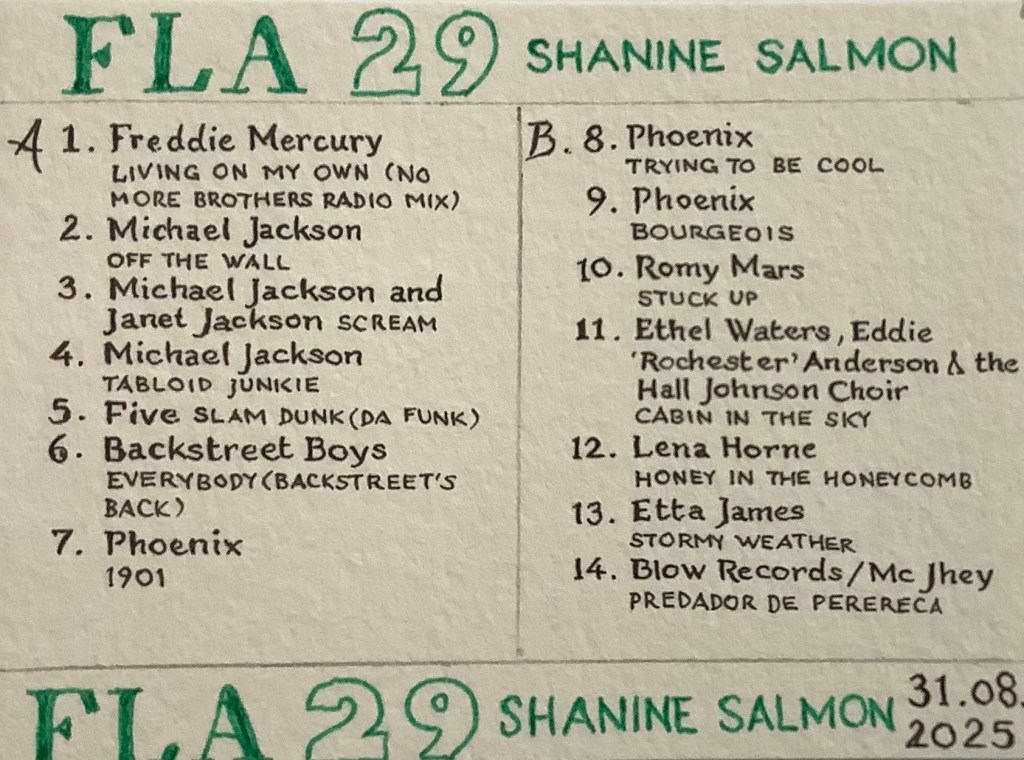
Track 3:

ST GILES, CRIPPLEGATE BELL RINGING TEAM: ‘Cambridge Surprise Maximus’: https://www.youtube.com/watch?v=o8rwhJHt9Ds&list=RDo8rwhJHt9Ds&start_radio=1
Track 4:

JONATHAN HARVEY: ‘Mortuos Plango, Vivos Voco’:

https://www.youtube.com/watch?v=0T-H-fVlHE0&list=RD0T-H-fVlHE0&start_radio=1

Track 5:

BJÖRK: ‘Overture’:

https://www.youtube.com/watch?v=6k4xT0qjUW4&list=RD6k4xT0qjUW4&start_radio=1
Track 6:

BJÖRK: ‘New World’:

https://www.youtube.com/watch?v=eNma-h_urvs&list=RDeNma-h_urvs&start_radio=1
Track 7:

LEONARD BERNSTEIN: ‘On the Waterfront Suite’

Bournemouth Symphony Orchestra, Marin Alsop:

https://www.youtube.com/watch?v=t4isx_tGYwM&list=RDt4isx_tGYwM&start_radio=1
Track 8:

OLIVIER MESSIAEN: ‘Le merle noir’:

Emmanuel Pahud, Eric Le Sage:

https://www.youtube.com/watch?v=hT8MQpg7oTo&list=RDhT8MQpg7oTo&start_radio=1

Track 9:

RICHARD STRAUSS: ‘4 Letzte Lieder [Four Last Songs], TrV 296: No. 3: Beim Schlafengehen’:

Gundula Janowitz, Berliner Philharmoniker, Herbert von Karajan:

https://www.youtube.com/watch?v=t5n0DqFlpMY&list=RDt5n0DqFlpMY&start_radio=1

Track 10:

QUEEN: ‘Bohemian Rhapsody’:

https://www.youtube.com/watch?v=xG16sdjLtc0&list=RDxG16sdjLtc0&start_radio=1

Track 11:

LOUIS COLE, METROPOLE ORKEST, JULES BUCKLEY: ‘Shallow Laughter: Bitches – orchestral version’: https://www.youtube.com/watch?v=bEmMAG4C1BE&list=RDbEmMAG4C1BE&start_radio=1

Track 12:

AARON COPLAND: ’12 Poems of Emily Dickinson: No. 10: I’ve Heard An Organ Talk Sometimes’:

Susan Chilcott, Iain Burnside:

https://www.youtube.com/watch?v=SvKLlCf2TWE&list=RDSvKLlCf2TWE&start_radio=1

Track 13:

OLIVER KNUSSEN: ‘Flourish with Fireworks, op. 22: Tempo giusto e vigoroso – Molto vivace’:

London Sinfonietta:

https://www.youtube.com/watch?v=wLkTfXPC-TU&list=RDwLkTfXPC-TU&start_radio=1

Track 14:

IGOR STRAVINSKY: ‘The Rite of Spring, Part 1: V. Games of the Rival Tribes’:

Seiji Ozawa, Chicago Symphony Orchestra:

https://www.youtube.com/watch?v=XiAr76Qs8WY&list=RDXiAr76Qs8WY&start_radio=1

Track 15:

IGOR STRAVINSKY: ‘The Rite of Spring, Part 1: VI. Procession of the Sage’:

Seiji Ozawa, Chicago Symphony Orchestra:

https://www.youtube.com/watch?v=nvBog5Tej2I&list=PL-XNw6p4EDBv7-H-z2Vo_c3sB3rvIxt7-&index=6

Track 16:

JOHANN SEBASTIAN BACH: ‘Musical Offering, BWV 1079: Ricercar a 6 – Clavecin’:

Pierre Hantaï:

https://www.youtube.com/watch?v=5K07rF5xOvQ 

Track 17:

FAKE TEAK: ‘Prufrock’:

https://www.youtube.com/watch?v=L5-1prkhHjU&list=RDL5-1prkhHjU&start_radio=1

Track 18:

THE UNTHANKS: ‘What Can A Song Do to You?’

[Poem read by Gabrielle Drake]:

https://www.youtube.com/watch?v=Jzqb_78LUkI&list=RDJzqb_78LUkI&start_radio=1

Track 19:

WILLIAM CORNYSH: ‘Salve Regina’:

The Cardinall’s Musick, Andrew Carwood, David Skinner:

https://www.youtube.com/watch?v=pQprxgtbk4E&list=RDpQprxgtbk4E&start_radio=1

Track 20:

STEVIE WONDER: ‘Happier Than the Morning Sun’:

https://www.youtube.com/watch?v=S4PcSOLtf-U&list=RDS4PcSOLtf-U&start_radio=1

FLA 31: William Ham Bevan (14/09/2025)

Journalist, travel writer and editor William Ham Bevan has worked for nearly every national newspaper in Britain at some point over the past 30 years, plus a raft of magazines and other publications. When I first met him, about 45 years ago, when we lived in the same street and our mums were best friends, we used to talk endlessly about our twin obsessions: pop music and ridiculous TV programmes. His perceptiveness and wit has only grown since then. On the one hand, he is one of the most brilliantly professional journalists I’ve known. He is also the first person I knew who posted something on the world wide web: in around 1996, when we hadn’t seen each other for a while, I happened to find a post by him in a discussion about the scariest TV logo, and he nominated the Yorkshire TV chevron. Especially when it moved, at the start of the Ted Rogers game show 3-2-1. Don’t have nightmares.

We talked over Zoom one afternoon in early September 2025, covering such conversational terrain as: being lucky enough to have parents who are open-minded about music, keeping old tapes of the top twenty, synthesizers, schools TV soundtracks, and why sometimes humour should belong in music.  

—-

JUSTIN LEWIS:

So what’s the first music you remember hearing? What sort of music was being played in your home?

WILLIAM HAM BEVAN:

Well, it would almost certainly have been on Swansea Sound. When I was living with my Mum and my grandfather, from 1974 till 1980 when we moved to Mumbles, I remember music being on in the background pretty much all the time. It was almost always Swansea Sound – commercial chart music. I was always quite aware of tunes that were in the charts: ABBA, the Bee Gees, or the songs from Grease. And Showaddywaddy obviously, because they never seemed to be off the charts.

JUSTIN LEWIS:

Always available.

WILLIAM HAM BEVAN:

Top of the Pops would be the other thing, which we watched each week. Mum would have been in her mid-thirties at the time. Grandpa would watch it too – he’d come in, and he’d have three stock phrases. One would be: ‘Why do they keep dancing around? They’d be able to play a lot better if they stood still.’ When Legs and Co or whoever the troupe was at the time came on, he’d say, ‘God, I’ve seen more meat on a skewer.’ And then, at some point, he’d excuse himself and go out to roll a fag, saying, ‘Well at least they look as though they’re enjoying themselves.’

I reckon he looked forward to those five minutes of performative bemusement every Thursday night. Look at the costumes, shake your head, go out to the kitchen.

JUSTIN LEWIS:

Pop TV now has this understanding that pretty much everyone alive has a connection with pop as we know it because rock’n’roll is seventy years old, so if you’re aware of that tradition, you’re familiar with it. But back then, there were these very wide generation gaps.

WILLIAM HAM BEVAN:

Back in those early years, I don’t remember much pop on TV beyond Top of the Pops, Tiswas, Swap Shop… and obviously those fillers on HTV when they’d play videos of ‘Wuthering Heights’ or whatever because a live broadcast had finished three minutes early.

JUSTIN LEWIS:

Or they hadn’t sold enough advertising.

WILLIAM HAM BEVAN:

Indeed. But record collections… Grandpa was very much into big band stuff like Count Basie, but he was quite open-minded, as were Mum and Dad. There was no real consideration of genre – if they saw something or they heard something they liked, then they’d get it.

When it was the US bicentenary in 1976, there were a lot of broadcasts from the States of military parades and tattoos. Gramps actually wrote to the US embassy saying he really enjoyed some of this music that was played, and wondered what it was and how he could buy it. About two weeks after that, a huge package wrapped up in ribbons turned up on the doorstep, from the US embassy: it was about seven or eight box sets of LPs, some of them pressed on red, white and blue vinyl. I’ve still got some of them – things like ‘A Bicentennial Salute to the Nation from the United States Guards band’.

JUSTIN LEWIS:

There’s going to be a lot of Sousa, isn’t there?

WILLIAM HAM BEVAN:

Yeah, I think the Monty Python theme [‘The Liberty Bell March’, composed 1893] is probably in there somewhere.

JUSTIN LEWIS:

So did your grandfather’s interest in big band music lead to this amazing interest in music in his children?

WILLIAM HAM BEVAN:

I’m not sure how the Hams came to be such a musical family – although we were really only two-thirds of a musical family. My Mum had two brothers: John was a jazz trumpeter, had a music shop in town, and had a jazz radio show on Swansea Sound. And then you had Pete, who’d been in Badfinger, and tragically ended up taking his own life. But Mum was the cuckoo in the nest. I mean, she tried learning violin when she was at school. She was a bit of a tearaway, apparently – I used to have one of her old end-of-term school reports, and the headmistress had written, ‘Wicked without malice’. She fell off the roof of the school – no idea what she was doing up there – and she injured both of her arms. Her violin teacher said, ‘Well, let’s take that as a sign from God.’ That was the end of her musical ambitions, and I’m afraid I’ve taken after her, rather than John or Pete.

JUSTIN LEWIS:

Didn’t you do some keyboard playing, though? I seem to remember, though this was after my time, that you were in a band at school.

WILLIAM HAM BEVAN:

I did muck about with synths. We used to cover ‘The Perfect Kiss’ by New Order, because if you look at the Jonathan Demme video, quite a lot of it is close-ups of Peter Hook’s fretboard and Gillian Gilbert’s keyboards. So it actually shows you how to play it. And yes, we did do one gig at the Bishop Gore Comprehensive school hall. There’s one surviving tape of it, and I keep it under lock and key.

JUSTIN LEWIS:

What else was in your set, then?

WILLIAM HAM BEVAN:

We did ‘Everything Counts’ by Depeche Mode. And then we did ‘Tainted Love’ and something very odd happened to the sequencer, halfway through. It started hammering out tom-toms on the drum machine, turning the song into a mash-up of something not far off ‘Atrocity Exhibition’ by Joy Division. Our set was followed by two heavy metal acts, and that was a salutary tale, because people had been politely sitting down in the hall during our set, but once the metal band came on, the whole stage was swamped and there were people moshing in the front. And we thought, Oh, okay…

JUSTIN LEWIS:

It’s always been a big rock town, has Swansea. But your mum, who was a great friend of my mum’s – this is how we know each other – and who I was terribly fond of, had worked in telly for a bit, at Thames Television in London.

WILLIAM HAM BEVAN:

She didn’t spend a long time at Thames, but she did hang round with a lot of people from that scene… a Fleet Street crowd. People like the This Week presenter Llew Gardner – she was his PA for years – the Parkinsons, Michael and Mary, and Hugh McIlvanney. And she’d been part of that quote-unquote Swinging London world. There were so many tales that she’d start telling me and would then say, ‘I’ll tell you the rest when you’re older’; sadly, she died when I was 17, so she never had the chance to. She’d mention stuff like having been present at the party where Germaine Greer’s husband walked out on her – apparently everybody was smashed out of their heads – or going to see the England v Scotland football international with Telly Savalas. It turns out he was a sports producer and reporter before he got into acting.

But to bring it back to music, she knew a lot more than she let on about. She didn’t often volunteer it, and I think that had a lot to do with what happened to Pete. I think she almost felt guilty, and didn’t like to think too much about what she used to listen to, because she loathed what the music business did to her brother and it was bound up in all of that.

JUSTIN LEWIS:

Actually, I can remember being about 11 or 12, this was the early 80s, and being this curious pop obsessive, and trying (innocently, I think) to ask your mum about Pete and his career – I knew he’d died tragically young but I didn’t know how it had got to that – and she understandably changed the subject very abruptly.

WILLIAM HAM BEVAN:

What did connect us, though, was The Rock’n’Roll Years [a presenter-free programme using news footage, music clips and captions, running on BBC1, 1985–87, and covering the years between 1956 and 1979*), one of the few programmes we’d watch religiously as a family – it was that, M*A*S*H and Ski Sunday. But things would come on The Rock’n’Roll Years, and Mum would make remarks… a band like Nazareth would appear and she’d say, ‘Oh I went to see them once’, and you’d think, Hm, that doesn’t strike me as being very you.

[*A further Rock’n’Roll Years series covering the 1980s aired on BBC1 in 1994.]

JUSTIN LEWIS:

I think as a young person, though, you quite often go and see all sorts of things, just because you go out. Regardless of what it is.

WILLIAM HAM BEVAN:

That programme was a massive piece of my education in rock and pop music – probably second only to coming over your house, reading Smash Hits and hearing your latest purchases. It was so well put-together, and not all the musical choices were obvious. you even had some album tracks, like ‘Hairless Heart’ by Genesis or ‘Medicine Jar’ by Wings, which I didn’t identify till years after.

I genuinely believe The Rock‘n’ Roll Years should be part of the National Curriculum. The downside is that even now, some songs are firmly linked in my mind with the news images played over them. ‘Life on Mars?’? That’s the Russian Concorde blowing up at the Paris Air Show. ‘Tubular Bells’? The IRA bombing Oxford Street. And unfortunately, Cyril Smith winning the Rochdale by-election for Alice Cooper’s ‘Elected’.

—–

JUSTIN LEWIS:

Something we both had as kids, now, but we didn’t know about at the time because we didn’t know each other: we each had one tape of the Radio 1 top 20. Yours is from Sunday 18 September 1977, when the number one is Elvis’s ‘Way Down’. Mine is from Sunday 2 April 1978, when the number one is ‘Wuthering Heights’.

(The dates above refer to the Sunday broadcasts for that week’s top 20 singles chart, but are officially dated for the previous day, ie the Saturday. You can find the full chart for that week in September 1977 here, and the full chart for that week in April 1978 here.)

JUSTIN LEWIS:

When I spoke to Ian Wade for the last episode [FLA 30], he described this multi-artist K-Tel compilation he owned as a small child as having ‘all the food groups’ in music, it had lots of different genres present. And these top 20s we had on tape, before we started buying our own records, have that same sort of air. I would say my tape has about fourteen belters on it out of twenty, and even the novelty records have a charm to them. I had my favourites – Blondie, Kate Bush, Costello, Nick Lowe, Darts – but I would often put the tape on and play all of it, no skipping ‘Ally’s Tartan Army’ or Brian and Michael. I’d just leave it running.

WILLIAM HAM BEVAN:

Yeah, I felt like it was cheating to skip songs. This sounds such a very odd thing to say in the streaming era – where, in one click, you can get just about and track you want – but I was insanely superstitious about cassettes. I always felt as though if you listened to one side, you had to listen to the other. Even if I didn’t particularly like one side of the cassette, I would force myself to listen, because the artist had put as much effort into side two as side one. It’s such a bonkers way of thinking.

JUSTIN LEWIS:

But it’s listening to an album as an album, though – as a complete piece of work.

WILLIAM HAM BEVAN:

It’s the same with this chart cassette. I’ve still got it, with all Tom Browne’s links. Terrible sound quality, as the tape has degraded, but you can just about make it out. And at the end of the one of the sides, my grandfather managed to tape over the end with a recording of the three-year-old me singing ‘A Bonnet Made of Lace’, which I think cuts off part of ‘Float On’ by the Floaters.

Inevitably, I’ve made that top 20 into a Spotify playlist. A few months back, one song – Carly Simon’s ‘Nobody Does it Better’ – suddenly became unavailable, and it really pisses me off when anything like this happens. It drives home to you that not only do you not own any of this music, you don’t even own the rights to listen to it. It’s entirely at somebody else’s whim whether you’re permitted to or not. Entirely my own fault for using Spotify, of course. I hate myself for it, but I’m a heavy Spotify user, and I was an early adopter.  

JUSTIN LEWIS:

Space’s ‘Magic Fly’ in there, the nostalgia rush for me there was just ludicrous.

WILLIAM HAM BEVAN:

Having ‘Magic Fly’ at number two in that top 20, and ‘Oxygène’ by Jean-Michel Jarre at number four, very similar in some ways – both gateway drugs for me and electronic music. And there’s another synth-tinged instrumental in that chart, ‘The Crunch’ by the Rah Band.

JUSTIN LEWIS:

Which is a bit like an electronic cover of ‘Spirit in the Sky’.

WILLIAM HAM BEVAN:

Yes, now you mention it.

——

FIRST: 10cc: The Original Soundtrack (Mercury Records, album, 1975)

Extract: ‘Une nuit à Paris’

WILLIAM HAM BEVAN:

I’d had other records bought for me before I bought this 10cc album. The first one I remember was ‘Mississippi’ by Pussycat (1976), so I’d have been about two when it came out – I’d probably tried to sing along with it once, and then Mum thought, Oh I’ll get this for him. Pink Floyd’s ‘Another Brick in the Wall (Part II)’ – that was another one.

But Original Soundtrack was the first tape that I went and paid cash money for – probably with a fiver from a Christmas card. Phonogram had a low-price reissue series in the mid-80s called ‘Priceless’ and all the early 10cc albums were in that range. Dad already had the 10cc Greatest Hits [1972–78] compilation, which I absolutely loved. But I wanted the cassette of this. I didn’t like handling vinyl records – media people lionise vinyl, but I hated it, I was paranoid about scratching them.

In terms of getting hold of old stuff, reissue labels were an absolute boon, something that’s been quite forgotten. That EMI bargain imprint, ‘Fame’ – we had loads of those tapes in the house. You could buy them from filling stations and newsagents, along with all sorts of other weird and wonderful stuff on the Music for Pleasure label. In places like Lewisnews in Mumbles, there’d be a carousel of tapes by the counter.

JUSTIN LEWIS:

Can you remember where you bought this from, then?

WILLIAM HAM BEVAN:

I can’t, I’m afraid. I can tell you where I got my third-ever cassette, which was 10cc’s previous album, Sheet Music (1974). I know I got that from the David Morgan’s department store in Cardiff, because I still have the till receipt from February 1986 in the cassette sleeve – you kept those in case the tape got chewed up. Original Soundtrack would have been the year before that. And my second purchase, in between Original Soundtrack and Sheet Music, was Jean-Michel Jarre’s Oxygene.

JUSTIN LEWIS:

So you’d have known the 10cc singles from your dad’s compilation, but can you remember how you reacted to something like the ‘Une nuit à Paris’ suite that opens The Original Soundtrack?

WILLIAM HAM BEVAN:

I was about eleven when I bought this, and before that, I thought albums were just collections of singles or songs. I didn’t realise they are things that are supposed to work together, or have suites that could take up an entire side of tape. But this cassette also lacked a lyric sheet, and generally early on with cassettes, the packaging was an afterthought. If you wanted the big sleeve with all the artwork, you had to opt for the LP.

JUSTIN LEWIS:

Yes, a convenience thing when it came to the cassette format.

WILLIAM HAM BEVAN:

It was a couple of years later that I saw the proper gatefold sleeve of the LP, which had the lyrics inside. The lyrics for ‘Une nuit a Paris’ are presented like a rock operetta, with all the characters’ names and lines. Now, one factoid you tend to see all over the Internet is that it was the inspiration for ‘Bohemian Rhapsody’ [released in October 1975, seven months after Original Soundtrack], but I’ve never seen reliable evidence for that. I think it’s just that they sound similar – they’re trying to achieve similar things and they were quite close in time.

JUSTIN LEWIS:

I’ll tell you who I thought of when I was listening to ‘Une nuit a Paris’ yesterday: vocally it sounds like Neil Hannon! But reading around, I found some interesting quotes about this record. I’m sure you know all these, I know you’re a very big 10cc fan. The band’s Eric Stewart said this: ‘When “Une nuit a Paris” first came out, it was passed off as a “10cc trying to be funny again” track.’ And then Kevin Godley is quoted as saying that it was supposed to be ‘a serious piece of music… but someone dismissed it as an extended piece of fun which pissed me off.’

Now – 10cc often got accused of ‘cleverness for the sake of it’, and if you are creative and imaginative in how you make records, it leaves you open to a charge of cleverness. What are your feelings about that, and how do you process their serious tracks and their more frivolous work?

WILLIAM HAM BEVAN:

Maybe it goes back to that Frank Zappa album title, Does Humour Belong in Music? I think it does, but it’s something that really seemed to fall out of fashion from the late 80s into the dreary, earnest 90s – this idea that you can be humorous, arch, witty, and still be writing serious and credible music. Anything that’s lyrically funny almost gets written off as throwaway.

Some of 10cc’s songs are absolutely beautiful: things like ‘Fresh Air for My Mama’ on the first album (10cc, 1973) or ‘Old Wild Men’ and ‘Somewhere in Hollywood’ on the Sheet Music album (1974). That one’s Godley and Crème par excellence. I mean that’s probably them pushing godleyness and cremeliness as far as it can go.

JUSTIN LEWIS:

Cremeliness is next to Godleyness.

WILLIAM HAM BEVAN:

Yes, I thought we’d get round to that one. And another thing that’s all over the Internet with 10cc: they’re forever compared to Steely Dan. OK, they have the studio perfectionism in common and the musicianship – though that’s something often overlooked with 10cc…

JUSTIN LEWIS:

There’s a bit more jazz in the influence with Steely Dan, I think.

WILLIAM HAM BEVAN:

But where it falls down for me is that both Steely Dan and 10cc had spent time as songwriters for hire. Both paid their dues in Brill Building, Tin Pan Alley-type settings – having to come up with quotas of songs, quickly. Steely Dan loathed having to do that, they felt they were degrading themselves. Whereas all four members of 10cc did it, but there’s still this residual affection about that pop sausage machine – even if they did satirise it in stuff like ‘Worst Band in the World’.

As for the humour with 10cc, a lot of it sailed over my head at the time. I didn’t have any knowledge of the common tropes of Jewish humour, and they are a very Jewish group, when you look at the set-ups and pay-off lines: ‘Art for art’s sake/Money for God’s sake’. But it’s also very British. It’s like I’m Sorry I Haven’t a Clue: they can’t resist the obvious pun or the cheesy joke. That’s something I love. Lines like ‘It’s me that’s been dogging your shadow/It’s me that’s been shadowing your dog’ [from ‘Iceberg’, 1976] or ‘Waiters mass debating my woman’ [from ‘Don’t Hang Up’, 1976]. Part of me thinks, ‘Oh for God’s sake’, but I also find it endearing – that they probably know it’s terrible but they can’t resist it.

JUSTIN LEWIS:

There’s often this thought process with pop: don’t put anything in that will jar, or which could put people off you. Better to have something bland and beige rather than ‘what the hell are they on about?’ Which is sometimes a shame, because the mystery is part of the allure.

WILLIAM HAM BEVAN:

With 10cc, if you counted up all the songs, the majority of them are written from the point of a view of a fictional protagonist. That’s one aspect where the Steely Dan comparison does hold water. It’s generally someone very unsavoury, a low life. You have stalkers, voyeurs, even a talking timebomb that’s about to blow up a jumbo jet [‘Clockwork Creep’, off Sheet Music]. It’s always risky, because there are people keen to take lyrics at face value, and assume it’s the singer venting their own sentiments. Why can’t music be dramatic in that sense of the word? When Hamlet’s giving a soliloquy, you don’t think ‘That’s what Shakespeare thinks.’ That’s a terrible analogy, but you know what I mean.

—–

LAST: RON GEESIN: Basic Maths (Trunk Records, album, 2024)

Extract: ‘Welcome to Mathematics’

JUSTIN LEWIS: This might be a contender for the most niche choice so far in our 31 episodes… and yet, to anyone who watched or experienced schools television in the UK around the turn of the 1980s, they will know this. This is a collection of theme and incidental music from the ITV schools series Basic Maths (ATV, 1981, Central 1982–86ish) by the Scottish-born experimental musician and composer Ron Geesin. And the only disappointment about this is it led me to see if Ron’s soundtrack for the earlier ITV maths series Leapfrog (ATV, 1978–81) was out on there on streaming. But it isn’t. At least, not yet. I mean, the Leapfrog theme is kind of nightmarish.

WILLIAM HAM BEVAN:

Yeah. We were both at Mumbles Junior Mixed School, though not at the same time. It’s only with the passing of time that I’ve realised how bizarre that school was. Parts of it were absolutely Edwardian – stuff like the teacher blowing a series of four whistles to pipe you in from the schoolyard, like it was a parade ground; segregation of the sexes at playtime; and of course, corporal punishment administered in front of the whole class with a bloody cricket bat. And then in the middle of all that, you’d have the TV wheeled in for these very progressive and whimsical schools programmes. Two that we watched were Starting Science and Basic Maths, and both of those were scored by Ron Geesin.

JUSTIN LEWIS:

Wow, he did Starting Science as well.

WILLIAM HAM BEVAN:

Yes. Starting Science had a track called ‘Twisted Pair’, which has been my ringtone for about the past ten years.

JUSTIN LEWIS:

It’s funny how maths and science schools series in particular seemed to go with classical music for a while and then changed tack. There was a show called Maths Workshop, made before colour came in, but was still being repeated in 1978 with the same theme as Face the Music… you know, ‘Popular Song’ from William Walton’s ‘Façade’. Then there was Maths Topics which had no presenter, all animation, but which had JS Bach’s ‘Badinerie’, which had also been the Picture Book theme in the 50s and 60s. If you go and check these out, they’re immediately recognisable. But then you had this influx of radiophonic electronic output, it was everywhere. And I had assumed that Ron Geesin was part of the Radiophonic Workshop for a while, but he had an entirely different sort of career, as you will probably know. I’d imagine you’re something of a connoisseur of his by now.

WILLIAM HAM BEVAN:

Yeah, though at the time, I don’t know if we even saw the credits of this – the teacher had probably already switched off the television and was wheeling it out of the room on its sturdy metal trolley. But yeah, he was a sort of one-man ITV Radiophonic Workshop. I’ve been following his stuff for a while, he’s not a particularly prolific composer. He’s done a few soundtracks… Sunday Bloody Sunday

JUSTIN LEWIS:

And also this strange documentary film from 1970 called The Body, about the human body, made by Tony Garnett and Roy Battersby. Geesin did the soundtrack with Roger Waters, who’d been a golfing opponent of Ron’s, apparently, this was just before Geesin helped out on Pink Floyd’s Atom Heart Mother – and it had lots of experimentation on it, to the point where one track, ‘Our Song’, basically consists of lots of fart noises. He put a mic down the toilet pan and it was a pun on ‘stereo panning’. So there you have it.

WILLIAM HAM BEVAN:

I caught him live just before COVID hit, in what he said on stage would be his last ever gig. I think it was the 50th anniversary of the Chapter Arts Centre, in Cardiff. Originally when they were raising money to start Chapter [founded in 1971], he was on the bill at a gala concert at Sophia Gardens. So he came back to Chapter Arts – and it was literally just him on stage with a tack piano and a Steptoe’s yard of other stringed, keyed and skinned instruments. And he just improvised for an hour and a half. I mean, it was absolutely compelling, the most bizarre concert I’ve ever been to. I’ve always bracketed him with Ivor Cutler, probably for no more complicated a reason than ‘they’re both Scottish’. But anyway, at the end, he said – and I’m not going to attempt the accent [let the record state he did not attempt the accent], ‘Well, this is my last gig, because I’ve found doing live concerts now interferes with my bowels too much.’ I don’t know if he’s actually held to that, or if he’s done any more performances since.

JUSTIN LEWIS:

As with 10cc, I do find myself wondering if it’s meant to be funny sometimes.

WILLIAM HAM BEVAN:

Have you read his books?

JUSTIN LEWIS:

There are books?

WILLIAM HAM BEVAN:

He’s produced a two-volume encyclopaedic history of the adjustable spanner. He’s the world authority on the adjustable spanner. And it’s entirely earnest.

JUSTIN LEWIS:

Oh that’s right. I read an interview with him in The Wire. Seems he acquired the collection of the previous world authority on the adjustable spanner after he died.

WILLIAM HAM BEVAN:

But anyway. When I heard that this Basic Maths album existed, there was no question, I was bloody well going to get that. A nice bit of nostalgia, but also a chance to work out if it’s as good or as strange as I recalled. Obviously I’d seen odds and sods of these programmes uploaded on YouTube. But this album… I was blown away. I really think some of it stands comparison with Wendy Carlos and Vangelis.

JUSTIN LEWIS:

There’s loads of ideas in it.

WILLIAM HAM BEVAN:

It’s amazing that all that musical inventiveness and effort went into a TV schools series that must have been produced on a shoestring – animations produced using scissors and sticky-back plastic, and Fred Harris and Mary Waterhouse just talking over a few building blocks and stencilled shapes.

JUSTIN LEWIS:

I find myself thinking of how Look Around You, Robert Popper and Peter Serafinowicz’s schools science pastiche in the early 2000s used their own specially composed music [under the name Gelg] to evoke that early 80s period, but actually the music in this is weirder. And obviously one immediately thinks of things like Boards of Canada…

WILLIAM HAM BEVAN:

Well, I’m not really on board with the whole hauntology trope. I think it’s a really reductive way of looking at things. The idea that everything back in this earlier era was uncanny, eerie… I just don’t think that holds water with Ron Geesin. I find his music very human, very humane if you like, very joyful, very playful. I can’t bracket it with that ‘spirit of dark and lonely water lurking behind you’ or ‘chucking a frisbee into the substation’.

JUSTIN LEWIS:

Yes, I do wonder if public information films have a lot to answer for there. I think some of that is just because the technology was still evolving. Television back then was generally a comforting presence with the proviso that something could come on that might scare the crap out of you, whether an electronic sound or the nightmarish face of a puppet. But that fear could be quite momentary, and then you’d be on to the next thing. I think the reason the hauntology thing took off is that, on television now, everyone’s a bit too keen to be your mate, whereas back in the day, it wasn’t quite that simple.

But one thing I really didn’t know about Geesin… I’d assumed he had a classical background or something, but not at all, seems it was jazz, he was a big Louis Armstrong fan, loved Black American jazz.

WILLIAM HAM BEVAN:

There’s a sort of general ease, a looseness, that’s quite human. A lot of the electronic music I like does colour outside the lines a bit. I think I read in one of the muso mags once that Pet Shop Boys’ ‘West End Girls’ didn’t work until they stopped sequencing the bassline and decided to play it live in the studio. Because the previous versions just didn’t have that feel. It needed that looseness.

JUSTIN LEWIS:

I once heard Brian Eno on some podcast – might have been Adam Buxton’s – saying that he thought Superstition by Stevie Wonder is actually quite sloppily played. But that’s part of the appeal, I think, it means it swings.

WILLIAM HAM BEVAN:

Absolutely. When I listen to 70s Kraftwerk now, which was branded ‘robot music’ at the time, they use things like the Vako Orchestron – actually an electromechanical device, with a spinning playback disk inside it. What stands out is the wow and flutter on it. It’s not precise. It may be a robot, but it’s a very analogue, sloppy robot, with dials and clockwork gears, working to fuzzy tuning signals rather than digital pulses.

—–

ANYTHING: TANGERINE DREAM: Exit (Virgin Records, album, 1981)

Extract: ‘Exit’

JUSTIN LEWIS:

I note this album was released in September 1981, the very same month Basic Maths debuted on television.

WILLIAM HAM BEVAN:

I did not know that!

JUSTIN LEWIS:

So why this one in particular? Because obviously Tangerine Dream has quite a back catalogue.

WILLIAM HAM BEVAN:

Well, two things really. One is perfectly simple. When I get my end-of-year Spotify report, it always tells me this is the album I’ve listened to the most, by a quite extraordinary degree.

JUSTIN LEWIS:

Do you put this on when you’re working?

WILLIAM HAM BEVAN:

Yeah. I find, when I’m working, that I can only listen to familiar music. I can’t do new stuff, particularly if I’m doing close work such as editing. If it’s new music, I end up getting wrapped up in it. But on to the other reason for choosing this. I got into electronic music in the mid-80s – Jean-Michel Jarre first of all, as I mentioned earlier – and it was difficult to know where to go from there. There weren’t other people in school who liked this stuff. So I could take a punt on spending my pocket money on something, but that’d be a gamble.

By chance, my dad worked with someone who was into this kind of thing, and he happened to mention to him once that his son liked Jarre. So this bloke taped the entire Jarre catalogue that I didn’t have – Equinox, Zoolook and Magnetic Fields – plus a Tangerine Dream compilation, which was the first I’d heard of them.

Having got all that, Christmas was coming up, and I went into HMV, looked at all the cassette sleeves of Tangerine Dream albums and wondering which was the best introduction to this group after that compilation. This one, Exit, is the one I chose. And so I got that for Christmas, but that year, I also got a yellow Sony sports Walkman.

JUSTIN LEWIS:

I remember those looked rather stylish at the time!

WILLIAM HAM BEVAN:

Oh, it was amazing. It was the first Walkman to have in-ear headphones. They weren’t like the ear buds you have now – they still had the band that went around the top, but not those horrible foam rubber earpieces that perished into tacky gloop. Instead they had these little discs that went sideways into your lugholes. And the sound was absolutely amazing. I mean, my yardstick at the time was the JVC mono boom box I had in my room, so it didn’t have to clear a particularly high bar, but you know… Christmas morning that year, Tangerine Dream and the yellow Walkman, and when I shoved that tape on, it really was one of those ‘Dorothy lands in Oz’ moments when everything suddenly goes into colour.

But even without the nostalgia kick, I think this is a genuinely great album – it’s the soundtrack to the greatest 80s sci-fi movie never made. At the time, Tangerine Dream had just scored Thief, the Michael Mann film, originally called Violent Streets. That was all right. But it’s a measure of how good Exit is that it’s been used so much for TV and film. Part of it got used in Risky Business, which the group mostly scored using bits of their old albums. More recently, ‘Exit’ cropped up on Stranger Things, and was supposedly a big influence on the original music created for it.

There’s something about this era, the early 80s, that I love. It’s that early digital sound – those really brittle, crunchy tones. One thing you may notice at the start of ‘Kiew Mission’, the first song: it uses the same sound as the start of Michael Jackson’s ‘Beat It’ (released at the end of 1982), which was apparently a stock sound from the Synclavier.

That spell when people were using early digital stuff like the PPG Wave synthesizer, really speaks to me. There’s also Larry Fast, Peter Gabriel’s keyboard player, who made a series of albums under the name of Synergy, and used the Bell Labs digital synthesizer; and Wendy Carlos was making very similar sounds, too. It just evokes this mood I like to wallow in – this sort of dystopic, rainy, neon-lit Middle-European soundscape, although that may just be me projecting Tangerine Dream’s German-ness on to it.

After that, everyone discovers digital systems like the Fairlight and the Synclavier, but they only use them for sampling – why bother laboriously adding up harmonics when you can just sample the sound of someone banging a lampshade? And OK, you do get some fantastic stuff out of that avenue, like Jarre’s Zoolook and the Art of Noise. And Yamaha launches the DX7 [in 1983] with its wipe-clean digital sounds, and that took over pop as we knew it. Suddenly everything sounded like a DX7.

JUSTIN LEWIS:

Where would you suggest people start with Tangerine Dream if they’re unfamiliar with the oeuvre?

WILLIAM HAM BEVAN:

Well, 80s Tangerine Dream is very different from their 70s stuff, and it’s dictated by the technology. I wouldn’t start with the earliest albums, on the Ohr label in Germany. They’re quite hardcore. The start of their period on Virgin Records, 1974, you’ve got albums like Phaedra and Rubycon, dictated by these sequencers that can only play eight or sixteen notes, so you get these repetitive, hypnotic pieces. Gradually they became more melodic and then, the turn of the 80s, there’s a revolution in the technology. Until around 1980, I think, most of their concerts were almost entirely improvised. After that, you get whole 40-minute suites that are pre-programmed.

Both 70s and early 80s Tangerine Dream throws up some fantastic stuff. But I suppose the golden rule is this: don’t listen to anything they did after 1986. That’s when they became terrible – what you’d now call a new age group. There’s one interesting thing around that time, one of the big what-ifs: they very nearly did the Miami Vice soundtrack, and they only didn’t because they’d already signed up to do Street Hawk [which lasted just 14 episodes in 1985]. I wonder if Miami Vice would have had an entirely different feel had it been scored by Tangerine Dream rather than Jan Hammer? And would [Tangerine Dream frontman] Edgar Froese have ended up on a NatWest advert?

—-

WILLIAM HAM BEVAN:

I’m hugely grateful to Mum and Dad for this idea that there should be no barriers to entry with music. If you hear something you like, get it. I can visualise the stack of tapes in the kitchen, and there’d be Jacqueline du Pre, Enya, John Cougar Mellencamp, Gershwin… as you said, all the food groups. There was one episode of [the eclectic BBC2 music programme] Rapido that I watched with Mum – she liked Voix Bulgares, the Bulgarian choir, and I liked Front 242, and we both bought the albums. Dad, who’s now 88, got into Propaganda and Frankie Goes to Hollywood in his retirement.

One other thing sticks in my mind. I remember playing Depeche Mode’s Violator in the car shortly after it came out, 1990. We were driving through France, and Dad said, I like this because it reminds me of The Moody Blues. Not a link I would ever have made, but I realised after a while that he was absolutely right: some of the production flourishes are a dead ringer for Moody Blues at the height of their prog era.

JUSTIN LEWIS:

I wonder if the song was ‘Sweetest Perfection’ because the rhythms in the vocal line are exactly ‘Nights in White Satin’.

WILLIAM HAM BEVAN:

You’re right! And listen to the orchestral segues in ‘I’m Just a Singer in a Rock and Roll Band’ next to ‘World in My Eyes’ – or compare the endings of ‘Legend of a Mind’ and ‘Policy of Truth’. What Alan Wilder was doing with millions’ worth of digital sound technology, Mike Pinder had managed by twiddling the tape-speed knob on a Mellotron.

Incidentally, Mum’s phrase when I was listening to slightly more challenging music in my teenage years… if I put something like Einstürzende Neubaten on the downstairs stereo, Mum would poke her head round the door and say, ‘Can you put something on that we can all enjoy?’ For all my parents’ open-mindedness, there were limits, and the sound of a load of half-naked Germans banging the walls of an underpass crossed the line for them. I suppose we all have our red lines.

—–

William now looks after the content agency Flong (www.flong.wales), providing editorial services for creative studios, businesses, universities and public bodies. 

You can follow William on Bluesky at @hambevan.bsky.social.

—-

FLA 31 PLAYLIST

William Ham Bevan

(For the time being, this site and project uses Spotify for the conversation playlists, but obviously I disapprove that Spotify doesn’t pay artists and composers properly, and other streaming platforms are available, as are sites to buy downloads and buy recordings. For consistency, you can also listen to the selections via YouTube (where available), and links are provided in each case, below.)

Thanks to Tune My Music, you can also transfer this playlist to the platform or site of your choice by using this link: https://www.tunemymusic.com/share/BWo1ohOiiF

Track 1:

PUSSYCAT: ‘Mississippi’: https://www.youtube.com/watch?v=eGL07TLQ5hM&list=RDeGL07TLQ5hM&start_radio=1

Track 2:

NEW ORDER: ‘The Perfect Kiss (12” Version)’: https://www.youtube.com/watch?v=l_12gjuysec&list=RDl_12gjuysec&start_radio=1

Track 3:

RAH BAND: ‘The Crunch’: https://www.youtube.com/watch?v=hIxnshqW84c&list=RDhIxnshqW84c&start_radio=1

Track 4:

JEAN-MICHEL JARRE: ‘Oxygène, Part 4’: https://www.youtube.com/watch?v=_PycXs9LpEM&list=RD_PycXs9LpEM&start_radio=1

Track 5:

SPACE: ‘Magic Fly’: https://www.youtube.com/watch?v=TONnzySDbqk&list=RDTONnzySDbqk&start_radio=1

Track 6:

10cc: ‘Une Nuit a Paris (Part 1)’ / ‘The Same Night in Paris (Part 2)’ / ‘Later The Same Night in Paris (Part 3)’: https://www.youtube.com/watch?v=Dc7drqD4RtI&list=RDDc7drqD4RtI&start_radio=1

Track 7:

10cc: ‘Old Wild Men’: https://www.youtube.com/watch?v=4it5yrI1MsA&list=OLAK5uy_ludkI5Lr35_6CwakMigXibZnBmgjyLVM8&index=4

Track 8:

10cc: ‘Somewhere in Hollywood’: https://www.youtube.com/watch?v=GW76HfE_zm0&list=OLAK5uy_ludkI5Lr35_6CwakMigXibZnBmgjyLVM8&index=7

Track 9:

RON GEESIN: ‘Welcome to Mathematics’: https://www.youtube.com/watch?v=395GMpPlmME&list=RD395GMpPlmME&start_radio=1

Track 10:

RON GEESIN: ‘Soft Mirors’: https://www.youtube.com/watch?v=0zL__7YW_cU&list=RD0zL__7YW_cU&start_radio=1

Track 11:

RON GEESIN: ‘Twisted Pair’: https://www.youtube.com/watch?v=ISDv0hLGmjk&list=RDISDv0hLGmjk&start_radio=1

Track 12:

TANGERINE DREAM: ‘Exit’: https://www.youtube.com/watch?v=UCPF_4eJJME&list=RDUCPF_4eJJME&start_radio=1

Track 13:

TANGERINE DREAM: ‘Network 23’: https://www.youtube.com/watch?v=vyyq83h4808&list=RDvyyq83h4808&start_radio=1

Track 14:

THE MOODY BLUES: ‘I’m Just a Singer (in a Rock and Roll Band)’: https://www.youtube.com/watch?v=5Xvr5l8s4YY&list=RD5Xvr5l8s4YY&start_radio=1

Track 15:

DEPECHE MODE: ‘World in My Eyes’: https://www.youtube.com/watch?v=XY3e46pf03Y&list=RDXY3e46pf03Y&start_radio=1

Track 16:

EINSTÜRZENDE NEUBATEN: ‘Sehnsucht’: https://www.youtube.com/watch?v=cOk_8foS0BM&list=RDcOk_8foS0BM&start_radio=1

FLA 30: Ian Wade (07/09/2025)

Ian Wade is a pop writer and DJ who is obsessed by its past, its present and its future. His superb and acclaimed book 1984: The Year Pop Went Queer, first published in the summer of 2024, has been a Guardian Book of the Year and a Clash Book of the Year. It documents a twelve-month period in which, despite a largely homophobic mass media, bands and artists like Frankie Goes to Hollywood and Bronski Beat became best sellers by being themselves. High-energy music popular in gay clubs crossed over to the top ten to be absorbed by the work of future hit machines Stock Aitken Waterman and Pet Shop Boys, while emerging figures like Madonna and Cyndi Lauper championed tolerance and awareness in a mostly hostile climate when it came to sexuality.

After training as a chef, and working at Our Price Records, Ian’s real entrance into popworld came in the 1990s at the age of 24 when, as part of a media course at Suffolk College, he landed some work experience at Melody Maker in London, where he worked alongside the likes of Caitlin Moran, Pete Paphides, David Stubbs and the late Neil Kulkarni, and set about making himself useful to the point of being indispensable. Stints at Vox, Smash Hits and The Face followed, as well as on the Music 365 website, before he became a press officer, which led to work on Later… with Jools Holland, Top of the Pops, and BBC Radio. He currently writes for Classic Pop, The Quietus, Record Collector and MusicOMH, among others. He also occasionally DJs at various joints around London, is very slowly working on a new Blood Everywhere album, ‘helps out’ at What A Fucking Record and has begun writing another book.

In short, Ian is a busy bee, and is fantastic and funny company. I was so grateful that he spared quite a bit of time to talk to me over two sessions in one day in late August 2025, about his career, his book, his passion of pop, and just some of his numerous key record purchases. We hope you enjoy it as much as we did.

JUSTIN LEWIS:

First question I ask every guest: What’s the earliest music you remember hearing in your home, what did your parents have in their collections?

IAN WADE:

It was a mixture. There was a piano, which was there for my mum, although she never played it when I was growing up. My dad was like an ‘MFP [Music for Pleasure] and instrumental ‘nice-bit-of-music’ type chap. And I was the youngest of five kids. My eldest sister, Janet, was about sixteen when I was born – and so in the early 70s she was into Deep Purple, Rod Stewart, Alice Cooper, that kind of thing. Next there was Pauline, very into Motown, and reggae – lots of Trojan compilations. With Christine, I always think of Hot Chocolate, Real Thing and Stylistics, but all that mid-70s pop and soul. And then Cathryn came in with disco, Chic, Shalamar, ‘Rapper’s Delight’ and stuff like that.

JUSTIN LEWIS:

So you’ve got four sisters.

IAN WADE:

Yeah, well, there’s only two now, sadly. But all of them fed into my love for music, early on. Each birthday Pauline would ask me what I liked in the chart and would buy me three singles. Christine took me to my first record shop and also bought me the Guinness Hit Singles books. Janet bought me my first copy of Smash Hits, and when she moved out and got married, she gave me some of her singles, and had written ‘IAN’ on about ten of them – things like Sparks’ ‘This Town Ain’t Big Enough for Both Of Us’ and ‘Hey Rock’n’Roll’ by Showaddywaddy, which is a banger.

—-

FIRST (1): VARIOUS ARTISTS: 22 Dynamic Hits Volume II (K-Tel, compilation LP, 1972)

Extract: ‘Son of My Father’ by Chicory Tip (CBS, single, 1972)

IAN WADE:

But the first album I remember being obsessed by was 22 Dynamic Hits Volume II. I must have been about three or four. I remember everything on this LP sounded so quiet, obviously later realising that that’s because they were trying to get eleven tracks on each side.

JUSTIN LEWIS:

And unedited too, I believe, is that right? There’s a couple of five-minuters on there. And it has a most unlikely opening track.

IAN WADE:

Yeah, ‘Sylvia’s Mother’, which is not terrifying, but still slightly disturbing for young ears.

JUSTIN LEWIS:

Feels like it should be a side-ender. Yes, the sequencing feels like the FA Cup third round draw panel are just fishing records out of a hat.

IAN WADE:

But then, when I looked at it again a few years later, I thought, ‘Oh this is all over the place’ probably because K-Tel was in its infancy in the UK and there was no real care taken. K-Tel and Arcade had this rivalry in the early 70s in the album charts with these compilations, a bit like the NOW/Hits Albums [in the 80s]. And in Christmas week 1972, the top three albums were all K-Tel compilations. Number one was 20 All-Time Greats of the Fifties, which was flicking back to records that were fifteen years old, the equivalent of looking back to 2010 now. Number two was this 22 Dynamic Hits compilation. Number three was 25 Rockin’ and Rollin’ Greats which we had as well. Oh and number four was Arcade’s second volume of Fantastic Hits.

We weren’t an artist albums family as such – it was Motown Chartbusters, Joe Loss having a crack at stuff or Marble Arch. Oh and lots of Hammond or Tijuana brass things – but there wasn’t a copy of Hunky Dory or The Dark Side of the Moon. The only one I really remember like that was Bridge Over Troubled Water, which I think everyone had to own by law.

JUSTIN LEWIS:

That or Simon & Garfunkel’s Greatest Hits.

IAN WADE:

And the rest of that album chart had David Cassidy and Slade, but I would be interested to know what the music industry’s vibe towards it all was at the time, whether they thought these compilations were good or bad.

JUSTIN LEWIS:

But also… November 1972 was the 20th anniversary of the first NME charts. So pop has its own proper history by now, it’s been growing, and then you get these what I suppose you’d call post-modern bands. Roxy Music quoting old riffs, 10cc, Steely Dan in America to some extent – all taking the influences and mixing them up. And Charlie Gillett had just written Sound of the City [first published in the US in 1970]. The first of those story arcs about pop music, no-one had quite done that before.

IAN WADE:

And meanwhile, around the same time, you had the big rock’n’roll festivals at Wembley with people like Wizzard and they unearthed Little Richard.

JUSTIN LEWIS:

And Chuck Berry at the Lanchester Arts Festival. But going back to this compilation… I mean there are two Chicory Tip singles here – which is like the two Kajagoogoo singles on the first NOW album. But apart from the weird sequencing, I was struck by how many straight lines go from this album to the other records you’ve selected for this, the things I know you’re really into. There’s some reggae here, there’s some funk – Billy Preston’s ‘Outa Space’, fantastic record, but I don’t think a ‘hit’ as such.

IAN WADE:

When I look at this album, this is where all my essential music food groups throughout my life come from. Chicory Tip, well the whole Giorgio Moroder thing [starts there]. T Rex, who, whenever your favourite pop stars in Smash Hits did a ‘My Top Ten’, T Rex and Bowie and Roxy were always in there. And there’s tracks I love by Sly & the Family Stone, Carpenters, Bill Withers, and like Hot Butter’s ‘Popcorn’…

JUSTIN LEWIS:

Having that straight after Johnny Cash’s ‘One Piece at a Time’!

IAN WADE:

I might actually have to go on to Spotify and make it more palatable. Because it’s… just off. I seem to remember Joe Cocker[‘s ‘With a Little Help From My Friends’] going on for about eight hours.

—-

FIRST (2): CHICAGO: ‘If You Leave Me Now’ (CBS, single, 1976)

JUSTIN LEWIS:

Tell me about buying your first single, then.

IAN WADE:

Yeah, Chicago’s ‘If You Leave Me Now’. It was meant to be ‘Dancing Queen’ by ABBA, which in retrospect might have been a bit too on the nose for me.

JUSTIN LEWIS:

Had the shop sold out of that?

IAN WADE:

Yes. So that was like: Uh, typical! But this was the first time I was taken to a record shop, so the disappointment wasn’t huge as I was overwhelmed. Lots of previous times, I’d like a song, and people would buy it for me. But this was the first time I was taken to a record shop. It was Debenhams in Ipswich, and it felt like this glorious dark silvery cave of wonder. My mind was blown. ‘This is where all the records are. This is everything.’ Of course, we learn later… But I remember following my sister Christine around this shop. She was showing me bits and pieces, and she bought this Invictus Chartbusters album, which had this amazing mirrory sleeve. And I got ‘If You Leave Me Now’ – this must have been just after my birthday when my sister Pauline had got me ‘Couldn’t Get It Right’ by Climax Blues Band, Sherbet’s ‘Howzat’ and Lalo Schifrin’s ‘Jaws’.

JUSTIN LEWIS:

That completely conjures up the soundtrack to the Swap Shop swap top ten. And this would have been autumn 1976, the point where I would have properly been watching Top of the Pops every week. I remember with Chicago, they didn’t come into the studio, they had some film clip of them performing it somewhere, with a full orchestra behind them.

IAN WADE:

Yeah, and it always looks slightly out of focus and kind of cosy and warm because, I mean, yeah, that’s sort of September, October… When seasons were seasons, Justin.

JUSTIN LEWIS:

A ‘clocks going back’ record.

—-

JUSTIN LEWIS:

I’m just going to read out a quote from your book – 1984: The Year Pop Went Queer – which you move on quickly from. ‘Music was going well once I’d binned the violin’. Now – had you got so far with it, and realised it wasn’t for you?

IAN WADE:

When I started school, I thought, ‘I’ll learn violin’ but also during that ‘autumn of the futurists’, in 1981, I wanted to learn keyboards because obviously synth-pop was in the air. I wanted to be Ian Burden in the Human League and pressing buttons, or Adrian Wright [with his slides]. And so my parents took me to do organ lessons, because I felt like piano was perhaps too difficult, but also because organs had built-in beats and melody. Plus my dad was a huge fan of the sound of the Hammond organ.

So, with electronic music, I found it was so much easier to put on a little beat as there were always these pre-programmed rhythms and basslines. And I realised it was far easier to make a piece of music with this than scraping across a couple of strings on the violin, though I got up to Grade 5.

JUSTIN LEWIS:

That’s not bad. It’s a hard instrument.

IAN WADE:

But that was more by applying my keyboard skills to the violin. I managed for about a year, but the teacher would say, ‘You haven’t practised’. And I hadn’t. But with the organ, there were these The Complete Organ Player books and I managed to go through those a lot quicker than the stuff at school.

JUSTIN LEWIS:

What sort of repertoire are we talking here, with The Complete Organ Player? Was it a bit of everything?

IAN WADE:

It was. My dad always loved me playing ‘Amazing Grace’, and that was in Book 1, so it got slightly harder after that. ‘I Love You Because’ by Jim Reeves, ‘Hava Nagila’ which was a favourite because it just gets frantic. ‘El Condor Pasa’ as well. I did feel, though, none of this was particularly recent, given I wanted to be the Human League.

JUSTIN LEWIS:

On the upside, you could easily have won the £1000 jackpot on Name That Tune.

IAN WADE:

But when I was at high school… we’re similar ages, so did you have options, after the third year?

JUSTIN LEWIS:

O levels [now GCSEs]? Yeah, that’s right.

IAN WADE:

Four people wanted to do Music as a first choice, but apparently they needed another person, otherwise it was pointless them doing it. So, I think I was only the fifth person in the rest of the year to put Music as one of my five options, and as art was oversubscribed they asked me to consider changing.

But my music teacher was really switched on. A real cool cat, he wasn’t ‘hey kids’ and he wasn’t trying to be a mate, but he knew what to teach us. For the final exam, you had to make your own music, come up with a piece.

JUSTIN LEWIS:

Wow, that’s extraordinary. We were never asked to compose anything, it was so weird.

IAN WADE:

I was trying to play guitar, but guitars hurt your hands, you know. Whereas at home, I’d been mucking around with tapes and things, and I had this tape-to-tape, which also had a voice recorder and stuff. I was into things like Art of Noise, Cabaret Voltaire… so I was making these little soundscapes, and taping my organ beats, like that Hammond/Jerry Dammers thing. I made all these tapes under the name Industry and brought one in to play to my music teacher, and he was like, ‘Whoa, yes! You can enter this!’ We’d have these one-to-one chats where he’d talk to me about Music Concrete, [Edgard] Varèse and [Karlheinz] Stockhausen… It’s like I’d unlocked something in him about his passions which were off the curriculum. And he could see that the people I liked, like Art of Noise, were equally inspired by those figures. He played Stimmung by Stockhausen in the class once, which made you giggle but you were also almost in awe that somebody’s managed to have this idea and do it. But I haven’t really sat down properly with actual keyboards for years.

—-

JUSTIN LEWIS:

1984 – The Year Pop Went Queer seems such an obvious subject for a book, it feels faintly incredible that no-one had really done it before. And the only thing I could put that down to might be that for a long time, music criticism wasn’t very keen on the 80s – and certainly not the mid-80s unless it was the indie scene. And yet, 1984 is the top selling singles year of the decade in Britain. Six singles sold at least a million copies, which had never happened before. So, had you been waiting or wanting to write a book like this for a while?

IAN WADE:

I always felt like 1984 was my year growing up after 1981. The book I wanted to do, first of all, was like a Gay Jukebox. To coincide with 50 years of Stonewall [in 2019], I wanted to do one of those 1001 Albums projects or the records of each year, covering people like Bowie, or Suede, or kd lang almost like the LGBTQ+ Record Collection. I listed all the years in a document, and then went through everyone who I might write about in those particular years. So,1970: Kinks, ‘Lola’, you know… And Jobriath and Bowie and Lou Reed, ‘Walk on the Wild Side’ and glam… But for 1984, that was the section that was growing and growing and growing. There wasn’t just Frankie Goes to Hollywood and obviously Bronski Beat… there was the rise of high-energy, Madonna, all these sorts of things. And so when I mentioned this to my publisher, he said, ‘Yeah, focus on that.’

You see, some people have said, ‘But there was already Annie Lennox and Boy George and Soft Cell [before ‘84]’ but I think 1984 was the most explicit year for gay acts. Boy George and Marc Almond were still perceived as ‘still haven’t met the right girl yet’.

JUSTIN LEWIS:

And it wouldn’t have occurred to me that George Michael, for instance, was in the closet.

IAN WADE:

I look at this book very much through two lenses: there was what they were saying at the time, and there was what we were seeing. So, you’d get Holly Johnson’s Personal File in Smash Hits [January 1984] where he’d talk about going to sex shops – whereas two years earlier, you had Marc Almond and ‘Sex Dwarf’ and all that and yet none of that was kind of hinted at anything other as ‘disgusting’ or whatever. And then you had Bronski Beat who were so revolutionary, by talking unapologetically about being gay, but there were no frills. There was no drag or eyeliner – they just looked like you, or your neighbours or your relations. And so those two acts – Frankie and Bronski Beat – just seemed like the big ones. Then there’s high-energy coming through, and Stock Aitken Waterman getting together at the start of 1984. During that year, they have their first big chart entry with Divine [‘You Think You’re a Man’], their first top five single with Hazell Dean [‘Whatever I Do (Wherever I Go)’] and by the end of the year, they’ve made ‘You Spin Me Round’ with Dead or Alive – previously this chart-allergic band – which is on its way to Number one in 1985, and so they’re preparing to revolutionise pop for the rest of the decade.

I wanted the book to be very much from a chart point of view. Everybody in it had to have actual chart hits that year, and that allowed me to bring in Sylvester, who came back with this really amazing album [M-1015], but everyone was just asking him about Boy George, you know. And he was a bit pissed off by that.

But then, people like Rob Halford and Judas Priest, and especially George Michael, through the benefit of hindsight, when you see what they were up to at that time. During research, I discovered that George had come out to Andrew and Shirlie on the set of Wham!’s ‘Club Tropicana’ video [summer 1983]. I realised that with Wham! in 1984, you can see in George a very, very driven person wanting to be as huge as possible in pop regard. So he’s parking his sexuality, because you look at ‘Wake Me Up Before You Go-Go’… Even when you look at the videos, and you look at his eyes while he sings to you… he’s so driven. It’s like he’s got everything planned, even down to splitting up.

JUSTIN LEWIS:

Some of it’s confidence, too, isn’t it. Andrew is arguably the real pop star at the beginning of Wham!, I think, he understood image really well, and pop in general. He wasn’t a songwriter but he was as lucid and thoughtful about the presentation as George was. You can see he’s been watching everything. But I guess the other thing about Wham! in ’84 is they had that terrible recording contract they’ve managed to extricate themselves from, and there’s that feeling of ‘Right, we’re going to do this properly now’.

IAN WADE:

Yeah – ‘We’ll show you.’

JUSTIN LEWIS:

I love the first album, Fantastic!, but it’s clear in retrospect that that’s everything they’re prepared to put out for the time being, they’re holding back a lot of the best stuff for later. To know that you’ve already got ‘Careless Whisper’, for instance.

IAN WADE:

That’s what I love about Fantastic! John Peel likes them, the NME likes them, but it isn’t really till ‘Club Tropicana’ when Smash Hits puts them on the cover, and they actually look like a pop pin-up force. So then it all goes to shit because of all the legal stuff, but what felt like forever then was only, what, six months.

But yeah, with George, I wanted to reflect on how a lot of gay people live and work and exist – do you have to park your true self, and your sexuality in order to become successful? It’s like that for a lot of people in general. Even though there were these bitchy barbs from Boy George towards George Michael when you read between the lines.

JUSTIN LEWIS:

Oh, looking back, you can see it, can’t you?

IAN WADE:

Oh yeah, and I also wanted to include people like Madonna and Cyndi Lauper… both of who would do so much for gay causes and AIDS awareness, that’s why I used ‘queer’ as the angle of the book. ‘Queer’ was something that suggested something else rather than the sex.

JUSTIN LEWIS:

Going back to Frankie Goes to Hollywood and Bronski Beat… it’s interesting to consider how Radio 1 reacted so differently to those two acts breaking through. Once they realised what ‘Relax’ was about, and banned it after playing it quite a lot for two months, and yet I remember being slightly surprised that they had no problem with Bronski Beat whatsoever, who also promoted ‘Why?’ on Saturday Superstore. Was it because the Frankie approach was hedonistic and the Bronski approach was… responsible?

IAN WADE:

That’s possibly it. Because a lot of the arguments, certainly part of Mike Read’s reasons, for banning ‘Relax’ were about the video. ‘Relax’ as a record is an exuberant disco romp, really. But when you see the video, when you see what’s going on with some of the extras… And also the cover art. ZTT were perhaps testing the waters and didn’t quite realise what they were doing, but yet they went with it. Whereas, with Bronski, when you watch the video for ‘Smalltown Boy’, which is like a Mike Leigh-type clip, there’s homophobia there and you can see the message going on – hanging round a swimming pool mooning over a hot guy in Speedos, you know. But I guess, as you say, because it wasn’t quite so explicit, and wasn’t about the sex… But both those videos are directed by the same guy.

JUSTIN LEWIS:

Really?! Bernard Rose also directed ‘Smalltown Boy’?! And he did UB40’s ‘Red Red Wine’ before ‘Relax’. While we’re on the subject of ‘Relax’, I’ve never managed to track down a recording of Mike Read announcing on air that he wasn’t going to play it [c. 8am on Wednesday 11 January 1984].

IAN WADE:

It’s weird. I remember hearing it.

JUSTIN LEWIS:

There are no direct quotes in the papers of the time of what he said, just press statements afterwards. No-one seemed to record it, although I suppose why would you be recording medium-wave era Radio 1 at breakfast time?

IAN WADE:

So, is Chris Barrie’s Mike Read impression taking the piss out of the ban on the ‘Power of Love’ 12” version [released November 1984] the only citation?

JUSTIN LEWIS:

And even that isn’t strictly correct, because Barrie’s impression claims that ‘Relax’ is number thirty-five, whereas on the day of the ban, it was at number six.

—-

LAST: SAINT ETIENNE: International (Saint Etienne/PIAS, album, 2025)

Extract: ‘Glad’

[Note: Ian and I spoke on 26 August 2025, ten days before the official release of this record, on 5 September. You can read his review for The Quietus here.]

JUSTIN LEWIS:

As you’ve selected this, I’d like to talk about farewell records. Because if something is trailed as ‘this is our last record’, you can’t help but listen with different ears, as opposed to a band splitting six months or a year after an album release. So obviously, Wham! spring to mind [‘The Edge of Heaven’ single, 1986] and The Jam [‘Beat Surrender’ single, 1982] – but, given that you have heard an advance copy of this, and I haven’t yet, apart from two tracks, how did it feel listening to International, the final Saint Etienne album?

IAN WADE:

Strange and sad and yet happy. When Saint Etienne first came along, in 1990, their ideas and references suggested so much, they were setting out their stall on records like Foxbase Alpha [1991] and So Tough [1993] – ‘This is who we are.’ Now, 35 years on, they have their own club. They’ve explored all those areas really well. It’s not like they kept themselves in a rut – and this has got a nice circular element with its in-between track references from people like Katie Puckrik. There are lots of little motifs in various tracks which remind you of this or that [from their back catalogue]. So whether that was a conscious decision when they were making this, because I know they were making the previous album, The Night, at the same time. And The Night is a very different album to International. While they’ve always been a really good pop band, this one – while not ‘He’s On the Phone’ twelve times – is very much them in ‘classic pop’ mode.

I love what’s in Bob Stanley’s head, and Saint Etienne’s outlook. There’s that spirit of having grown up with them. Foxbase Alpha was all about being in the centre of London: ‘We don’t have much money, but we’re just going to have an adventure, we’re going to have a great time.’ And that’s how I felt when I first moved to London, I went and visited all these places that were mentioned in their songs, all the tube stations and so on.

JUSTIN LEWIS:

Sometimes I wonder why weren’t they bigger than they actually were. I think you put your finger on it when you said they didn’t stay with one thing for too long. But also, most of their records have got a weird bit in them. Even ‘Glad’, the first single off this, has a dead stop after the first chorus, which you wouldn’t get on, say, a Sophie Ellis-Bextor single. Saint Etienne never lost that indie ethos of making things a bit odd.

IAN WADE:

There’s that thing in your own pop world where Saint Etienne are number one, whereas they’re sadly nowhere near in the real world. There was a recent interview where they said, ‘Oh it’s a shame we never had a top ten single.’

JUSTIN LEWIS:

‘He’s on the Phone’ (1995) and ‘Sylvie’ (1998) came close.

IAN WADE:

Yeah, it seems silly that Cola Boy [a Saint Etienne alias project] did manage it [‘7 Ways to Love’, summer 1991], but they never managed it as Saint Etienne.

JUSTIN LEWIS:

Unless you count ‘Tell Me Why’, the Paul van Dyk collaboration (#7 in 2000).

IAN WADE:

But I think eventually there wasn’t anything for new fans to get hold of. They didn’t seem to attract new people. ‘He’s on the Phone’ was a major crossover in terms of being a banging top record, but…

JUSTIN LEWIS:

I wonder why they disappeared for two years after that, although they did that weird thing of putting out an album only in Japan [Continental, 1997, but out as a deluxe edition everywhere now], when if they’d put it out here as well, that could have taken off. Why didn’t they put out ‘Burnt Out Car’ as a single in early ’96? Surely a lost massive hit!

IAN WADE:

They were their own A&R team, they’ve always picked canny remixers for their remixes. But there’s also the indie ethos where they wouldn’t pull loads of singles off an album. I wish they’d been a lot bigger. It amazed me that I’ve Been Trying to Tell You (2021) was their first top twenty album in over twenty years [since 1998’s Good Humor].

JUSTIN LEWIS:

I must say, I love that side of them, I loved I’ve Been Trying to Tell You – and I loved Sound of Water, which I know divided the fanbase somewhat.

IAN WADE:

All the people I know and love a lot: friends and lovers and whatnot, we’ve been there together through Saint Etienne, but yet I’ve rarely known of anyone coming into that circle. Saint Etienne’s way is curating and keeping that audience going. It’s not like Oasis, where suddenly a whole new generation of kids gets into them, or even Blur when I saw them live a couple of years ago – I was surprised how many youngsters were there.

I sound ancient, but I think that’s been the downside with Saint Etienne. They could have crossed over, could have pulled in more people, but after ‘He’s On the Phone’, they deliberately kept away from the whole Britpop thing, even though they were initially mentioned when the term was first coined in that Select feature [spring 1993]. When Britpop encompassed the Auteurs, and Denim and Pulp. Also, they never really slogged themselves around the live circuit – even the past 10 or 15 years – they’ve not done massive tours. And there have been quite big gaps between albums.

But to me, they are superstars, for everything they represent, and the people I know through them. You know, even I, I guess my partner is kind of somebody I’ve got into Saint Etienne and that was kind of make-or-break. But there hasn’t been anything for a while that’s brought people in.

JUSTIN LEWIS:

I remember a few years back, when Graham Norton still did Saturdays on Radio 2, one morning he played ‘Only Love Can Break Your Heart’, their very first and probably still their most played record from 1990. And it sounded exciting to hear it there, but it sounded lo-fi, it sounded weird, it sounded indie. It really didn’t sound like it belonged there.

IAN WADE:

And that’s the thing. They don’t really fully sit anywhere, but that’s pop. The catalogue is all very shifty, good in a way, and bad in a way. It’s a shame, really. But they’ve said, ‘Look, we’re not splitting as such, we just decided [to stop]…’

JUSTIN LEWIS:

Because they are still friends.

IAN WADE:

Yeah, and maybe more people should know when to stop. We’ve all been fans of bands where eventually we’ve collected the albums on autopilot. Yet you don’t get that with Saint Etienne. Nothing sounded automatic. And with Saint Etienne, they’ve all got kids, they’re all about sixty, well Bob is. Virtually everyone I know has been facing various challenges to do with age recently with illnesses and bereavements and all that, and Saint Etienne have reminded a lot of those people of that kind of post-ecstasy carefree time…

JUSTIN LEWIS:

What really scares me is that the song ‘Teenage Winter’, a song about growing older, is itself now 20 years old.

IAN WADE:

Exactly! And ‘He’s On the Phone’ is 30 this year.

—-

ANYTHING (1): CHICKS ON SPEED: Will Save Us All (Unicat Records, album, 2000)

Extract: ‘Euro Trash Girl’

JUSTIN LEWIS:

I didn’t know this at all, I must confess. I’d heard of them, but I’d not heard them, I don’t think. It’s brilliant.

IAN WADE:

This dates back to a period in the late 90s when I first heard like a split single with them and DJ Hell covering [The Normal’s] ‘Warm Leatherette’. I liked them as they felt a bit like The Slits where it was art and ideas over ability, and I just absolutely loved it. It’s pre-electroclash… almost just pre-Internet, really. I didn’t even have an email address until around then. Around 2000 I was working at Music 365 and Angus the reviews editor would say, ‘Look on the review shelf and see if there’s anything you fancy covering’. I saw Chicks on Speed Will Save Us All, and convinced Angus to let me write about it as he had no idea of what it was and was won over by me being a bit deranged about it. I reviewed it under the name ‘Dixon Crack’ [Laughter]. That was around the time I reviewed Glastonbury while on E, so… ah, halcyon days.

It’s just so amazing though. ‘Euro Trash Girl’, the cover of The B-52’s’ ‘Give Me Back My Man’. At the same sort of time, Peaches were coming through, and then eventually Fischerspooner became seen as the big electroclash act with ‘Emerge’ a few months later. But it definitely felt as if there was something happening, you know? This kind of European art-pop thing.

JUSTIN LEWIS:

I don’t know if this is just because it was from abroad, but it made me think of Pizzicato 5 from Japan. I’m not sure how I missed this at the time though.

IAN WADE:

I think that there’s a line from this sort of thing, via mash-up culture, then to the sort of Xenomania stuff being made for people like Rachel Stevens and Sugababes and it leads to something like Charli XCX’s Brat album – that kind of ‘up yours, I don’t care what you think’ vibe. I guess, although Chicks on Speed might be horrified by all that.

JUSTIN LEWIS:

Did you know that ‘Mind Your Own Business’ was a cover back then [Delta 5, post-punk classic from 1980]? I don’t think I’d have known.

IAN WADE:

No, it sounded familiar but I had no idea that ‘Euro Trash Girl’ was a cover of the record by Cracker, who’d been Camper Van Beethoven. I didn’t realise that half these songs were covers, but when you hear the originals, you can see what the attraction was.

There’s a boxset of electroclash coming out in October [When the 2000s Clashed], compiled by Jonny Slut, who ran the Nag Nag Nag club. It’s got all this kind of stuff on it but also people like Kylie, LCD Soundsystem and Soulwax. And the fifth and final disc has the origins, so like Cabaret Voltaire and Human League and so on. Electroclash felt like a very American-European thing, and the nearest British act to the scene felt like Ladytron. And then maybe Goldfrapp a bit later, that kind of sexy electronic sound. But I’m really glad electroclash is having this revival. Felix da Housecat, and Chicks on Speed have both recently come back with new stuff. But we’re also getting a throwback to it with current people like Decius – sexy, randy dance music with minimal electronics, which seems and feels very 1981, 1988 and 2001.

JUSTIN LEWIS:

We’ve used the term ‘perfect pop’ but I often think of this kind of thing as ‘imperfect pop’, this element of the music that threatens to sabotage it. It might be a strange sound, or humour, or the singer might not be technically brilliant. Do you know what I mean?

IAN WADE:

Yeah! It’s like The Hacker and Miss Kittin track, ‘Frank Sinatra’, it just makes me laugh, the bleak humour of it. Kittin goes ‘You know Frank Sinatra? He’s dead’, and she sort of laughs this really cold laugh, this dominatrix lick-my-legs-in-an-airport-lounge vibe. Or maybe it’s nervous laughter, maybe it’s not meant to be as cold as that, but yet it is so perfect for that.

—-

ANYTHING (2): AMANDA LEAR: Sweet Revenge (Ariola Records, album, 1978)

Extract: ‘Follow Me’ (Single Version)

JUSTIN LEWIS:

How to define Amanda Lear – forming the connection between Salvador Dali and Bryan Ferry. How has there not yet been a full-length biography of Amanda Lear?

IAN WADE:

It is an amazing story.

JUSTIN LEWIS:

And we still don’t entirely know which bits are true, and which bits aren’t.

IAN WADE:

Not officially, no. For years, I’ve been fascinated by the kind of artists who are huge in certain territories. A few years ago, during lockdown, Steve Wright – God bless him, but at the time, I was furious – played ‘Do It Do It Again’ by Raffaella Carrà, and he was taking the piss, as if it was this comedy naff piece of shit. And while that record is not ‘full’ Raffaella, when you watch things like the performances of ‘Rumore’ where she’s just really going for it, it’s just incredible. There’s a documentary which was on Disney [Raffa, 2023], and you realise she was bigger than Madonna and Elvis combined. Massive. But over here, there’s just this one song. And then there’s people like Dalida, in France, who has statues and areas of Paris named after them. I follow this account on Instagram called Disco Bambino, which puts clips of late 70s/early 80s performances from Italian entertainment shows. And Amanda Lear is always on those and she always looks absolutely amazing, fantastic. She would really benefit from a book, yes, but also the type of compilation Grace Jones got with Island Life [in 1985], because people knew all the Nightclubbing songs…

JUSTIN LEWIS:

Yes – I didn’t know her early disco stuff at all.

IAN WADE:

No. But that really contextualised her work in how she got to ‘Slave to the Rhythm’. But Amanda only had her first chart hit in the UK a couple of years ago because ‘Follow Me’ (which peaked at #68 in November 2023) was on the Coco Chanel Mademoiselle advert. And then there’s ‘Enigma (Give a Bit of Mmh to Me)’, which is on a dog food advert. And both of them are on this album, Sweet Revenge. Early last year, I didn’t have any of her records other than on download, and when me and my other half went to Stockholm, we were in one record shop, and the guy had a Discogs account, and I left with five singles and an album – and this was in Sweden! And then a few weeks ago, when my boyfriend was out of town, and I could spend more than five minutes in a record shop, I was in Crystal Palace, digging through the crates, and I found another Amanda Lear album. So suddenly I had gone from zero to about a dozen Amanda records. I mean, they’re an acquired taste, you know. Her cover of ‘Back to Black’ is… quite something.

JUSTIN LEWIS:

I really enjoyed listening to Sweet Revenge for this.

IAN WADE:

I do love that Eurodisco pop from the late 70s, there’s that kind of space fantasy about it.

JUSTIN LEWIS:

Yes, yes, it is like everyone’s in space. There’s Space’s ‘Magic Fly’…

IAN WADE:

Nightflight to Venus by Boney M…

JUSTIN LEWIS:

‘Automatic Lover’ by Dee D. Jackson.

IAN WADE:

It’s a kind of cosmic disco. Every time I do a Eurodisco compilation, I find there’s another hundred things to discover on the playlist.

JUSTIN LEWIS:

For a long time, we tended to look down on European pop in this country. We were even pretty grudging about ABBA, or at least the music gatekeepers were. But I wanted to mention this Seaside Special special from August 1979, recorded in Belgium – you might have seen clips from this on that Instagram account, actually. It went out on BBC1, and ITV was on strike at the time, so there was almost nothing else to watch on TV at all, so this must have got huge ratings. But it was a cast of European pop stars in one venue. So you’ve got the Gibson Brothers, Dalida who you mentioned earlier, Plastic Bertrand, Eruption… and Amanda Lear. And the whole kaboodle was linked by, of all people, Rod Hull and Emu.

IAN WADE:

Oh my god, I’ve got to see this.

JUSTIN LEWIS:

Michael Hurll, the entertainment producer at the BBC, was often trying out these pan-European specials.

—-

ANYTHING (3): KING TUBBY & AUGUSTUS PABLO: King Tubby Meets Rockers Uptown (Yard Music International, album, 1976)

Extract: ‘Keep on Dubbing’

IAN WADE:

Lately, I’ve been finding myself listening to lots of minimal music because I want to have something to drown out my own thoughts. After my sister Cathryn dying suddenly in February, and then my mum died in April, it’s been no end of family history and obsessions and collections to go through clearing out the house. Mum was ninety-five and had been there 68 years and so it was just heartbreaking as first I cleared all the stuff of mine I had there – about 90 per cent of my record collection and all sorts – then her everyday stuff, and then we’re going through cupboards, where you’ve got family stuff – cards, letters, photos, no end of things that mum kept hold of. So I’ve been almost assaulted by all this ephemera and memories that I grew up with… all these associations, like a crash course. And a family record collection that had all our names on whose record belonged to who, so it’s been an onslaught of memories.

I found myself wanting to listen to something detached from it, something which didn’t throw up any of those memories. I don’t want to sound too Bobby Gillespie about this record, but in a way, for all his faults, sometimes he’s on to something with what he recommends, and this really is amazing.  

Also, as if this year hasn’t been difficult enough, I had an operation on my ear, and had a grommet put in. For years and years, I thought my hearing had been affected by seeing My Bloody Valentine at UEA in Norwich on the Loveless tour. I was at the front even when my mates fled to the back. I assumed it was that, and I thought, ‘Well it’s a small price to pay, at least I lost my hearing to something worthwhile eh’.

But over the years, I’d be in bed listening to the radio, and when lying on one side, the sound was getting increasingly mumbly. And with sinuses and colds in recent years, it was becoming really painful. It turned out that my ear canal is very strange and there’s a couple of tiny bones that are fused together, which has actually stopped me being able to use my ear properly. I could hear around the ear, but not directly through it.

But since the grommet’s been put in, I can hear things again! I feel like I have to apologise for all the albums and artists I’ve slagged off over the years because my ears have been impaired. I was also tested for my ears when I was five or six because my parents thought I couldn’t hear properly even then, but I’d never really thought about it. I just played everything really loud.

So anyway, I’ve been re-listening to music because of going through all that, and dub – because of all the space in the music – was something I wanted to try and get lost in again. This particular King Tubby album has got lots of space, echo, dimension, and it also just took my mind off everything else going on.

I’ve always been a toe-dipper with dub. If you remember those Blood and Fire compilations which Mick Hucknall bankrolled, the King Tubby things – I had those and loved them. And there’s lots of Lee Scratch Perry and Adrian Sherwood stuff I like. It’s also the perfect music, I find, when you’re on a plane. I don’t know why, but hearing Prince Jammy as the plane was just taking off sounded perfect.

JUSTIN LEWIS:

Listening to what you’ve just been saying, looking at my prep notes, do you know the first thing I’ve written for this bit? ‘Is this the music I find most comforting when I’m grieving?’

IAN WADE:

Oh my God.

JUSTIN LEWIS:

In my case, the record I listened to a lot after my father died, which was late 1994, was the Mad Professor version of Massive Attack’s Protection album. The Massive Attack singles at the time always had some dub versions on them, slightly unsettling some of them, but I loved that album. I loved the original Protection album as well, but I loved the way this emphasised different things in the music. I loved how dub takes things away, or amplifies something else. And what I find charming about this King Tubby album is how tracks just stop, it’s like a tape has run out, you don’t get these elegant fade-outs.

IAN WADE:

It’s like they’ve been uncovered and done on the hoof. There doesn’t seem to be any ego in it. There isn’t a main singer, or a key vocal, and I’ve always liked minimal dance and acid house in the same vein for the lack of ego. I mean, it drives my other half mad if I’m listening to something for about twelve minutes and nothing is happening. He looked like he wanted to open a vein when we were out the back in Space Hall in Berlin where they keep all the dance stuff.

JUSTIN LEWIS:

But the other thing I wanted to mention with dub is that when I started buying 12” singles in the 80s, they’d often have a ‘dub version’ on the other side, or in the case of Scritti Politti singles, they’d call it ‘version’, and I didn’t at that point know what all this was referencing. I didn’t know the tradition, I barely owned any reggae at that point. In fact, Scritti’s ‘The Word Girl’ – the flip side which was called ‘Flesh and Blood’ with Ranking Ann – was where the penny dropped and I went, Oh okay, that’s what this means.

IAN WADE:

I didn’t really think of it as dub at the time, but we had things in the house like the Dave and Ansel Collins singles, ‘Double Barrel’ and ‘Monkey Spanner’, which had ‘Part 2’ on the other side, which was either a continuation or a version minus the words.

JUSTIN LEWIS:

And obviously something like Love and Dancing by the League Unlimited Orchestra, effectively a dub version of Dare by the Human League. Which I don’t think I knew about for quite a long time after it came out (1982).

IAN WADE:

Dare is my favourite album of all-time, and I’m so in awe of Love and Dancing – the fact that it was all manually done.

JUSTIN LEWIS:

Martin Rushent trapped in a room for weeks sticking bits of tape together.

IAN WADE:

The way he became so obsessed with that record. They’ve just reissued the first two Pete Shelley albums – Homosapien and XL-1 – and Martin Rushent produced the first one. I knew the ‘Homosapien’ single, but I’d never really known the albums. They sound so fresh for things that are nearly 45 years old. Probably my favourite reissues this year.

—-

IAN WADE:

My ethos, my worldview… I’ve always wanted to be a DJ, I guess, in a club or on the radio. In writing about music or making playlists, and I’ve always been making tapes and stuff like that throughout my life, saying to people, ‘Listen to this.’ I like being enthusiastic about things. This morning, my other half was telling me about when we first met, and the CDs I made for him, where I was basically saying, you know, ‘Here are twenty songs that say a bit more than me talking for an hour and boring you.’ And that’s been the icebreaker for how I’ve made half my friends. I was always a bit awkward and shy, but music helped me with all that.

—-

Ian Wade’s 1984: The Year Pop Went Queer is published in paperback by Nine Eight Books/Bonnier Books. It will be published in the US in October 2025. You can order it from loads of places, but let’s say Bookshop.org.

You can follow Ian on Bluesky at @wadeywade.bsky.social and on Instagram at @ianedwardwadeywade.

—-

FLA 30 Playlist

Ian Wade

(For the time being, this site and project uses Spotify for the conversation playlists, but obviously I disapprove that Spotify doesn’t pay artists and composers properly, and other streaming platforms are available, as are sites to buy downloads and buy recordings. For consistency, you can also listen to the selections via YouTube (where available), and links are provided in each case, below.)

Thanks to Tune My Music, you can also transfer this playlist to the platform or site of your choice by using this link: https://www.tunemymusic.com/share/CLVcuTUYfY

Track 1:

CHICORY TIP: ‘Son of My Father’: https://www.youtube.com/watch?v=x8mf4i_10mE&list=RDx8mf4i_10mE&start_radio=1

Track 2:

T REX: ‘Get It On’: https://www.youtube.com/watch?v=GuIOfvAFQqs&list=RDGuIOfvAFQqs&start_radio=1

Track 3:

CHICAGO: ‘If You Leave Me Now’: https://www.youtube.com/watch?v=-9_d-sFhmRM&list=RD-9_d-sFhmRM&start_radio=1

Track 4:

THE HUMAN LEAGUE: ‘Love Action (I Believe in Love)’: https://www.youtube.com/watch?v=wRo27TwTaWg&list=RDwRo27TwTaWg&start_radio=1

Track 5:

KARLHEINZ STOCKHAUSEN: ‘Stimmung: Model 44: diffffdaffffdiffffff’

Singcircle, Gregory Rose: https://www.youtube.com/watch?v=y3EU35xWLrw&list=RDy3EU35xWLrw&start_radio=1

Track 6:

FRANKIE GOES TO HOLLYWOOD: ‘Relax (Come Fighting)’: https://www.youtube.com/watch?v=AKBbMlp0nEA&list=RDAKBbMlp0nEA&start_radio=1

Track 7:

BRONSKI BEAT: ‘Smalltown Boy’: https://www.youtube.com/watch?v=E5i2Wa7daDA&list=RDE5i2Wa7daDA&start_radio=1

Track 8:

SAINT ETIENNE: ‘Glad’: https://www.youtube.com/watch?v=h5fWxY9IHkw&list=RDh5fWxY9IHkw&start_radio=1

Track 9:

SAINT ETIENNE: ‘Avenue’: https://www.youtube.com/watch?v=AAjgW-q-IeQ&list=RDAAjgW-q-IeQ&start_radio=1

Track 10:

CHICKS ON SPEED: ‘Euro Trash Girl’: https://www.youtube.com/watch?v=JBXoZQmZoQw&list=RDJBXoZQmZoQw&start_radio=1

Track 11:

PEACHES: ‘Lovertits’: https://www.youtube.com/watch?v=wZz5nBc2_Bw&list=RDwZz5nBc2_Bw&start_radio=1

Track 12:

MISS KITTIN & THE HACKER: ‘Frank Sinatra’: https://www.youtube.com/watch?v=yXN2UrmdRHY

Track 13:

AMANDA LEAR: ‘Follow Me’ (Single Version): https://www.youtube.com/watch?v=F9ajaniHukc&list=RDF9ajaniHukc&start_radio=1

Track 14:

RAFFAELLA CARRA: ‘Rumore’: https://www.youtube.com/watch?v=nD8Gb8VkhME&list=RDnD8Gb8VkhME&start_radio=1

Track 15:

KING TUBBY & AUGUSTUS PABLO: ‘Keep on Dubbing’: https://www.youtube.com/watch?v=spD6nZehlzI&list=RDspD6nZehlzI&start_radio=1

Track 16:

PRINCE JAMMY: Jammy’s a Shine’: https://www.youtube.com/watch?v=7zknELG5yQE&list=RD7zknELG5yQE&start_radio=1

FLA 29: Shanine Salmon (31/08/2025)

Shanine Salmon - Theatre News Contributors | London Theatre ...

Shanine Salmon, a lively, knowledgeable and funny writer, quizzer, quiz question writer, theatregoer and theatre reviewer, is another friend I knew I wanted for First Last Anything. We were both on internet forums for years before we actually met, about 15 years ago. She is the very first person who ever commissioned me to do an art birthday card – this was in 2017 when I’d just started doing the When is Births daily birthday card series on the internet, and so began an intermittently profitable sideline project. Thank you, Shanine.

When Shanine and I spoke, via Zoom, one evening in August 2025, it had been a while since we’d had a proper chat, and so what follows has been carefully extracted from a three-hour gossipy ramble about what we’d both been up to lately. Expect some thoughts on Michael Jackson compilations and biopics, nepotism, quizzing and expanding one’s knowledge, and finally, the thorny and timely topic of AI-generated music, and whether or not it’s easy to spot. We hope you enjoy our conversation.

—-

JUSTIN LEWIS:

So tell me about your earliest memories of music and what you first remember hearing at home. It can be anything, anything at all.

SHANINE SALMON:

Apparently, as a baby toddler, in the late 80s, my mum would play vinyl records, because I’m quite old now. And I used to cry, I wasn’t someone who was naturally musical, apparently. The first album I remember listening to, on a loop, and feeling, ‘I want to listen to this’ was a NOW album, NOW 25, released in 1993. My mum was really shocked at how much suddenly I was into music, and I don’t think I was into anyone specifically. I just liked listening to that NOW album. It had the remix of Freddie Mercury’s ‘Living on My Own’ on it [which was a number one single the same month, August 1993]. And then certainly later, we had things like The Box [cable music TV channel 1992–2019], so that’s how I would get a lot of my new music, and then obviously through radio.

JUSTIN LEWIS:

In this run of FLA, I seem to have got guests born in the 80s, and what I realise is how many of them in their formative years saw TV channels continuously full of music videos. And that is the big difference between what I grew up with, where you would have pop programmes and you might see a video, but you didn’t see videos round the clock – you still had to listen to the radio. Did you have Sky or something like that?

SHANINE SALMON:

We had cable, which I don’t think we could afford! I feel like if it was MTV… my memories of MTV were then they started to move into programming rather than just videos. VH1, similarly – I got asked a question in a quiz: ‘Who sang “Love and Pride”?’, and because as a small child, I’d seen Paul King being a VH1 presenter, I couldn’t believe it was the same man. He was still a good-looking man, but he was so different to when he’d been in King 10 years earlier. Being ancient now, we’re losing that visual medium. One of the reasons I probably struggle to keep up with new music is I don’t have that visual reference.

And I stopped listening to the radio quite early on in my life – in my twenties when I felt that Radio 1 was just unlistenable. I had been big on my boy and girl bands. But I felt I lost touch with music when I had to start working full-time, in 2011. I was doing the sorts of job where you wouldn’t have the radio on. I think if my career had taken a different path and I had other sorts of job, maybe I would still listen. It was just really hard to access – and equally, smartphones were just coming out. I think I had iTunes and those kinds of things, but it was very difficult to work out ‘What is new out there?’ And keeping up with it, as well as doing an eight-hour day of work or whatever.

JUSTIN LEWIS:

It felt like around 2010, 2011, there was a bit of a dip, it felt like there wasn’t a lot going on.

SHANINE SALMON:

There wasn’t really. It was peak X Factor [era], so it took me a long time to really appreciate someone like One Direction, by which time they’d long broken up, and there was actually good stuff like Little Mix. So it wasn’t me consciously going against those since I was watching those programmes, but what X Factor released was usually quite dirgey and boring. And that would dominate Christmas.

JUSTIN LEWIS:

Well the Christmas charts are terrible now.

SHANINE SALMON:

Oh, who even cares?

JUSTIN LEWIS:

It’s the only time anybody looks at what’s number one anymore.

SHANINE SALMON:

It all went wrong [in 2015] when they moved the Sunday chart show, which I was obsessed with, to Fridays. Every Sunday it had been the proper countdown, and you didn’t know till the end what was number one. And when it moved to Fridays… There aren’t big shocks anymore.

JUSTIN LEWIS:

All the tension’s gone, hasn’t it?

SHANINE SALMON:

This is it. It’s not exciting to even listen to music, let alone buy music. I write quiz questions now, and if you’re going to contribute to writing quiz questions about music, to do ‘so and so charted’ – who cares? That isn’t how music works.

JUSTIN LEWIS:

When I was in my teens in the 1980s, at school, I would take in my tiny little portable radio on a Tuesday and at Tuesday lunchtime, just before one o’clock, Gary Davies on Radio 1 would announce the new Top 40. He’d play number 5, 4, 3, 2, then he’d count down the whole top 40 towards number one and would play the new number one. Which was really exciting, though it sounds ridiculous at this distance to say that now, but it seemed to mean everything at the time.

SHANINE SALMON:

You wouldn’t get a Blur/Oasis type war now.

JUSTIN LEWIS:

No, I don’t think you would.

—–

FIRST: MICHAEL JACKSON: HIStory: Past, Present & Future, Book I (Epic Records, double album, 1995)

Extract: ‘Off the Wall’

JUSTIN LEWIS:

I’m gonna ask you now about the first record you bought.

SHANINE SALMON:

Yes – this was not with my own money, but I chose it. It’s the double cassette of Michael Jackson’s HIStory, which was a combination of a ‘best of’ on the first cassette, and new stuff on the second…

JUSTIN LEWIS:

Which was officially called ‘HIStory Continues’, which I didn’t know at the time.

SHANINE SALMON:

No, I didn’t realise that. I just knew the good stuff was on tape one, and then… tape two, it’s alright.

JUSTIN LEWIS:

So it was the hits you went for?

SHANINE SALMON:

I think it was the hits, because my mum had Off the Wall, which is still as good as Thriller and Bad are. Yeah – Off the Wall is the one I still go back to. Particularly the single of ‘Off the Wall’- a sign of what he was capable of. And yeah, HIStory obviously comes at a weird time. It’s post-allegations, and so the second cassette is songs about that, so that isn’t fun to listen to even now, whereas the old stuff [is].

Just in the last few days, they’ve been talking about this Michael Jackson biopic [Michael] that was due to come out this year. It’s been delayed. It’s starring Jaafar Jackson, one of his nephews, as him, but while Michael Jackson is long dead, his estate are still controlling what is and isn’t said. But it’s going to be a four-hour film, right, which is insane, and they might have to split it into two films. But this isn’t like the Wicked film – I went to see it, didn’t think it was that good – but you have to see the second part of it to conclude it. But why would you go back to see a second part of this where you know what happened: he dies in the end, and he doesn’t get any justice and the people that accused him don’t get any justice.

In any case, you’ve already got Michael Jackson biopics, both good and bad. You’ve got The American Dream, the TV miniseries with the Queen of Music Biopic, Angela Bassett, which is what this sounds like, but not as good. Like, why would you do that? And then there’s a terrible one called Man in the Mirror (2004), made while he was still alive, which I watched years ago and then watched again in lockdown as apart of a Friday film flop group watch I was part of – one of the most cheaply made films that you will ever see.

But yeah, as a child, I used to be really scared of Michael Jackson, when I was about four or five, because there was a big gap, a scary four-year gap between Bad and Dangerous. When he came out with Dangerous, particularly the ‘Black and White’ video, he obviously got older, but he looked like a different, odd man.

JUSTIN LEWIS:

Also, the album titles get more and more extreme. So you’ve got Thriller – though it should really be called ‘Horror’ if you’ve got Vincent Price on it – then Bad, then Dangerous. What’s the next album going to be called? ‘Monstrous’?

SHANINE SALMON:

Yeah, he goes back to that theme with the final album, Invincible.

JUSTIN LEWIS

But I was listening to the second disc of HIStory, ‘HIStory Continues’, and realising how angry a lot of his records are. Even the really good ones.

SHANINE SALMON:

Yeah, the anger on ‘Scream’ works, because I think it’s a really good track with Janet. And the excitement, which you wouldn’t get now, about its music video – which doesn’t look that expensive but I think was the most expensive at the time. And him and Janet hadn’t duetted before, they’d had quite separate careers.

JUSTIN LEWIS:

Apart from… Janet’s on ‘P.Y.T.’, on Thriller. She’s one of the backing singers.

SHANINE SALMON:

But yeah, the anger on this record. ‘DS’, which is an attack on one of the attorneys and he’s changed the name very slightly. I think that’s as bad as it gets, and if you don’t really know who that man is, or anything about the allegations… yeah, the whole thing is very angry. It’s very righteous. Like, ‘Earth Song’’s awful.

JUSTIN LEWIS:

I’m quite relieved you’ve said that! [Laughter]

SHANINE SALMON:

It’s the worst song, not just the worst Michael Jackson song. But I quite like ‘Tabloid Junkie’, but it’s quite similar to stuff he’d done earlier, so a bit like ‘Price of Fame’ [originally intended for Bad] and ‘Leave Me Alone’ [which was on Bad]. That kind of vibe. But had he still been alive now, even after the Leaving Neverland documentary, that absolutely would not have been the end of him. It couldn’t have afforded to have been the end of him, but he wouldn’t have been making new music. He would still have been, I think, a big global star, he might have retreated a bit or just toured and hoped for the best.

But with HIStory, the ‘best of’ bit is great, the best of that period – but the second disc feels quite dated for 94, even in hindsight. Somebody said he was not working with the most up-to-date rappers. I think the Notorious B.I.G. is on one of the tracks. But then there’s things like the cover of Charlie Chaplin’s’ Smile’.

JUSTIN LEWIS:

Which he’d been talking about doing for years. And the cover of ‘Come Together’ – which had been in the vault for years [since 1986], and was that just because he owned the copyright for all the Lennon/McCartney songs at the time?

SHANINE SALMON:

I go back to the odd song: ‘They Don’t Care About Us’… ‘Stranger in Moscow’, actually. Recently, I’ve actually been listening more to some tracks from Blood on the Dance Floor, the remix album which grew out of tracks from HIStory.

JUSTIN LEWIS:

Were you buying singles as well at this time?

SHANINE SALMON:

After this, yeah. I remember going to Woolworths and buying ‘Slam Dunk (Da Funk)’ by Five. But I also had Backstreet’s Back by Backstreet Boys, the whole album. It was like peak-boyband era.

JUSTIN LEWIS:

Do you still regard that 90s pop period fondly? Have you read Michael Cragg’s book [Reach for the Stars]?

SHANINE SALMON:

Oh the one about S Club 7 and so on? That’s a really nice oral history, the best way to do it because most of the people involved are still alive. Rather than a book where it’s him coming at a ‘fan angle’. There’s lots of people being very shady and bitter – and you realise what a horrible time it was. Did you see the Boyzone documentary?

JUSTIN LEWIS:

I haven’t yet. I believe Louis Walsh comes out of it badly.

SHANINE SALMON:

It’s incredibly evil. These poor young men and the Stephen Gately story has this obvious tragedy to it, but even if he was still alive, it would still be really sad. They didn’t get on, they were kind of manipulated, and it’s not unique to Boyzone. Only now do I think we’re at a point where we knew this kind of stuff happened, and we’re willing to talk. The music is very nostalgic, but digging deeper, you realise there’s a lot of sadness and manipulation and abuse, and all sorts of things that were happening to get those songs out there.

——-

LAST: PHOENIX: Wolfgang Amadeus Phoenix (Ghettoblaster SARL, album, 2009)

Extract: ‘1901’

JUSTIN LEWIS:

Let’s move on to something that probably hasn’t got any allegations attached to it.

SHANINE SALMON:

Well, you say that – but Phoenix controversially, though it wasn’t controversial at the time – released an album in 2013 called Bankrupt, and they did the Coachella Festival, and they brought on R Kelly…

JUSTIN LEWIS:

Oh god.

SHANINE SALMON:

Performing a version of ‘Ignition’. And this was 2013, 2014, so people already knew about R Kelly and the allegations. And they said, ‘Oh, it’s all been disproven’ – and then obviously the Surviving R Kelly series came out (2019–23) and they had to release a statement saying, ‘Actually, sorry, we were wrong.’ So, all my music choices are fuelled by R Kelly’s base controversy.

But anyway, Phoenix. Adam Buxton used to host a thing called Bug [series of live events, which became a TV series for Sky], which was like a presentation of music videos – and that’s how I got into Phoenix, because he played the video for ‘Trying to Be Cool’, which came from Bankrupt. Which I thought was really good. I got into them, and then didn’t listen to them for years, but then got back into them just after their last album, Alpha Zulu (2022). I went to see them at Brixton Academy about two weeks before there was a horrible crush there, and so it closed for about a year.

But yeah, they’re French, French touch, they’re same era as Air. The guitarist Lauren Brancowitz used to be in a band with the future members of Daft Punk, called Darlin’ – and the review that Darlin’ got [‘a daft punky thrash’, a live review in Melody Maker] is how Daft Punk got their name.

JUSTIN LEWIS:

Doing the research for this, I discovered one of my favourite Air songs has Thomas Mars from Phoenix on it: ‘Playground Love’ [from The Virgin Suicides soundtrack]. I somehow had no idea that was him. Because it doesn’t sound like him singing at all.

SHANINE SALMON:

He’s not credited as Thomas Mars, is he? He’s called ‘Gordon Tracks’. I know my Phoenix! So anyway, I’ve got obsessed with them again, last couple of years, but they’ve been going a long time. United the first album was released in 2000.

JUSTIN LEWIS:

Some of their songs have enormous streaming stats, especially things off Wolfgang Amadeus Phoenix (2009).

SHANINE SALMON:

Yeah, which won the Grammy. ‘1901’, you don’t necessarily know it by that title, but you’ve probably heard it because it appears in Friday Night Dinner, quite randomly.

JUSTIN LEWIS:

That does show up a lot in that.

SHANINE SALMON:

That’s probably still my favourite album by them, but it takes me a while to get into their albums. There’s one album of theirs I didn’t like, and now I listen to a lot of songs from it. There’s still stuff of theirs I need to explore because they’ve got this big back catalogue.

JUSTIN LEWIS:

Feels quite exciting, though, when you discover a new band and they’ve done all this stuff you’ve never heard.

SHANINE SALMON:

And you realise they’re not that young anymore, but it doesn’t feel tired. They haven’t got some kind of weird Rolling Stones reputation. The Rolling Stones to me always seemed ancient. There’s a sense of tragicness to the Rolling Stones trying to stay relevant – whereas with Phoenix, I don’t know if it’s because they’re not British or American, but they’ve got this sort of ageless quality, it doesn’t sound like the stuff of old men, though I think they’re all 50, or approaching it.

JUSTIN LEWIS:

I think when people start out in bands now, and they’re taking it remotely seriously, they have to think in terms of a career. It’s hard to imagine the Rolling Stones starting and thinking, ‘We’re still going to be doing this in twenty years.’ Let alone sixty. Nobody could have guessed what rock’n’roll would become. Not even The Beatles could have dreamt of where they would get to, whereas now because they’ve seen what those groups have done, the triumphs and the mistakes, and they think, ‘Okay, how can we live our lives, and stay alive’ – which helps, but also doing other interesting things, maybe taking a break sometimes.

SHANINE SALMON:

There’s that joke in The Simpsons in the 90s when Lisa’s getting married, and it’s set ‘in the future’ in 2010 and the Stones are still touring, and it’s called the Steel Wheelchair Tour. But you’re saying about musicians taking a break. You’ve got a situation where Taylor Swift and Beyoncé are like throwing out albums, throwing out music, and that’s obviously how they like to work. But Phoenix are genuinely exciting, because they have at least a couple of years, if not four or five, between albums. There isn’t this kind of churning out with them. The next album, if they do one, will be their eighth, which is nothing, you know.

JUSTIN LEWIS:

They seem to be doing singles at the moment, or collaborations, remixes.

SHANINE SALMON:

Yes, they released ‘Odyssey’ with Beck, but they’re meant to be doing something with Lil Nas X in the studio. But I’ve never really been that involved in the fandom of waiting for an album, and despite following them sort of on and off for twelve years, this is the first time I’ve been wondering, ‘When’s the next album coming?’

And this leads me on – though she doesn’t sound anything like Phoenix – to Romy Mars, who’s Thomas Mars’ daughter, he’s had two daughters with Sofia Coppola. Romy Mars is this TikTok star nepo baby now, she’s good pedigree for a nepo baby because she’s related to Nicolas Cage, her father’s this musician… she’s related to everybody. She came to fame with this TikTok clip where she’d been grounded after trying to use her parents’ credit card to charter a helicopter for a friend. So it was this weird sketch, she was saying ‘Come and make vodka pasta sauce with me’, she’s got her babysitter’s boyfriend there. She says to him, ‘Do you remember the helicopter fiasco?’ and he’s like, ‘Do you mean “fiasca”?’ because it’s like ‘feminine’ – it’s really odd. It feels like she’s going to be like her mum and wants to direct films.

But then, maybe end of last year, she released her first single, I think she’s released four now. And even though I can’t relate to this 18-year-old nepo baby who’s clearly incredibly rich, it’s surprisingly good stuff. I think I like it because she’s clearly taking a lot of influence from her dad, vocally. And obviously there’s talk about how, to get into the music industry, you have to have a parent… all these gazillionaire parents who are funding studio time for their kids. She isn’t really doing much with her dad, though, as far as I know, she’s writing her own stuff.

JUSTIN LEWIS:

Yes, it’s quite good. She probably stood more of a chance with the work being good than, say, Brooklyn Beckham. Can you imagine if he’s got an album lined up? I guess that’s the point – it’s not just about having talented parents, it’s about having a particular vision. No disrespect to Victoria Beckham, who’s obviously become incredibly successful. And anyway, it’s not like the offspring of rich, famous people make uniformly terrible stuff. It doesn’t work like that – sure, they’ve got those connections, but they can actually do it as well.

SHANINE SALMON:

And historically, you would probably go into a field that your parent has been in, so you wouldn’t judge someone who was a doctor and whose dad had been a doctor. I’m not really sure how I ended up in the field I work in, but my mum didn’t really work, and I didn’t really know what jobs existed and how you got into them. It’s such a privilege to have that connection, that knowledge, to know you need to go to university and get these A levels, or do that apprenticeship… whatever it is. You only get that with knowledge, and I think younger people now have more access to that sort of knowledge: ‘I know “so and so” is a job. How do I get into that?’

I think it’s the nepo babies that don’t realise they’ve got the privilege, or play it down with, ‘Oh no, I’d have still been here.’ No you wouldn’t, because you wouldn’t have that knowledge! And you wouldn’t have had the money and time spent on you getting to the standard you are at. Even just being able to play an instrument. I don’t know how it is at schools now, but I started playing one, and then didn’t really finish it off. Where do you get that support, particularly when state schools don’t have the money to support and develop an interest or a talent. It wouldn’t surprise me if there are schools that don’t have music, or drama, or art.

JUSTIN LEWIS:

They’re just considered luxuries by some.

SHANINE SALMON:

They’re absolutely not, but we’re already seeing it through the drama school system. The top drama schools, it’s all probably going to be people who went to private schools that are able to do drama exams. I used to work at Trinity College London, administering the drama exams, and the majority were all private schools. There’d be the odd state school, and they’d get very excited about that, but that was because they were like one of two or three. The rest were all private school, or self-taught people. But I started that job over a decade ago, and at the time, I thought, ‘This is why you’ve got a situation where so many actors have been to Eton.’ There was a quizzing tournament against people who were in quizzing but who happened to be teachers, and one of the teachers worked at Eton, and they were all talking about how they had these inter-school competitions. So yeah, that’s still common. If you go to public school or private school, suddenly there are these opportunities because parents are happy to pay the school fees for the extra-curricular stuff.

But, like anything, you have to start people young. Take languages, in terms of learning languages, this country is a disgrace. The only way for most people to pick up multiple languages is that they’re in a household with them, because they heard it from birth. We should be teaching languages from the moment children enter the nursery, or infant school at the latest. To leave it till eleven or twelve like I had it is too late, unless you’re only going to be teaching me entirely in French.

But that’s why you’ve got the situation in the music industry where it feels like it’s dominated by people with privilege, and while it’s not impossible for those without those connections, it would take them a lot longer, and lots of talented people don’t make it. There’s no guarantee that you’re going to be found.

JUSTIN LEWIS:

When they opened the Brit School in 1990, one of the big ideas was that talent would be nurtured, but while it’s true that some very talented people have come out of it, the records all sound the same. I mean, some of them are fine, very accomplished.

SHANINE SALMON:

Yeah, Brit school is interesting. It’s in a really awkward bit of Croydon, in fact it’s Selhurst. It’s so hard to get to. But you have to be in or near London, which I’m going to say is a privilege. London is expensive. There was a story where someone I can’t with the context that someone had moved down from.the North of England so their child could attend the Brit School. Again, that’s privilege. So, even though on paper, ‘it’s accessible to everyone as long as they audition, and they’re very good’, it’s still London, and their parents still have to make sacrifices. And how many parents do they have?

—-

JUSTIN LEWIS:

I sort of know the answer to this, but I’ve sort of forgotten. How did you get into quizzing? Because you’ve appeared on a lot of TV quizzes. What was the first one you did?

SHANINE SALMON:

The first one I did was in the summer of 2007. It was National Lottery Jet Set, on BBC1, hosted by Eamonn Holmes. I have a picture – where I argue I look exactly the same even though I was 19 and I’m not anymore – of Eamonn Holmes standing behind me in a slightly menacing fashion, with his arms on my shoulders. And I post that whenever, inevitably, he does something ridiculous.

How did I get into it? I didn’t really watch game shows – I don’t really watch them now. I just like reading and knowing stuff, and the pressure of having to pull the answer out quickly. There’s no fun for me in having all the time in the world to answer the question because most people can do that. Oh, and you can win money, that was always attractive!  

I’m not good at crosswords. No word puzzles, I’ve been doing the one on LinkedIn called Cross Climb, I quite like that. But I could never do Countdown. What interests me is general knowledge, and particular areas that I’m interested in. I’ve always been bad at science and geography, from school, and didn’t pick up any interest in them as an adult.

JUSTIN LEWIS:

And your degree is history, is that right?

SHANINE SALMON:

History degree, very modern history. But between 2014 and 2021, I didn’t do quizzes, and I’m not sure why. I was doing a lot of temp work, and taking time off work would have been really difficult. And also I was going to the theatre a lot, which I wasn’t making any money from, but it was a big hobby, and still an area of interest.

But with recent quizzing, this came about in December 2019, just before everything went weird. Oliver Levy, who’s married to Paul Sinha, had been trying to get me into quizzing for years, and I was like, No, it’s for professionals. And the quizzing was always at weird locations, and I was quite a lazy person so I didn’t bother going! [Laughs] But people kept saying to me, ‘There’s not really many women in quiz, come along and join it’. So I agreed that when I got home, I’d sign up for the Summer Friendly League. And then obviously I forgot about it, but I was doing a lot of quizzes with friends during lockdown, and then finally during summer 2020, the Summer Friendly League of Quiz of London went online. So as with everything else at the time, I was doing it from my living room or bedroom. And I’ve been in the quiz community ever since, I’m on the Quiz of London Committee now. I do a lot of question writing.

And I started going on television again. The first thing I did was The Tournament [BBC2, hosted by Alex Scott] in 2021. In the first episode they’d ever recorded of it. It’s the only TV quiz I’ve won, and it still gets repeated – so everyone will tell me now that my episode is on again because I win. It was nice to win, but with television I’ve not had much luck. I’ve come close, but I’ve not won anything since.

JUSTIN LEWIS:

Would you agree it’s actually quite difficult to win TV quizzes, because it’s not just about knowing the answers, it’s about the strategy of whatever the format for that quiz is. You can’t always know in advance what strategies you’ve got to employ.

SHANINE SALMON:

Because of the quizzing I do, I don’t feel relieved if I recognise other players, or if I don’t recognise other players. Just because I don’t know them doesn’t mean they’re not better than me. And that’s what I’ve often had. There are people you’ve never come across before who are not in the quiz community, but are very naturally bright and intelligent and are probably doing lots of quizzing. So I agree – it’s very tough. There are all sorts of other circumstances. They’re very long days. I’m not a morning person, so if I have to get up at 7am for a briefing. You’re often in a hotel – most of the game shows are filmed outside London now, places like Belfast, Glasgow. But certainly in terms of competition and other factors, you can’t control those.

JUSTIN LEWIS:

They’re like job interviews, really!

SHANINE SALMON:

They are! And the whole process of just getting on them in the first place. The last one I did of these was Jeopardy with Stephen Fry [in September 2024]. I’ve done a couple of radio quizzes, last few years. I did Brain of Britain and also Counterpoint [Radio 4 music quiz].

JUSTIN LEWIS:

Remind me, did you get to the final of Counterpoint?

SHANINE SALMON:

I got to the semi-final, same with Brain of Britain. I managed in both cases to win my first heat, both of them a shock. I’m very good at thinking, ‘Oh who cares, it’s just a heat’ with quizzes. But at semi-final, I think, ‘Oh this is serious’ and then I sort of fall apart. With Counterpoint, I did read some classical music books, but they didn’t help me! But I’m not too bothered about those ones, cause there’s no money.

JUSTIN LEWIS:

There’s a trophy.

SHANINE SALMON:

But I’m always willing to try out a new quiz format. I’ve participated in development run-throughs [quizzes broadcasters are piloting to see if they work]. Development run-throughs are great if you want to do a game show but you don’t want to be on television and they pay you like £50 for three hours to see if the show works. I get on run-throughs a lot, because I’m great to have in front of a TV commissioner, who will think: ‘She’s a woman, she’s not white, she knows how to talk to people…’

JUSTIN LEWIS:

You don’t freeze on camera or under pressure.

SHANINE SALMON:

As much as I consider myself an introvert, I’m happy to talk, I’m great at having to run through, and I behave myself. And I’m always happy to give feedback, good or bad. But they’re so desperate for women on quizzes – I think that’s why Jenny Ryan [on The Chase] and Beth Webster [on Eggheads] and a few others have been rewarded because they were there when there were hardly any women. When you go to quiz events, there’s a lot more now.

JUSTIN LEWIS:

Do you have particular strategies you’re prepared to share about how to improve? What advice would you give to anyone wanting to get into this?

SHANINE SALMON:

It depends on how you learn. If you enjoy reading, there’s no shame. I am a history person, I’m a lifestyle person, I like sport. In a team quiz, that’s going to be really useful. So don’t feel you need to learn everything, but I would say, learn your level 1s, your easy science if you find it incredibly boring like I do. That stuff is going to stick, and that stuff is going to keep coming up – and it’s the stuff you should vaguely know anyway. But I don’t really have any personal tips. If you enjoy a hobby, you will get better at it, perhaps, but you can only do that by getting into it in the first place, and then hearing lots of different questions and different formats.

JUSTIN LEWIS:

From about 18 to 21, I worked in a record shop which tended towards heavy metal. It didn’t exclusively stock that, it did some indie, and a bit of dance, and we were on the panel of shops for the BBC Radio 1 and Top of the Pops chart. But I realised I would very quickly have to get more knowledgeable about it, as I wasn’t particularly a fan. You’d have to be vaguely on top of it, so I’d read Kerrang! every week, and gradually you’d work out who customers were asking for. It’s surprising how much of that has stuck in the memory. It’s not always just about what you already know, and it’s certainly not always about what you like.

SHANINE SALMON:

Yeah, for me it’s about lived experience. That’s far more exciting than having heard a question a million times before, or having read a book.

JUSTIN LEWIS:

Our mutual friend Simon Scott interviewed you once, and you were talking about how quizzing was finally adapting beyond the world of mainly white men, both in representation and in subject matter. Is that still improving?

SHANINE SALMON:

The league quizzing is still dominated by older white middle-class writers and edited by older white middle-class writers. So, as a result of going, ‘You can’t beat them, join them’, I’m learning that stuff, and then improving as a result. Television, I don’t know because I don’t watch as much television, but in my experience, beyond Tipping Point, most of the quiz shows are getting much harder. Pointless is harder. The Finish Line, when I did the second series, was much harder. Jeopardy was tough, but Jeopardy is always tough. The questions in that were pretty diverse, but there was stuff that suited me, like quite modern television, like The Wire. You wouldn’t really get that in a lot of daytime shows.

But yeah, you don’t see that much diversity in quiz casting. There was Dave Rainford on Eggheads, but he died. There’s Shaun Wallace and Paul Sinha on The Chase. Even with hosts now, Clive Myrie’s probably the biggest one, on Mastermind, there’s Amol Rajan on University Challenge, but both of those took the old white men to go, ‘I don’t want to do this anymore’ for them to make that change, they wouldn’t have willingly done that otherwise.

But where are the new formats? And then where are the new contestants? I do a lot of league quizzes that are based in India, where obviously Indian people are the majority. But there isn’t a racial barrier to quizzing – there shouldn’t be. I would say the biggest barrier is about where your parents are from. You have a lot of people who are white British passing, but actually, if your parents grew up in America, or Australia or any other places with their own cultures, they’re going to pass that on to you. You very rarely hear people saying, ‘My mum is why I’m in quizzing.’ Men and women always say, ‘Me and my dad would watch stuff together.’

There’s still this male dominance there. The non-white side is improving. But I whenever I try and kind of expand the canon with questions, it’s met with ‘What the hell is this?’ There was one I wrote: ‘What was the first film that Vincent Minnelli directed?’ And I paired that question with the title of another film, one that shared its title with a song. Both films from 1943.

JUSTIN LEWIS:

This feels like something I should know.

SHANINE SALMON:

It feels like you should? It’s Cabin in the Sky, 1943. It’s a Lena Horne film, it had Bill Robinson in, Cab Calloway, Fats Waller. It’s Minnelli’s first feature film, but it’s also the first feature film with an all-Black cast. So I think that’s quite notable. But it’s old cinema, there were a lot of things that made it a tough question. But you expand it by saying ‘There’s two notable films, and the other one was called Stormy Weather, which ties in with the song of the same name.’

JUSTIN LEWIS:

I suppose there’s the option to reverse the question. ‘Cabin in the Sky was the first feature film directed by who?’

SHANINE SALMON:

Yeah, but then you make the white man the answer!

JUSTIN LEWIS:

Oh god, how embarrassing is that. [Laughter] I just wasn’t thinking at all, there. Totally fell into the trap.

SHANINE SALMON:

And this is what keeps happening.

JUSTIN LEWIS:

I’m going to leave this in, to embarrass myself. [Laughter] Because it’s quite revealing, isn’t it?

SHANINE SALMON:

Because it’s not on your radar. Why would you want to watch this all-Black cast in a 1943 musical film?

JUSTIN LEWIS:

But what’s also shocked me about this is that I didn’t know the name of the film.

SHANINE SALMON:

Stormy Weather was a slightly easier question, because of the song, and Etta James had recorded it. So sometimes with a Level 4 question I do try and soften it a bit. But yeah, these are two films with an all-African-American cast released in 1943. That to me is notable at that time because obviously you’ve got segregation, and ‘Who was this film for?’, during wartime. So it’s a really interesting question.

JUSTIN LEWIS:

Was Carmen Jones around the same time? Or was that a couple of years later?

SHANINE SALMON:

[Checks] 1954. But that was the film. The stage musical was 1943. The musical’s around. But yeah, there’s this idea – and this is not a non-white or racial thing – this term we use called Ins for Him, questions about women’s interests, or things that women are going to be interested in. Make-up is a top subject, fashion – women-led hobbies etc, I’m loathe to say it, because of course men wear make-up! It’s a ridiculous thing to say. But you get round it by adding in a clue, so something like ‘This person shares their name with this sportsperson that you like’. 

JUSTIN LEWIS:

So you embellish the question.

SHANINE SALMON:

You embellish the question, to focus it on the thing that the man might know.

——

ANYTHING: Mc JHEY AND BLOW RECORDS: ‘Predador de Perereca’ (2025, Blow Records)

JUSTIN LEWIS:

I am still relatively ignorant on the issue of AI music. So were you consciously looking for this, or did this come looking for you?

SHANINE SALMON:

I don’t think I was aware of how prevalent it is. I still think I’m probably quite naive. But when you messaged me for this, asking, ‘What do you want to talk about, what’s interesting you at the moment?’, I thought of this, because this song is on my ‘liked songs’ list, which currently has 927 songs. Which makes it sound like I’m not very fussy, but…

JUSTIN LEWIS:

No, I’ve got a list like that as well!

SHANINE SALMON:

But most of my new music comes from hearing a song somewhere, which I Shazam, and then find it’s either actually really old, or on TikTok. Certain songs will trend, and I think PinkPantheress is trending with ‘Illegal’ at the moment, you’re going to hear that a lot. The more the algorithm [recognises] this is a really popular song and video, it’ll get more viewers. I’ll try and find the exact name…

JUSTIN LEWIS:

Was it the Blow Records track?

SHANINE SALMON:

It was my understanding that it was put on TikTok because the lyrics are quite suggestive, although it’s in Portuguese, so if you played it to your Portuguese-speaking parent they’d be really shocked, because it’s over what sounds like an 80s disco track. And you think, ‘This is a really good song, but I don’t remember hearing it before’… My understanding is that it’s a rap song that’s gone through a filter process to sound like it was made in the 80s. The lyrics are kind of a song, but instead of making something new out of something old (like Fatboy Slim’s remix of Cornershop’s ‘Brimful of Asha’), this is like putting ‘Brimful of Asha’ through the AI and seeing what it comes up with.

That’s what I think is the more tricksy element of AI, because you’re going to go, ‘Well, why wouldn’t some musician hear this song and remix it?’ but instead they’re putting lyrics through… There are various processes.

Last year, I went through a period of being quite obsessed with Udio [AI music generator]. You can give it prompts, as you would with any other language module. So you could say, ‘I want a song about going to the fish and chip shop in the style of… jazz, or whatever. And you’d probably get more out of it with a Pro version, but: you’d get a two-minute song. And if you’re a lyricist but you can’t or don’t sing, or you don’t read music, you can put your original lyrics through that, and it’ll create a song for you. And then you send it to an A&R department or whoever now listens to new music.

So I think it’s got the potential to be a bit more dangerous, and we’re already seeing that with the mysterious ‘group’ Velvet Sundown.

JUSTIN LEWIS:

Yes, Velvet Sundown. When I prepare for each of these interviews, I put together a long playlist of everything we’re likely to discuss, everything the guest has suggested, and maybe a few surrounding tracks as well. And I’ll put that on while I’m working on other things. And so when the Blow Records track came on, I’d forgotten it was on your list, and I found myself thinking, ‘This is rather good, who’s this?’ And that really confronted my prejudices as an old person but also as a ‘creative’ person, so to speak. Because I had assumed I could spot AI-driven music, and maybe I can’t.

SHANINE SALMON:

Yeah, that’s been my shock because it was all over TikTok, I just liked it as a song, and then someone said, ‘Hang on, I’ve deep-dived, this song didn’t exist beforehand, and it’s only just been uploaded, and actually, if you look into it further, they’re not claiming it is a song from the 80s.’ They put their name on it, and I think they have admitted that they ran it through some software. What it actually says about the artist: there’s nothing on Spotify saying, ‘This might be AI generated.’ Whereas with Velvet Sundown, I think they added something recently after they did an investigation. How did they describe it: [Reads from Spotify description]: ‘Synthetic music project, guided by human creative direction and composed voice and visualized with the support of artificial intelligence.’ But they’re saying, ‘We’re not trying to trick audiences, we’re still providing, we’re still going through a process to create music.’

JUSTIN LEWIS:

And ‘they’ve’ released three albums just this summer.

SHANINE SALMON:

As somebody who uses AI a lot in work, I find myself wondering, ‘Is using computers to enhance stuff bad?’ That whole T-Pain kind of autotune – nobody sings like that, that’s not natural. You use effects on music all the time. But where it crosses a line is, for instance, what technology you’d have used to remix the Blow Records song. Remixes have always happened – Fatboy Slim with Cornershop, the Julian Raymond mix of Freddie Mercury’s ‘Living on My Own’ – but it’s always been made clear that ‘this is a remix’, that they’ve been given the rights to the song, so off they go.

With AI, it’s not clear actually. Does someone have the right to that song, to those lyrics? And also the legal element, and what happens to those genuinely creative people now? Anyone now can just put something through a computer and create a song, but they haven’t got a musical bone in my body. Like that’s scary.

JUSTIN LEWIS:

When I was listening to a Velvet Sundown album, I found myself listening out for the lyrics first and foremost, which are actually bollocks. There’s all these references – I counted them up – to sky, light, fire, wind, all very elemental, lots of stuff about shadows and silence. It’s not really about anything. There’s a complete lack of humour.

SHANINE SALMON:

Yeah. But I think there are so many musicians out there like that. I think Lewis Capaldi seems quite a fun, interesting person, so why are his songs so boring? So with that, maybe you’ve got a generation of sad young men for whom that’s potentially relatable. But that article I shared with you from Associated Press [dated 31 July 2025], which was saying that actually there are certain words that keep turning up in AI songs… like ‘neon’.

JUSTIN LEWIS:

Oh my god, yeah, ‘neon’. And all these attempts at oxymorons like ‘silent voices’ as if it’s trying to sound deep. [Laughter] And then I found myself thinking of examples of terrible, vague lyrics being spouted by real human beings over the years.

SHANINE SALMON:

With the Velvet Sundown albums in particular, I was thinking earlier about [the Italian pianist and composer] Ludovico Einaudi, because his stuff often has these wishy-washy titles, and I wouldn’t have been surprised if all these Velvet Sundown tracks had [started as] instrumentals. I don’t know if that crosses a line. There is some input, but what I think is happening is: whatever software or hardware you’re running it through, it’s going, ‘Yeah, we wrote a song for you last time that had “neon” and weird oxymoron titles, so that’s what you want, you downloaded that, you were happy, I’m just going to keep giving you what you want, because you’ve done that on time.’

I mean, I use AI in my work, I create assessments. I’ve flirted with it for quiz writing, particularly when I’m compiling buzzer quizzes, to try and work out where things should go, and in what order. But I found I had to refine it so much that it’s not really worth doing. I’d love to know who’s behind this, and what are they filtering down – if anything? Like are they looking at the output and saying, ‘This is terrible, can you get rid of that lyric or change the tune slightly?’

JUSTIN LEWIS:

Yes, how much of it is going through the editing process later?

SHANINE SALMON:

Yes, it’s not so much ‘What is AI?’ as ‘Where is the human?’

—-

Shanine Salmon’s extensive archive of her theatre reviews, View from the Cheap Seat, can be found here: https://viewfromthecheapseat.com

You can follow Shanine on Bluesky at @braintree711.bsky.social, on What Was Twitter at @braintree_, and on Instagram as @shanine_salmon.

——

FLA PLAYLIST 29

Shanine Salmon

(For the time being, this site and project uses Spotify for the conversation playlists, but obviously I disapprove that Spotify doesn’t pay artists and composers properly, and other streaming platforms are available, as are sites to buy downloads and buy recordings. For consistency, you can also listen to the selections via YouTube (where available), and links are provided in each case, below.)

Thanks to Tune My Music, you can also transfer this playlist to the platform or site of your choice by using this link: https://www.tunemymusic.com/share/kyzUBBZp2k

Track 1:

FREDDIE MERCURY: ‘Living On My Own (No More Brothers Radio Mix)’: https://www.youtube.com/watch?v=SbWY5c-kJnw&list=RDSbWY5c-kJnw&start_radio=1

Track 2:

MICHAEL JACKSON: ‘Off the Wall’: https://www.youtube.com/watch?v=_BfcRjZn6y4&list=RD_BfcRjZn6y4&start_radio=1

Track 3:

MICHAEL JACKSON & JANET JACKSON: ‘Scream’: https://www.youtube.com/watch?v=0P4A1K4lXDo&list=RD0P4A1K4lXDo&start_radio=1

Track 4:

MICHAEL JACKSON: ‘Tabloid Junkie’: https://www.youtube.com/watch?v=loCFx_eelXE&list=RDloCFx_eelXE&start_radio=1

Track 5:

FIVE: ‘Slam Dunk (Da Funk)’: https://www.youtube.com/watch?v=pNMgraIeUJc&list=RDpNMgraIeUJc&start_radio=1

Track 6:

BACKSTREET BOYS: ‘Everybody (Backstreet’s Back)’: https://www.youtube.com/watch?v=xPsiB9GlgKQ&list=RDxPsiB9GlgKQ&start_radio=1

Track 7:

PHOENIX: ‘1901’: https://www.youtube.com/watch?v=dLawb_TKWXQ&list=RDdLawb_TKWXQ&start_radio=1

Track 8:

PHOENIX: ‘Trying to Be Cool’: https://www.youtube.com/watch?v=LXBUnNWeqzc&list=RDLXBUnNWeqzc&start_radio=1

Track 9:

PHOENIX: ‘Bourgeois’: https://www.youtube.com/watch?v=HcsIYlYJ45A&list=RDHcsIYlYJ45A&start_radio=1

Track 10:

ROMY MARS: ‘Stuck Up’: https://www.youtube.com/watch?v=DSobFLenJVw&list=RDDSobFLenJVw&start_radio=1

Track 11:

ETHEL WATERS, EDDIE ‘ROCHESTER’ ANDERSON & THE HALL JOHNSON CHOIR: ‘Cabin in the Sky’: https://www.youtube.com/watch?v=cezhs6G2B60&list=RDcezhs6G2B60&start_radio=1

Track 12:

LENA HORNE: ‘Honey in the Honeycomb’: https://www.youtube.com/watch?v=LmvVIlOmxpo&list=RDLmvVIlOmxpo&start_radio=1

Track 13:

ETTA JAMES: ‘Stormy Weather’: https://www.youtube.com/watch?v=VE5_fDmPt0w&list=RDVE5_fDmPt0w&start_radio=1

Track 14:

BLOW RECORDS / Mc JHEY: ‘Predador de Perereca’: https://www.youtube.com/watch?v=vRBu_RLBt1A&list=RDvRBu_RLBt1A&start_radio=1

FLA 28: Dr Leah Broad (24/08/2025)

Picture (c) Monika Tomiczek

Since the day I started reading the author, broadcaster and musician Dr Leah Broad’s magnificent Quartet: How Four Women Challenged the Musical World in the early spring of 2023, I knew I wanted to talk to her for First Last Anything.

Quartet is an accessible, thoughtful biography of four of England’s foremost women composers. It has won several book awards (including a Presto Music Books of the Year Award in 2023, and the Royal Philharmonic Society Book Award in 2024), and has led to a series of concert events of talk and music called Lost Voices, in which the composers’ works were brought to life by Leah, the violinist Fenella Humphreys (who was the guest for FLA episode 5 in July 2022) and the pianist Nicky Eimer. 

With their overlapping lifespans covering a total of nearly 150 years, the four composers that Leah focused on for Quartet are Ethel Smyth (1858–1944), Rebecca Clarke (1886–1979), Dorothy Howell (1898–1982) and Doreen Carwithen (1922–2003). In our conversation, on Zoom one afternoon in August 2025, Leah explains why she chose these four women for the book, but we also talk about much besides – including the representation of women composers in educational syllabuses, at the 2025 BBC Proms, and for her forthcoming book project: women in music during World War II. Plus find out Leah’s first, last and wildcard music purchases. Leah was so generous with her knowledge, experience, expertise and time, and I found it all absolutely fascinating. I’m sure you will too.

——

JUSTIN LEWIS:

The first question is one I ask everybody. What music do you first remember being played in your home when you were growing up?

LEAH BROAD:

Oh, it was a highlights record. It was Highlights from [Puccini’s] La Boheme, on vinyl, with Pavarotti singing. I used to play this whenever there was a storm because I was really afraid of the storms, and so this was just really calming. My parents listened to mostly Kate Bush, Genesis, The The, and then they had some popular classics albums especially because my grandfather really loved classical music and so we got some of his vinyl as well.

So that’s what I remember, along with Kate Bush’s Lionheart, which my mum had. I guess when I grew up, there was nothing unusual about classical music. My family weren’t musicians. My dad had played drums before I was born, but nobody played an instrument while I was growing up. There was nothing classical musical background-wise there whatsoever, but it was just part of the music that I chose to listen to when I was little.

JUSTIN LEWIS:

It’s interesting that you have the pop and the classical in your life at the same time.

LEAH BROAD:

Yeah, my dad had once wanted to be a drummer, and so he had played professionally for a little while. So he was heavily into drumming before I was born. By the time I came along he was an estate agent for a while, and then he set up his own business, was small shop owner, but he still loved prog-rock. My mum was the biggest Kate Bush stan on the planet and for some reason I liked classical music – so I don’t know what happened there.

JUSTIN LEWIS:

Do you still keep up with pop as well as classical? Are you still into both?

LEAH BROAD:

Oh, do I!

JUSTIN LEWIS:

I presume it doesn’t feel like a big gap between the two.

LEAH BROAD:

To me, in terms of what I listen to, it just feels like I listen to music that I enjoy and I am quite happy seguing from like, Janelle Monáe to… Avril Coleridge-Taylor. Just what I happen to be listening to. In terms of cultures that surround this music, though, there are vast differences between the two. Classical music feels like it’s going through a period of change in terms of who both listeners and performers are. Very often you find out that for younger performers and younger listeners, there is no massive bridge between pop and classical. We all grew up like this, right? Pop, and classical, and everything else combined.

But particularly in the way that classical music is written about… the things that are written about female performers, by example, by classical music reviewers, are jaw-dropping compared to pop criticism. The type of language we see used about somebody like Yuja Wang [astonishing Chinese-born American piano virtuoso], for example. So much is written, derogatorily, about her short skirts and tight outfits. And I’m like, ‘Get your ass to a Taylor Swift concert and learn!’ It’s unacceptable.

JUSTIN LEWIS:

Are we talking about Norman Lebrecht here, by any chance?

LEAH BROAD:

It’s not just him. It is widespread, this sort of entrenched idea that classical music is special, and it shouldn’t be defiled by “slutty women”. It’s quite alienating. The idea that you’re disgracing yourself and the music if you wear a slightly short skirt, is just not something you’d see written by pop critics. There does feel like there’s a divide in the way the music is being thought about. Because narratives about reverence that come with classical music are just not present in pop.

JUSTIN LEWIS:

I’m about to have a new book published about a history of the 1980s in pop music [Into the Groove, out in October 2025] and one reason I wanted to do that is to try and reassess that decade in terms of the greater inclusivity we have now. And it’s really surprising quite how male it was. These were my formative years, so I didn’t really think about it too carefully at the time, but it’s as if the industry was, ‘We’ve got Kate Bush, we don’t need another’. Maybe Annie Lennox, both of whom absolutely brilliant, obviously. And funnily enough, the arrival of Madonna – I was just thinking then when you mentioned Yuja Wang – it became all about what she was wearing. After which there was this explosion of creative women pop stars.

LEAH BROAD:

Right. And it feels like classical music is almost having that moment now. Forty odd years later, right? We need our Madonna — maybe we’ve got her in the shape of Yuja Wang. And there are so many performers now who say, I’m going to wear whatever I want to wear. And also a more widespread understanding that women aren’t these alien creatures that are included only because you have to, because they’re singers. They’re an integral part of the fabric of classical music. But yeah, it feels like we’re having that realisation and it takes a long time for attitudes to change.

I really want to read your book, by the way, because this transition period just absolutely fascinates me. Talking about formative periods… I was born in 1991, and I was growing up with the Spice Girls. I remember them as pioneering feminists – and I look back now… I saw this interview with Victoria Beckham the other day. She was so painfully thin and had these issues around body image and eating and weight. And this interviewer asks, ‘Have you lost the weight you’re intending to? Have you lost the weight you wanted to?’ And she says, ‘Oh yes’, and then he gets out a pair of scales and goes, ‘Go on then – get on the scales and prove to me you’ve lost the weight.’ What?! We grew up with this! This was on TV, this was just the way that women and their bodies were treated. And here was one of the women I remember as being a powerful woman of the 90s being treated so disgracefully…

JUSTIN LEWIS:

I think the Spice Girls came along at a point when Britpop had been pretty male, there weren’t many women in Britpop, really. But the number of younger women I know who have all said, ‘Yes, I was a massive Spice Girls fan’ partly because visibility in itself was so important.

LEAH BROAD:

I was six or seven when the Spice Girls were coming out. We’d all sit in our little group listening to the new Spice Girls record, saying ‘Oh my god, they’re so good’, but it was really because they were the only people we saw in pop like that, and they were very unapologetic for who they were as well. I think that was really powerful for young women growing up. But now, there’s a flip side of realising that there were all these other narratives surrounding them that I don’t remember quite as well, but obviously will have been assimilating at the same time really problematic ideas about the way women are being treated and presented. We still have criticism talking about opera singers’ body weight and this kind of nonsense — in ten or fifteen years, we’ll look back on it and think, ‘That’s disgraceful.’

JUSTIN LEWIS:

When I was reading Quartet, even vaguely knowing that awful things had been written about women in music over the years, it was still quite astonishing to see them in print like that. But during the research for my book, I discovered two incredible things: the first solo female rapper to have an album of her own released was MC Lyte as late as 1988, and that the first ever female head of a major record company in Britain was Lisa Anderson at RCA and that was as late as 1989. So to look at the 80s through that prism, seeing how it was mostly men who were making those decisions about marketing. Even now, I can’t think of many women record producers who aren’t producing their own stuff. Are there many staff producers who are women? It’s very difficult to think of them.

LEAH BROAD:

There are statistics on this. The 2024 Misogyny in Music report  found that record production is still one of the most male-dominated areas of the industry, as are the more techie kind of jobs as well. It’s still a big problem.

JUSTIN LEWIS:

An album I was going to mention when you were talking about younger performers is Women by the violinist Esther Abrami – which came out this year.

LEAH BROAD:

I nearly mentioned her just then, yeah! Because she just did an Instagram post about comments she gets about wearing skirts that were too short.

JUSTIN LEWIS:

I did see that! That album is programmed in a refreshing way, it’s got a wide range of music, but it’s sequenced in such a way that it flows, there aren’t really gaps between the tracks, it has this pace to it, even though it has many different styles and moods.

LEAH BROAD:

A little like a concept album.

JUSTIN LEWIS:

Yes, and in fact it starts with ‘March of the Women’, composed by Ethel Smyth – who we’ll come to shortly – and it ends with a piece Abrami composed herself (‘Transmission’) and there’s an arrangement of ‘Flowers’, the Miley Cyrus song, and arrangements of work by film composers such as Anne Dudley and Rachel Portman, but also selections from women composers whose names were new to me [including Irene Delgado-Jiménez and Chiquinha Gonzaga].

This must be a very exciting period – perhaps frustrating at times – for you as a historian because there’s all this untapped material about women composers, that almost nobody knows about.

LEAH BROAD:

It’s incredibly exciting. Overwhelming sometimes, but incredibly exciting. There’s still a widespread lack of knowledge, and it’s surprising because there have been feminist musicologists around since the 60s, 70s, 80s, 90s… They did the groundwork, and I couldn’t do my work if they hadn’t been around preserving things, especially by 20th century composers who would otherwise have completely fallen off the radar. But prejudice — or ignorance — is still widespread. One question I get asked a lot is ‘Oh, but are there any good pieces by women?’ Or: ‘If they were good, wouldn’t I already know them?’ Or: ‘Oh my goodness, having read this book, I didn’t realise that women wrote music’. I think those thoughts are still there for so many reasons, but women are on the radar in a niche sub-section of classical music. But it can still feel quite surprising for some people that there are really good works by women.

Interestingly enough, I’ve experienced less surprise from literary readers that women write music, than from readers who think of themselves as classical music lovers. Classical music audiences can come with the belief, ‘Well I listen to a lot of classical music – therefore, if it was good, I’d have heard it already.’ Whereas literary audiences are more likely to say: ‘I don’t know much about classical music, but totally makes sense to me that women would have written music’. So it’s less surprising to them because they’re not coming with that backlog of knowledge.

Classical music readers are more likely to say: ‘What? What do you mean? There’s all this extra stuff I didn’t know about!’ So when you encounter new music by women I think you have to confront something, as a classical music listener, about prejudices in the industry, and admit the gaps in your own knowledge. That’s a really interesting difference in how readers have come to Quartet. They’ll often email me or come and talk to me after gigs. There’s a really marked different in terms of how surprised people are by women being composers.

JUSTIN LEWIS:

I started a music degree at university, in 1989, and I only did the first year – switched to English single honours after that – so it may be that I wasn’t fully paying attention, and I’m happy to acknowledge that could be a possibility! But I do not remember at any point in that year, and the same during A level, same in school orchestras, learning instruments… at no point ever in that period do I remember anyone mentioning a woman composer. And contrasting that with reading English at university – funny, given you just mentioned the literary world – where we were studying Jeanette Winterson or Alice Walker or Caryl Churchill, and it was quite a political course in many ways, obviously because we were doing a lot of contemporary study as well as the traditional canon.

But anyway. Nobody ever seemed to mention female composers then, and I was wondering if you, someone a lot younger than I am, did it occur to you that there didn’t seem to be any? Did that hit you quite early on?

LEAH BROAD:

No, no. I trained as a pianist, and I think the only piece by a woman I remember playing was by Pamela Wedgwood on the Grade V syllabus, a sort of jazz piece. The question: ‘Where are all the other women?’ didn’t really register. Because I did the Beethoven sonatas, I played Ravel, I was really into Debussy, these were the people I studied and you never saw women’s names on the lists of repertoire for all the big competitions. So I absorbed this narrative that the good composers were just men, and that’s just how it was.

At university, [studying music], there was an optional course on women composers. And I don’t want to say this, but it’s true: I did not take it because the general view was ‘Well the music on it isn’t very good but you have to know this stuff because it’s historically interesting about how women were treated.’ And I didn’t want people treating me differently because of my gender, I wanted to be taken seriously here. I think, as a teenage woman, I was very used to being sexualised all the time, growing up. I did not want my university experience to be marked by that, so I was not gonna take this course. I wanted to do the “serious” music that people respected. One of my dear, dear friends, a wonderful feminist, said, ‘Leah, you get on that course’, and we had a huge argument over it. I was like, ‘No, I do not want to be seen as a woman first and a thinker second – absolutely not. This is not for me.’

And then I was listening to BBC Radio 3 on my phone so I couldn’t see details about what was playing, and this piece of music came on, and I had to stop and find out who the hell wrote it. It was Rebecca Clarke, her Viola Sonata – and after that, I started looking up pretty much everything I could find by her. And it was really good! It did not fit what I’d been told about “women writing rubbish music but we study them because it’s politically important”.’ I was midway through my undergraduate degree by then, this was 2011, 2012, and I decided to start independently reading all this feminist literature about women and listening to the music. And luckily it coincided with this boom in recordings of women, and particularly more broadcasts of women on Radio 3, where they were incorporating women as Composer of the Week. So I could go through and listen to those.

JUSTIN LEWIS:

Yeah, it’s not just International Women’s Day with Radio 3, they seem to be committed all year round.

LEAH BROAD:

Exactly. Radio 3 have been really stellar. Right through the year, they programme an awful lot of music by women, they’ve been fantastic.

I’ve stopped teaching at university now – I write full-time – but I taught at Oxford for about ten years, and very often, when students came into my tutorials, it was the first time they would have encountered music by women, because I incorporated women in my courses, including in subjects that weren’t gender focused – like analysis, for example. And that felt just so disappointing, that you could still study music for so long and not have encountered women as composers. It’s especially disappointing for those women students who wanted to compose. Comparing when I started teaching, though, and when I ended, the students were so politically engaged that by the end of those ten years, they’d be coming to me and saying, ‘I want this on the syllabus’ and ‘Why aren’t you teaching THIS?’ So I have so much faith for the future. They know what’s what.

JUSTIN LEWIS:

So you were teaching undergraduates in this period?

LEAH BROAD:

Yes.

JUSTIN LEWIS:

I have a theory, which may not hold water, but I’ll say it anyway. Just after I did O level music, in the late 80s, they introduced the GCSE syllabus at school, and one of the new features of the GCSE syllabus was composition, which had never been part of the O level course at all. Do you think that the GCSE syllabus has enabled more young composers to emerge, simply because they’re encouraged to compose at an earlier stage?

LEAH BROAD:

Oh man. This is such a difficult topic because of all the defunding of music in schools. At the point where I left university teaching, the undergraduate entrance criteria were being changed so you didn’t have to have A level music, because so few state schools offered A level music that it would have been deeply exclusionary. So this is a problem that universities are having to deal with. A lot of people who would want to study music haven’t had the opportunity to study it at school – and so you can have these incredibly talented performers who somehow managed to learn music because they’ve had independent teaching, but would be excluded from university applications because their schools don’t offer A level music. And so in a sense, it’s immaterial what goes on to the GCSE syllabus if your school doesn’t have the resources to teach it.

JUSTIN LEWIS:

So that’s changed since, when, 2010? Was it better before that?

LEAH BROAD:

Well, music was not quite such a fringe subject as it’s now becoming in the UK. It’s deeply concerning.

JUSTIN LEWIS:

That’s just astonishing. I mean, clearly, I’ve not been paying the right kind of attention to that. But then I don’t have children, I don’t have that direct connection to education. When I was a teenager in the 80s, I was at a comprehensive in Swansea, quite a good one, we had a school orchestra, pretty good music department, so that was an option. But the idea you wouldn’t have those subjects anymore… education should fire the imagination a bit.

LEAH BROAD:

For classical music in particular, it takes money and time and resources to learn an instrument. Funding in schools is just so important, and being able to explore music, maybe try learning an instrument… that’s how most people get into loving music, through records, and trying out an instrument.

It’s really depressing, honestly… but in principle, having composition as part of the GCSE syllabus, as part of the A level syllabus is really important, and I’m really glad that the A level syllabus is changing as well to make sure there are musical examples by women. There was a campaign several years ago, by a student, her name was Jessy McCabe. She got women included on the A level syllabus, and it’s been increasing since then.

[In December 2015, McCabe’s campaign led to Pearson (who offer the Edexcel qualifications) altering its A level music specification to introduce five new set works by female composers: Clara Schumann, Rachel Portman, Kate Bush, Anoushka Shankar and Kaija Saariaho. McCabe’s campaign began when she noted that Edexcel’s list of 63 composers on its syllabus had not included a single woman.]

——

FIRST (1): VLADIMIR ASHKENAZY: Ludwig Van Beethoven – Favourite Piano Sonatas (Decca Records, double CD compilation, 1997)

Extract: Beethoven Piano Sonata No 17 in D Minor (‘Tempest’) – III. Allegretto

FIRST (2): AVRIL LAVIGNE: Let Go (Arista Records, album, 2002)

Extract: ‘Complicated’

JUSTIN LEWIS:

I didn’t think to ask you which Beethoven Piano Sonatas collection by Ashkenazy it was. There’s a box set which is about 9 hours long. But there’s also a selection.

LEAH BROAD:

It was a Decca double CD, all the big hit sonatas. So the Moonlight, the Appassionata, the Tempest, the Pathétique, the Pastoral, Waldstein and Les Adieux.

JUSTIN LEWIS:

And meanwhile you’ve got Avril Lavigne. Were both these albums around the same time? 2001, 2002?

LEAH BROAD:

Yeah, it must have been. I was about eleven. I had an Avril Lavigne phase, and I was going around with my arm-warmers and all my great big eye make up on, being like Avril Lavigne… and then turning up and playing the [Beethoven] Waldstein [Sonata No 21]! [Laughs] But that was me! I wanted to be a punk on weekdays and a classical musician on the weekends. And I didn’t really see any problem there, or discrepancy between those two. So yes – I was a piano-playing teenage goth.

JUSTIN LEWIS:

So what was it about Avril then?

LEAH BROAD:

The music first of all, I was so there for ‘Sk8er Boi’, I really loved that. And I wasn’t a girly girl, I was a bit of a tomboy – and so when she came out with this very grungy look, I was like, ‘That’s me with the baggy trousers and this great big black cardigan like on the front cover of the album.’ And I think she also had this slightly overwrought teenage angst that, frankly, I felt I could also explore in some of Beethoven’s piano sonatas!

JUSTIN LEWIS:

How interesting! These two sides inspiring the same sorts of reactions from you.

LEAH BROAD:

I just didn’t see any sort of barrier between the two, and so I was listening to both at the same time.

JUSTIN LEWIS:

Were you studying pop at school as part of the music course at all? Did you have to study a pop album?

LEAH BROAD:

I mean, it was pop music, but I think we did The Beatles and Jimi Hendrix. It wasn’t the stuff I was listening to. It was sort of like “worthy” pop that had been deemed appropriate for inclusion and ‘wouldn’t corrupt our youth now’ kind of vibe.

JUSTIN LEWIS:

Which Hendrix album was it?

LEAH BROAD:

I think it was just one song, ‘Little Wing’.  Maybe this was just one song that my teacher liked. I don’t know whether it was actually on the syllabus. And then there was Sergeant Pepper – we did more songs from that, but… god, you’re testing my memory now! Syllabuses take so long to catch up, right? I mean, what would I have been listening to? Christina Aguilera’s Stripped (2002) – but I don’t see ‘Dirrty’ anywhere on the GCSE syllabus!

JUSTIN LEWIS:

That might be a while away, I think!

LEAH BROAD:

There is still a kind of divide between music you study in school and music you listen to… and this is why I really like university. Very often tutors will be teaching on their passion projects, so they’re teaching about the stuff they listen to and enjoy. So a lot of my colleagues teach about Billie Eilish or drag, so stuff that’s much more contemporary.

JUSTIN LEWIS:

Music has this thing of going in and out of fashion. We’ll talk about this more in relation to Quartet but one thing that blew my mind – something I’m sure you’ve known for years – was a couple of years ago, when Petroc Trelawny was still on Radio 3 Breakfast, he happened to say one morning about how JS Bach’s music had barely been played after his death [in 1750]… until Felix Mendelssohn revived it in about 1830.

LEAH BROAD:

Yes, Bach’s a bit of a 19th century phenomenon.

JUSTIN LEWIS:

And that’s when I realised that almost nothing can escape the risk of going out of fashion. It’s a bit different these days because of recordings, but… I think you mentioned in Quartet about how Beethoven and Schubert were perpetually popular, but it was unusual for composers to have that kind of afterlife.

LEAH BROAD:

But with caveats, right? Because there were Beethoven pieces that were very popular, but also there was the Beethoven that was thought of as densely intellectual. And if you were going to programme that, you needed to break it up with some sort of musical filler and some nice songs – because otherwise the audience are going to get bored and scared and not turn up.

So, yes, Beethoven has always been popular but it depends which bits, and which audience as well. And that’s why he was so important at the start of the 19th century. He was this very intellectual composer who wrote music that sounded a bit like noise at first — so he was patronised by the tastemakers who wanted to show how clever they were by patronising this composer who wrote densely intellectual music that very few people could understand. So yes, he was very popular within certain circles, but it’s music that you aspire to, rather than music that you just GET – unless it’s ‘Fur Elise’ or the first movement of the Moonlight, pieces that take on a separate life outside of these smaller classical music audiences.

JUSTIN LEWIS:

I was interested, re-reading Quartet, to realise that after you’d suggested the Beethoven Sonatas to discuss, to read that the sonatas were also an obsession for the teenage Ethel Smyth. And I saw another parallel, again maybe unwitting, about how Rebecca Clarke would present pre-concert lectures about what she would play, and how you’ve been doing something similar with the Lost Voices live events you’ve been doing.

LEAH BROAD:

I probably have brought out things like that a little bit, because in the experience of writing up the book, I would often be reading these composers’ materials, reading what was important to them, and for the first time be able to relate to them. I read about Dorothy Howell and Doreen Carwithen and their going to the Royal Academy of Music to study, writing about their pre-concert nerves… and I’d remember my own nerves going up there for my audition… and I felt terrified too.

I think I never really felt as though it was important to me, or even mattered to me, that composers’ experiences felt even a little bit relatable to me. I liked the oddness of the people I wrote my PhD about – Sibelius, Ture Rangström and Wilhelm Stenhammar. When I read about Sibelius’s life, I was fascinated by it intellectually. But with some of the women in Quartet, there was an emotional connection that I hadn’t experienced previously. And I wonder what we’re missing by reducing our histories so hugely. Maybe there are other experiences that other people want to relate to as well, and those books need to be written.

JUSTIN LEWIS:

In fact, didn’t you win the Anthony Burgess Prize for a Sibelius essay? In The Observer newspaper maybe a decade ago.

LEAH BROAD:

Yes, I wrote a piece about his theatre music. I like the stuff that other people think is inconsequential! My PhD – here’s a niche subject for you – was about Nordic incidental music. And that was great fun because it opened up this different lens of thinking about Nordic composers. In a lot of the classical music literature, they were written about as peripheral Nordic northerners, defined in relation to this central, Germanic canon. But I felt: ‘OK, but what if we stand in the Scandinavian countries and look out?’ And then you find that they were really quite happy… yes, there was this anxiety about their relationship to Germany and France… but especially in the theatre, there was this abundance of creativity and experimentation. Nordic theatre was world-leading in this period, 1880 to 1930, the playwrights Ibsen and Strindberg were at the front of the theatrical avant-garde, and that’s who these composers were writing music for. Really redefining what theatrical music can do, and can be – and I loved it. And so when you start taking Sibelius’s music really seriously, it opens up new ways of thinking about his symphonies and his other music. And that led to this piece for the Anthony Burgess Prize. Which was very nice, doing that. That was great.

JUSTIN LEWIS:

How did your writing, then, start to move from academia towards articles and eventually books?

LEAH BROAD:

In my last year of undergraduate, I set up a review site called the Oxford Culture Review because I wanted a space for academics who were world leaders in their subjects to give their take on culture. So it was a place for long-form reviews by people who knew a lot about particular topics. Very often, when you get invited to review something, you’ve got 200 words, and you can give a brief impression, but you can’t mention ‘the producer has put so much work into this symbolism in the third act’ or whatever. And sometimes you need a longer form for constructive criticism. If something doesn’t work in a production, sometimes that’s the most useful criticism to get. Anyway, I set that up, and out of that, I was writing very regular cultural criticism. God knows why I decided to do that during my Masters and also my PhD. But, you know, I like to be busy!

And then I hit the end of my PhD, I had to decide what I wanted to do career wise. Making my work accessible and publicly relevant has been really, really important to me. I was always involved in access and outreach projects – from year one, as an undergraduate, I did all the open days and talks for schools, that was all so important to me. So when I was thinking about tanking years of my life into writing a book, I thought: ‘Do I want to write an academic monograph that costs several hundred pounds to buy that very few people are going to read and find it interesting?’ Maybe my mum won’t even find it interesting but she’ll read it dutifully!

JUSTIN LEWIS:

And so, with Quartet, did that start as the story of one composer which then became the stories of four composers?

LEAH BROAD:

While I’d been doing my PhD, I was accepted on to the BBC Radio 3 New Generation Thinkers programme and so my career was already moving in a more public direction. So, doing this broadcasting, I wondered, ‘What is the actual story that I think is important to tell and that a public readership might go for?’ I spoke to an agent, we talked through this list of book ideas, and I thought, I’d love to write one about women composers — but surely there’s no public readership for this, which publisher is going to take a punt on this? And he said, ‘No, Leah, that’s the book.’

We talked about what shape it should take, and we agreed that a group biography was right for various reasons – which I talk about in the introduction. Ethel Smyth would have been the person I would have done on her own because she’s definitely the best known, but she’s so unusual.

JUSTIN LEWIS:

I know it’s not all about the stories, but there are good stories about her. If this was a rock star’s biography, you’d be intrigued.

LEAH BROAD:

I really hope she gets a big public biography. She deserves it, desperately needs it. But I really wanted to show that music by women is more than Ethel Smyth because a lot of people have heard her name and said [Dismissively], ‘Don’t like her music. Women can’t write music.’ So I really wanted it to be more than her.

JUSTIN LEWIS:

We should probably explain all these four composers in turn, and your reasons for choosing them. Because their overlapping lifetimes cover a period from the 1850s to the 21st century. Would you like to introduce them, one by one?

LEAH BROAD:

Okay. Ethel Smyth is my first composer. She was an utterly extraordinary woman. She was a composer of six operas at a time when it was thought not just improbable, but biologically impossible for women to write great music. She had all of those operas staged in her lifetime. She was also a militant suffragette. She was imprisoned in Holloway for her militant suffrage action. She was lovers or friends with pretty much anybody interesting in the early 20th century, including Emmeline Pankhurst… Virginia Woolf, not lovers with her, but wanted to be. She really was a pioneering figure.

JUSTIN LEWIS:

Oscar Wilde’s brother [William] has a walk-on part in her story.

LEAH BROAD:

Oh yes, she was briefly engaged to Oscar Wilde’s brother! And then got bored of him, so turned him down! [Laughs]. What a hero! There are so many times now, if I’m feeling uncertain of myself, I think, ‘What would Ethel do?’ And then I don’t do that because I’d probably get banned! But I will do a more muted version, slightly more confident than how I’d instinctively be.

Rebecca Clarke is my second composer, also a viola player, and she is probably most famous for her Viola Sonata that she wrote in 1919. She was acknowledged as one of the pioneering modernist composers in Britain in the 1920s, and had a stellar career as both composer and performer.

My third composer is Dorothy Howell, a composer and pianist. She is definitely the quietest woman in Quartet. She was a Catholic composer, a lot of her choral music was written for the Catholic Church, although she was predominantly an orchestral composer. Her big pieces include Lamia – also from 1919 – an orchestral tone poem based on a poem by Keats which was a whirlwind success at the Proms where it was premiered. Her other big works include a Piano Concerto, which also premiered at the Proms with herself at the piano, a ballet called Koong Shee, and The Rock, a big orchestral work. And also some symphonic dances called Three Divertissements.

Doreen Carwithen, my final composer, the youngest of the four, was mainly a film composer, and also a very good pianist, but she didn’t have the same public career as Dorothy Howell. But I mean… I adore her music.

And the reason for these four… I don’t think you can accurately write a history of British music in the 19th or 20th century without including Ethel Smyth. It’s been done before, and I think it’s very wrong. And it’s led to the perception – Benjamin Britten promoted this narrative himself – that British opera before Britten was Purcell. No, actually! Ethel Smyth was a DBE, the first woman to be made DBE for composition. You know – she had three honorary doctorates in music. She was a celebrity, and her operas were really important to the story of British opera in the early 20th century.

So Ethel Smyth was always going to be in Quartet. She, Rebecca Clarke and Dorothy Howell made a very natural trio because in their lifetime they were thought of as the three leading women composers in Britain. They all pleasingly had very different personalities and were good at different things and so they lend themselves well to being the first three composers in Quartet. For the fourth composer, I kind of wanted to stretch into the 21st century… and it could have been so many people actually because there were so many women composing. It was almost Elizabeth Maconchy, but I really wanted somebody whose music was stylistically similar to that of the other three women. It already felt like an enormous book, and if I’d started writing about the stylistic change of modernism in the 20th century, it would be too massive.

JUSTIN LEWIS:

That felt like a different book?

LEAH BROAD:

That felt like a different book. And one day I hope to write about Elizabeth Maconchy, Grace Williams, Elisabeth Lutyens – and Ruth Gipps staunchly holding up her flag: ‘No modernism here!’ But I ended up choosing Doreen Carwithen because she was a film composer, still something that’s considered a bit unusual for women to do today. I wanted to show that actually there’s a precedent, that there’s this woman who was very successful in the 40s and 50s as a film composer.

JUSTIN LEWIS:

To the extent of composing the music for the Pathé documentary on Queen Elizabeth II’s Coronation in 1953.

LEAH BROAD:

Yes! And dubiously credited! She comes up as the ‘conductor [Adrian Boult]’s assistant’. So not quite completely uncredited, but she did write original music for that, she arranged all the pieces you hear on that soundtrack, and she had to do it extraordinarily quickly.

JUSTIN LEWIS:

Yes, didn’t it have to be in the cinema the following day, the following morning?

LEAH BROAD:

Yeah, because there was a kind of a competition between two production companies to see who could get their movie out first, because whoever did was going to make bank, basically. And so it was worth a lot of money to them to have a good composer who was quick. And she was the woman they trusted. And they were right – that film went out first. So she was really going places and.it seemed like an important story to tell as well because she did something that the other three women did not do. She married someone and wrote herself out of the narrative by promoting her husband [the composer William Alwyn], and I wanted a woman who represented that kind of story because it’s such a familiar trope.

JUSTIN LEWIS:

It’s interesting that Carwithen is the most recent of the four composers – if you’d known nothing about any of them, you might presume the earliest of the four composers would suffer that fate. In fact, it’s worked the opposite way – Smyth, the most apparently ferociously independent – is probably the best-known. The ones who have come since have fallen away from the limelight, often out of whatever was in fashion at time, or even conscious erasure.

Even with Smyth, after she died, her music wasn’t really performed very much anymore, and she was castigated for ‘not making it all about the music’. But to some extent as a pioneer, you have to put that personality forward.

LEAH BROAD:

Maybe this is going to sound off-tangent, but it’s not, I promise! I watched Oppenheimer, this huge behemoth of a biopic that really is about ideas and intellectualism. And I just thought it would be so nice to see a movie like that about a historical woman – but also it would probably be a bit of a lie. Because women having to fight against gender prejudice is such a definitive aspect of historical women’s experience that it would be very difficult to make that kind of film in parallel without it tackling gender dynamics. So it’s so frustrating for women like Smyth who desperately wanted it to just be about the music, but who found that she couldn’t, because people forced her to say, ‘Yes, okay, I’m a woman, let’s talk about that and then we can talk about the music’ – because she was always approached as a woman first and an artist second. She was so desperate to be taken seriously that she wanted to hide the fact that she was a woman at all. Her first works were out under the name ‘EM Smyth’ rather than ‘Ethel Smyth’. Because as soon as people realised she was a woman, that became the foregrounded thing. I don’t think she wanted to be exceptional as a woman; she wanted to be exceptional as a composer AND as a woman. It was impossible to be anything other than exceptional as a woman, and I think that’s why, when she kept hitting up against this, she was, ‘Alright then, I’ll meet you where you are forcing me. Yes, I’m a woman – what you going to do about it?’ Whereas other women, I think, just gave up and crumbled under that kind of relentless exceptionalism.

But definitely in her early life, she had no interest in being viewed as a woman at all. Given the constraints of her time, I think if she could have chosen her gender and just allowed herself to be viewed primarily for the quality of her music, she would have absolutely, without hesitation, dispensed with any gender.

JUSTIN LEWIS:

Yes – when her work first gets performed in public in England, at Crystal Palace in about 1890, there she is as ‘EM Smyth’ in the programme, but the crowd are euphoric, and they go even more nuts when she appears, to take her applause, and they see she’s a woman. That’s something to note, too – how often you mention premieres of these composers’ new works, and the public often really take to them, really like them.

LEAH BROAD:

Well, yeah – and I think this still persists as a kind of double conversation. As an example, take the Lost Voices tour [featuring music covered in Quartet] which I’ve been doing with Fenella Humphreys [violin] and Nicky Eimer [piano]. Audiences who have come to that have been so blown away by the music. What’s been particularly lovely is people often come up afterwards and say they like Dorothy Howell the most, but they’ve never had the opportunity to hear it before then.

JUSTIN LEWIS:

Would it be true to say that she’s the least recorded of the four of them?

LEAH BROAD:

Absolutely, for sure. And that’s changing. Rebecca Miller has been doing incredible work to promote Howell’s orchestral music, and has just brought out the premiere recording of her orchestral works [in 2024]. So little of Howell’s music was published during her lifetime, so it wasn’t recorded and then wasn’t broadcast. But Howell has this really accessible but quite restrained style that a lot of people really want to hear – at least people who’ve been speaking to me after the concerts.

JUSTIN LEWIS:

We should say that she tried to destroy a lot of her music while she was alive, and it was only the quick thinking of the people around her that saved all this. That must have been challenging to go through that archive.

LEAH BROAD:

Yeah, it was challenging both emotionally and physically – with a lot of it, her niece and nephew have done their best to preserve it as best they can. But it’s material that needs a professional archive, and archive conditions to be preserved because some of it’s on trace paper, on very old manuscript paper, and it will disintegrate if it’s not taken care of properly. So that’s an ongoing conversation. Also, it’s just so sad knowing that she suffered quite badly from depression at the end of her life, and a lot of that was to do with her music being completely ignored. There are fewer things sadder for composers than to know your music is going to die with you. And so, she thought, I’d better destroy it. Merryn, her niece, was telling me how she saw Dorothy ripping up her pages, and saying, ‘Come on, Dorothy, don’t be silly, nobody wants this.’ It’s just heartbreakingly sad, that prejudice around gender basically led to this.

JUSTIN LEWIS:

Quartet was published about two and a half years ago, March 2023. What are the most important developments you’ve noticed since its publication, and in terms of these four composers, are there particular recordings you can recommend to people?

LEAH BROAD:

Absolutely. The world premiere recording of Ethel Smyth’s second opera Der Wald with the BBC Symphony Orchestra and BBC Singers, and John Andrews conducting – that’s a big one. I’m so glad that has come out. Then: Rebecca Miller’s recording of Dorothy Howell’s Orchestral Works – that’s a big, important one. And the pianist Samantha Ege has just recorded Doreen Carwithen’s Piano Concerto – there are many more performances of the Carwithen, the piano concerto has really taken off. Pianists seem to love that. And when you look at the number of performances of Doreen Carwithen’s music in the last few years – really shooting up. Programmers, performers and audiences are all really embracing her, which is so encouraging to see.

JUSTIN LEWIS:

And Quartet seems to have crossed over to a readership who might not normally have read a book about classical music.

LEAH BROAD:

I hope so. It’s always hard talking about your own work! I’ve had some really lovely feedback from readers, and I know for sure it has reached people who didn’t know anything about classical music before coming to it. It’s lovely that people can come to classical music through this music by women. One person said to me: ‘Oh I discovered Beethoven through this!’ I wanted these women to be remembered and I wanted their music to be heard. It’s so important to get that music out there so people can make up their own minds about whether they like it or not.

JUSTIN LEWIS:

Are you able to say what your next book is about?

LEAH BROAD:

For sure. It’s about women in music in World War II. My composer of choice, and there’s only one in this next book, is Avril Coleridge-Taylor. And so there’s a world premiere recording of her Piano Concerto and Orchestral Works coming out in November. Again, John Andrews conducting, with the BBC Philharmonic, Samantha Ege on piano – my dream team.

JUSTIN LEWIS:

Avril Coleridge-Taylor, when I put her name into the streaming service search engine, almost nothing came up, I think I’m right in saying.

LEAH BROAD:

Yes, there’s one recording of ‘Sussex Landscape’ by the Chineke! Orchestra, and then there’s a transcription of two of her songs for cello and piano. Here endeth the lesson. Yeah, it’s a really tiny discography, and that was why it was so important to get this recording done. John and I have been working on a series of recordings of world premiere recordings of women’s compositions, and this is building off the one we did of Grace Williams’ Orchestral Works with the BBC Philharmonic [released in 2024]. So this Avril Coleridge-Taylor collection is coming out to coincide with the book – and I’ve got some other recording projects in the works as well to really get her publicly available, and a lot of that is going to involve publication because none of her orchestral works are published.

JUSTIN LEWIS:

That must feel so extraordinarily rewarding for you, that you are able to revive these people’s works, that might otherwise just never be covered.

——

LAST: WDR SINFONIEORCHESTER/ELENA SCHWARZ: Elsa Barraine: Symphonies 1 and 2 (CPO, album, 2025)

Extract: ‘Pogromes’

LEAH BROAD:

Because I’m writing about women in World War II at the moment. We’re so used to thinking about men as political thinkers and political writers and wartime composers who obviously responded to the war in their compositions. It would be odd if all these women living through World War II were not responding creatively in any way. Elsa Barraine was fascinating, she was one of the few French composers who really opposed the Occupation, and refused to perform under those conditions. She was arrested by the Vichy police and later she had to go into hiding – she was of Jewish descent.

Just an utterly fascinating and extraordinarily brave woman who wrote really interesting music – that, as you observed, has lapsed out of popularity. So I was utterly delighted to see this come out because I’d gone to look at her scores in Paris, I thought, Oh my God – this woman needs an outing.’ And here it is. Hurray!

JUSTIN LEWIS:

Obviously, Elsa Barraine has been performed at the Proms this year, 2025. and one of the things I’m putting at the end of this conversation is a playlist compilation of available works by women composers for this year’s Proms. Obviously not everything’s on there, although a surprising amount is.

LEAH BROAD:

Well, it’s not a surprise – for the reason that when programmers come to programme a piece, the first questions they ask are: ‘What’s the instrumentation?’, ‘Where’s the score?’ and ‘Where’s the recording?’ So they can hear whether it fits with the rest of a programme – and this is one of the biggest barriers with programming unusual works. If you have to say, ‘Well, actually, there’s no recording, the score’s in an archive, and I can tell you the instrumentation but you’ll need to run it to be able to work out the full timing and actually, the score’s in a bit of a mess’… that’s a huge lot of work when you could just google Beethoven’s Fifth, with the bonus that the performers already know Beethoven 5 because they’ve played it a hundred times before.

When Glyndebourne did Ethel Smyth’s The Wreckers [in 2022], they made their own edition. When [conductor] Odaline de la Martinez did The Wreckers at the Proms in 1994, she made her own edition. So that’s a huge barrier, because it’s a lot of work when multiple editions of Beethoven’s Fifth Symphony just come up for free on IMSLP [the International Music Score Library Project]. So it’s actually not a coincidence that performed works at the Proms have been recorded – it’s an important point. Recording this work is crucial to getting it performed because nobody programmes music they don’t know.

JUSTIN LEWIS:

Looking at what’s on at the Proms in summer 2025, and I’m asking this from very much an outsider’s perspective, but it still feels unusual to have music by women as the headlining work at a Prom. Obviously, there are women with their own Prom – Anoushka Shankar and St Vincent spring to mind this year – but it’s still relatively unusual in the classical world, would you agree?

LEAH BROAD:

Absolutely. I was so pleased when they did The Wreckers in 2022. I was like, Thank god. The Proms is a huge festival, they have more latitude than a lot of music festivals to take some risks with programming. But having said that they are trying to fulfil a lot of different competing wants, and I think headlining unusual or unfamiliar works to an audience is perceived as a bit of a risk financially, for a venue of that size. There’s still the practicality of bums on seats, which can be tricky because sometimes the weirdest things impact on whether an audience turns up – sometimes it’ll be too hot, or there’s a tube strike, completely unrelated to the music in question.

This is why I come back to recording and broadcasting as the fundamental base block for getting this music performed more broadly, because then people can go, ‘Oh I heard that on Classic FM, I liked it.’ And so then programmers are less scared that when they put on Doreen Carwithen’s Suffolk Suite, nobody’s going to turn up because they have no idea who Doreen Carwithen is. This is why I always look through the Proms programme and look for the women they are there – but the title will say, for instance, ‘Mahler’.

JUSTIN LEWIS:

Yes. You have to go to each event’s webpage and click on it to see the full programme, not just the headlining work. A good example of that was the other night, when they had Dvořák’s New World Symphony televised on BBC Four and that was how it was billed, but the first half of the concert also had three less-heard works: Adolphus Hailstok’s An American Port of Call, Jennifer Higdon’s blue cathedral, and Arturo Márquez’s Concierto de otoño for trumpet.

LEAH BROAD:

It was the same when I did the radio interval for the Prom [31 July 2025] with Elsa Barraine [Symphony No 2], Aaron Copland [Clarinet Concerto], Artie Shaw [Clarinet Concerto] and Rachmaninov’s Symphonic Dances. And Rachmaninov and Copland were the headlines. And it’s because everyone goes, ‘Oh! Rachmaninov’s Symphonic Dances! Yes, I’ll buy tickets for that’ – but then they can hear Elsa Barraine as well. What I love about the Proms programming is that I trust their promoters to know what they’re doing in terms of getting people there. But also they’re doing a great job of matching up works, and of not token-womaning in the programme (where you’d turn up to a concert, and there’s an aesthetically coherent programme – and then a piece by a woman that sounds completely different, it doesn’t bear any relation to the rest of the programme). That Prom I just mentioned was all World War II [era] music, or from roughly around that period. So it made sense as a programme.

Credit where it’s due, I think the Proms are doing a pretty good job of integrating women throughout the season, both contemporary and historical. They’ve done quite a lot recently – they’ve done some Ruth Gipps, they’ve done Avril Coleridge-Taylor – ‘A Sussex Landscape’, with the Ulster Orchestra in 2024… Yes, there’s still stuff to work on. When you look at the duration of pieces by women…

JUSTIN LEWIS:

Yes, that occurred to me. There’s a lot of ‘oh, there’s a work by a woman but it’s four minutes’.

LEAH BROAD:

Yes, concert openers, right? Exactly. But I think this stuff is a process, and fair enough, people need to go at a pace that is sustainable for them, financially, and take audiences with them. I think there’s a lot of fear about programming music by women because people are worried that audiences aren’t going to turn up. So I do want to give credit to venues and festivals that are pushing ahead and are putting this music on programmes. Overall they’re doing a really good job.

JUSTIN LEWIS:

It does feel, fingers crossed, this is not going to be treated like a fad. This is going to continue to evolve.

LEAH BROAD:

I hope so. See what happens in America, because a lot of funding comes from America. And if American private philanthropy starts being entirely redirected to US audiences and venues – because the public funding’s being stripped away – then the UK infrastructure gets impacted as well. Let’s see…

JUSTIN LEWIS:

Maybe I’m being a bit optimistic!

LEAH BROAD:

Put it this way, we aren’t going to lose all the stuff that has been done in the last few years, so if nothing else, there’s a lot more material available now for programming than there was 30 years ago.

JUSTIN LEWIS:

The Internet I’ve also found so helpful with gathering together so much information and material about some of these forgotten figures. Just in terms of realising how many women composers there have been in history. There are, it turns out, thousands and thousands.

LEAH BROAD:

But a lot of this is building on work that was done in the 70s and 80s by women like Sophie Fuller who did the Pandora Guide to Women Composers [published 1994], and she went round, she did this archival work, and she has interviewed the women, and she has bloody well gone and done the groundwork. Then there were these big volumes by these big pioneering musicologists of the 70s and 80s, Jane Bowers and Judith Tick, Women Making Music [first published 1986]. It’s because of them that a lot of these women’s names have persisted and so because of that work, we can now start to go and do way more archival work. Which is still really important. Digitisation is great — like the British Newspaper Archive, for example – what a bloody godsend to have all this digitised material! But I really want to stress that not everything is digitised. Sometimes there’s a perception that if it’s online, that’s all there is, that everything’s been uploaded and digitised now. But especially writing about World War II, this is super not-the-case. There is still so much to be said for going to an archive and looking at the material and getting down and dirty with the historical manuscripts, and with the material from the time. Because so much digitisation is really selective – you’ll sometimes find one random newspaper hasn’t been included for digitisation, for copyright or legal reasons or something odd.

One of the women I’m writing about [at the moment] was a Nazi musician. She was rehabilitated, almost, immediately after the war, and it’s now very clear that she was very important during the Nazi regime. Some of the press around her has been digitised – some of it really has not, and it’s incredibly revealing! So it’s still really important to do the archival stuff.

——

ANYTHING: DOBRINKA TABAKOVA: String Paths (ECM, 2013)

Extract: Cello Concerto (Kristine Blaumane, Lithuanian Chamber Orchestra, Maxim Rysanov):

I. Turbulent, Tense

II. Longing

III. Radiant

LEAH BROAD:

How did I even find this? I think I interviewed a conductor who’d been performing Dobrinka’s music, and she mentioned that her music was one of the things she’d most enjoy conducting. So I went and looked her up – and there is nothing she’s written I haven’t absolutely loved. I defy anybody to listen to the Cello Concerto on this disc and not just have their heart stop.

JUSTIN LEWIS:

I am going to buy this one. You actually said to me when we were discussing choices on email, when I asked about the ‘Anything’ category: ‘I think this one has to be String Paths.’ It was that emphatic!

LEAH BROAD:

Yes, I evangelise about this to anyone whenever I get the opportunity. My goodness, that particular album has got me through some pretty miserable times and it means a great deal to me. So whenever I’m asked to pick a piece that means a lot to me, it’s probably going to be that Cello Concerto. It’s just one of these pieces of music that has absolutely everything in it.

JUSTIN LEWIS:

I noticed that she’s used a lot of the musicians on these recordings she had been studying with at college in London [Royal Academy, Guildhall, King’s]… and I was thinking, How exciting that must be – to have composers and musicians collaborating in that way.

LEAH BROAD:

Collaboration is such a fruitful way of writing music for a lot of composers, right? It’s absolutely fundamental to what they do. Everything she writes is so emotionally driven and intellectually fruitful. And she has a way of kind of speaking to the audience – it just works for me.

JUSTIN LEWIS:

I’m so glad you introduced me to this because I did not know about her at all. This is one of the reasons I do these conversations – there’s always a new name in the choices I didn’t know before.

LEAH BROAD:

Brilliant! Another convert!

——

Leah Broad’s Quartet: How Four Women Changed the Musical World is published by Faber Books. Her forthcoming book on women in music during World War II will be published in early 2027, and you can read an extract from the book here: https://www.whiting.org/content/leah-broad#/.

You can read plenty more about Leah and her work at her website: https://www.leahbroad.com/

I also must recommend Leah’s Substack site, Songs of Sunrise, with a plethora of her essays, articles and material. Check it out here: https://leahbroad.substack.com/

You can follow Leah on social media: on Bluesky at @leahbroad.bsky.social‬, and on Instagram at instagram.com/leahbroad.

——

FLA 28 PLAYLIST

Leah Broad

(For the time being, this site and project uses Spotify for the conversation playlists, but obviously I disapprove that Spotify doesn’t pay artists and composers properly, and other streaming platforms are available, as are sites to buy downloads and buy recordings. For consistency, you can also listen to the selections via YouTube (where available), and links are provided in each case, below.)

Thanks to Tune My Music, you can also transfer this playlist to the platform or site of your choice by using this link: https://www.tunemymusic.com/share/hXx1vojBXq

Track 1:

GIACOMO PUCCINI: La Bohème: Act I: ‘Che Galida manina’

Luciano Pavarotti, Berliner Philharmoniker, Herbert von Karajan: https://www.youtube.com/watch?v=0DXtDcP4ESw&list=RD0DXtDcP4ESw&start_radio=1

Track 2:

KATE BUSH: Babooshka: https://www.youtube.com/watch?v=3NMhpI2-pLU&list=RD3NMhpI2-pLU&start_radio=1

Tracks 3–5:

REBECCA CLARKE: Viola Sonata

Judith Ingolfsson, Vladimir Stoupel.

  1. Impetuoso. Poco agitato: https://www.youtube.com/watch?v=pBKO8nwi1gQ&list=RDpBKO8nwi1gQ&start_radio=1
  2. Vivace: https://www.youtube.com/watch?v=xyHi9jGZWBI&list=RDxyHi9jGZWBI&start_radio=1
  3. Adagio – Allegro: https://www.youtube.com/watch?v=fDGkUELIW0k&list=RDfDGkUELIW0k&start_radio=1

Track 6:

LUDWIG VAN BEETHOVEN: Piano Sonata No. 17 in D Minor, Op. 31 No. 2 – ‘Tempest’:

Vladimir Ashkenazy:

III. Allegretto: https://www.youtube.com/watch?v=TQBBOZ8a0yg&list=RDTQBBOZ8a0yg&start_radio=1

Track 7:

AVRIL LAVIGNE: ‘Complicated’: https://www.youtube.com/watch?v=pjrBPHjCiuI&list=RDpjrBPHjCiuI&start_radio=1

Track 8:

DAME ETHEL SMYTH: Serenade in D Major: II. Scherzo. Allegro vivace:

BBC Philharmonic, Odaline de la Martinez: https://www.youtube.com/watch?v=Ka2bpiucgq4&list=RDKa2bpiucgq4&start_radio=1

Track 9:

REBECCA CLARKE: The Seal Man:

Götz Payer, Sarah Wegener: https://www.youtube.com/watch?v=hvztghVqQBU&list=RDhvztghVqQBU&start_radio=1

Track 10:

DOROTHY HOWELL: Lamia:

BBC Concert Orchestra, Rebecca Miller: https://www.youtube.com/watch?v=HySxRaxwlRU&list=RDHySxRaxwlRU&start_radio=1

Track 11:

DOREEN CARWITHEN: Concerto for Piano and Strings: I. Allegro assai:

Richard Hickox, London Symphony Orchestra, Howard Shelley: https://www.youtube.com/watch?v=mqbgm8KTVwg&list=RDmqbgm8KTVwg&start_radio=1

Track 12:

ELIZABETH MACONCHY: The Land: Suite for Orchestra: No. 2 Spring. Allegro:

BBC Scottish Symphony Orchestra, Odaline de la Martinez: https://www.youtube.com/watch?v=HIoKkaKIHO4&list=RDHIoKkaKIHO4&start_radio=1

Track 13:        

AVRIL COLERIDGE-TAYLOR: A Sussex Landscape, Op. 27: I. Largo:

Chineke! Orchestra, Roderick Cox: https://www.youtube.com/watch?v=JbT5NCaVgm0&list=RDJbT5NCaVgm0&start_radio=1

Track 14:

ELSA BARRAINE: Pogromes:

WDR Sinfonieorchester Köln, Elena Schwarz: https://www.youtube.com/watch?v=cazapIbpynQ&list=RDcazapIbpynQ&start_radio=1

Tracks 15–17:

DOBRINKA TABAKOVA: Cello Concerto:

Kristine Blaumane, Lithuanian Chamber Orchestra, Maxim Rysanov:

  1. Turbulent, Tense: https://www.youtube.com/watch?v=utujACA3xa4&list=RDutujACA3xa4&start_radio=1
  2. Longing: https://www.youtube.com/watch?v=Rv0EvERYsQI&list=RDRv0EvERYsQI&start_radio=1
  3. Radiant: https://www.youtube.com/watch?v=7vPQmm7eeQI&list=RD7vPQmm7eeQI&start_radio=1

APPENDIX: WOMEN COMPOSERS AT THE BBC PROMS, 2025 PLAYLIST

As I mentioned in the above conversation with Leah, I decided to compile a playlist of works from women composers which are being performed at the 2025 BBC Proms, where I could find recordings (not available in all cases, but should this change, I will add new recordings to the linked playlist, and to the list below).

(For the time being, this site and project uses Spotify for the conversation playlists, but obviously I disapprove that Spotify doesn’t pay artists and composers properly, and other streaming platforms are available, as are sites to buy downloads and buy recordings. For consistency, you can also listen to the selections via YouTube (where available), and links are provided in each case, below.)

Thanks to Tune My Music, you can also transfer this playlist to the platform or site of your choice by using this link: https://www.tunemymusic.com/share/DNyCxrxx6p

Track 1: CHARLOTTE SOHY (1887–1955): Danse mystique:

Orchestre National de Lyon, Nikolaj Szeps-Znaider: https://www.youtube.com/watch?v=nIFAVyEJtWo&list=RDnIFAVyEJtWo&start_radio=1

Tracks 2–4: GRAŻYNA BACEWICZ (1909–69): Concerto for String Orchestra:

Primuz Chamber Orchestra, Lukasz Blaszczyk

  1. Allegro: https://www.youtube.com/watch?v=hvYOwIEPrLI&list=RDhvYOwIEPrLI&start_radio=1
  2. Andante: https://www.youtube.com/watch?v=iITnM1ItrRk&list=RDiITnM1ItrRk&start_radio=1
  3. Vivo: https://www.youtube.com/watch?v=9KXDYTaDkAM&list=RD9KXDYTaDkAM&start_radio=1

Tracks 5–7: ELSA BARRAINE (1910–99): Symphony No. 2 “Voïna”:

WDR Sinfonieorchester Köln, Elena Schwarz:

  1. Allegro vivace: https://www.youtube.com/watch?v=OgFQgA2vzJc&list=RDOgFQgA2vzJc&start_radio=1
  2. Marche funèbre: https://www.youtube.com/watch?v=sx29-aPeGQU&list=RDsx29-aPeGQU&start_radio=1
  3. Finale: https://www.youtube.com/watch?v=LealxkhMDhU&list=RDLealxkhMDhU&start_radio=1

Track 8: GALINA GRIGORJEVA (b. 1962): Svjatki: V. Spring is Coming:

Else Torp, Estonian Philharmonic Chamber Choir, Paul Hillier: https://www.youtube.com/watch?v=2nEdpUzFMMw&list=RD2nEdpUzFMMw&start_radio=1

Track 9: AMY BEACH (1867–1944): Bal masque, Op 22:

Moravian Philharmonic Orchestra, Hector Valdivia: https://www.youtube.com/watch?v=LWds9q2md3o&list=RDLWds9q2md3o&start_radio=1

Track 10: GRACE WILLIAMS (1906–77): Elegy:

Royal Philharmonic Orchestra, Owain Arwel Hughes: https://www.youtube.com/watch?v=sWWjoX0KGqQ&list=RDsWWjoX0KGqQ&start_radio=1

Track 11: JENNIFER HIGDON (b. 1962): blue cathedral:

Atlanta Symphony Orchestra, Robert Spano: https://www.youtube.com/watch?v=dyOVPwYZR8w&list=RDdyOVPwYZR8w&start_radio=1

Track 12: MARIA HULD MARKAN SIGFÚSDÓTTIR (b. 1980): Oceans:

Iceland Symphony Orchestra, Daniel Bjarnason: https://www.youtube.com/watch?v=p_LJtQ2FMqo&list=RDp_LJtQ2FMqo&start_radio=1

Track 13: ANNA CLYNE (b. 1980): Restless Oceans:

Kanako Abe, Orchestre Pasdeloup: https://www.youtube.com/watch?v=TAwFdBo4yNk&list=RDTAwFdBo4yNk&start_radio=1

Track 14: CAROLINE SHAW (b. 1982): The Observatory:

BBC Symphony Orchestra, Dalia Stasevska: https://www.youtube.com/watch?v=zqMK-eeO9nQ&list=RDzqMK-eeO9nQ&start_radio=1

Track 15: ANOUSHKA SHANKAR (b. 1981): Stolen Moments: https://www.youtube.com/watch?v=3Kcdme8DLTs&list=RD3Kcdme8DLTs&start_radio=1

Track 16: ETHEL SMYTH (1858–1944): Komm, süsser Tod:

SANSARA, Tom Herring: https://www.youtube.com/watch?v=-DtTONu4KGo&list=RD-DtTONu4KGo&start_radio=1

Track 17: ALMA MAHLER (1879–1964): Licht in der Nacht:

Iris Vermillion, Royal Concertgebouw Orchestra, Riccardo Chailly: https://www.youtube.com/watch?v=QO2CgGsKuRM&list=RDQO2CgGsKuRM&start_radio=1

Track 18: AUGUSTA HOLMÈS (1847–1903): Andromede:

Staatsphilharmonie Rheinland-Pfalz, Samuel Friedmann: https://www.youtube.com/watch?v=e6TS_-wBc5M&list=RDe6TS_-wBc5M&start_radio=1

Track 19: MARGARET SUTHERLAND (1897–1984): Haunted Hills:

Melbourne Symphony Orchestra, Patrick Thomas: https://www.youtube.com/watch?v=gLhPqzXS68o&list=RDgLhPqzXS68o&start_radio=1

Track 20: HANNAH KENDALL (b. 1984): Weroon Weroon:

Pekka Kuusisto: [work currently not on YouTube]

Track 21: CAROLINE SHAW (b. 1982): Plan & Elevation: V. The Beech Tree:

Mari Samuelsen, Scoring Berlin: https://www.youtube.com/watch?v=hdO6rxBQomE&list=RDhdO6rxBQomE&start_radio=1

Track 22: RUTH GIPPS (1921–99): Death on the Pale Horse, Op. 25:

BBC Philharmonic, Rumon Gamba: https://www.youtube.com/watch?v=6x1ChTFr_Ck&list=RD6x1ChTFr_Ck&start_radio=1

Track 23: LILI BOULANGER (1893–1918): D’un matin de printemps:

BBC Philharmonic, Yan Pascal Tortelier: https://www.youtube.com/watch?v=5jW3mLOQ0Xc&list=RD5jW3mLOQ0Xc&start_radio=1

FLA 27: Ben Baker (17/08/2025)

I began as a fan of Ben Baker’s work, before I became a friend. I’m still a fan – should clarify that. For nearly twenty years now, I’ve been listening to and enjoying his various podcasts, which later expanded into more and more podcasts, books and radio shows. He currently presents on one of the best internet radio stations I know, Noisebox Radio, where his shows include the soon-to-return hour-long music show Middle-Aged Teenage Angst. He also co-hosts the podcast, ALFsplaining, a compelling episode-by-episode deep dive into the US 1980s sitcom ALF [which stands for Alien Life Form], a podcast returning for its third series this autumn. Plus he’s always working on projects. He’ll have hatched two or three just while you’ve been reading this paragraph.

The conversation that follows took place on Zoom one afternoon in early July 2025. As well as Ben’s reminiscences about his first, last and wildcard purchases and acquisitions, you can find out how the music of the mid-1990s (both in the charts and on the fringes) coalesced and became a teenage obsession for him. You will also discover why silliness in music holds a special place in his heart, and how an internet radio station aims to attract and hold its listenership. Plus! What is the first ever track in the history of FLA to be chosen by two separate guests?

I’ve just realised: FLA is ALF backwards. Coincidence? Probably.

—–

BEN BAKER:

The earliest memory of music I can remember is not so much listening to it as visual. My dad had this little red box of records and he had it for years and years – to the point where it was more and more taped up with brown parcel tape around the side. So as a kid, I was always digging through them, which I don’t think my dad appreciated. Because as a kid, I don’t think you’re quite delicate with that sort of thing. But I was fascinated with certain artwork. Bad Manners singles always had cartoons on them, or ‘Oxygene’ by Jean-Michel Jarre with the ‘skull in the earth’ thing which used to freak me out.

So I’ve got lots of visual memories in my very early years, but also my dad has several younger brothers, and they were obsessed with Madness. So my grandma’s house – my dad had moved out – had three sons there, always life going on, and ‘Our House’ reminds me of that. Genuinely, there was always something going on that was usually quite loud – and it does make me a little bit melancholy, that record. With certain Madness records, you don’t pick up on that different level till you’re older, even though they were young men themselves when they did a lot of this stuff. I have an actual Uncle Sam – confusing because obviously there is a Madness song called that.

JUSTIN LEWIS:

With both Bad Manners and Madness, it was very visual. ‘Special Brew’ by Bad Manners was maybe the fifth or sixth single I ever bought.

BEN BAKER:

They were kind of like 2-Tone without the sort of political stuff of say, the Specials. They were cartoons.

JUSTIN LEWIS:

It’s interesting that Bad Manners became massive when the Specials cut down on relentless touring and would only gig at weekends. So they moved away from ska, and Bad Manners filled that role of being gregarious. And well, there are about forty-two people in the group as well.

BEN BAKER:

This is the thing. You look back at Top of the Pops footage and with Buster Bloodvessel, you wonder, ‘How old is he?’ You look back and he’s like 21, 22. He’s not old at all, but he doesn’t look youthful, he looks like a 48-year-old brickie.

Later, in ’92, when Madness came back, my dad bought Divine Madness, the compilation. I hammered that, used to walk around listening to that all the time, for maybe a year. I remember saying to my dad at one point, ‘When did Madness go serious?’ – and he went, ‘They didn’t go serious, what are you on about?’ Because I’d got this impression listening to that compilation, in chronological order. If you go from ‘The Prince’ [1979] to ‘Waiting for the Ghost Train’ [1986], that is a huge leap in terms of themes and styles and emotional stuff. Coming back to ‘Our House’ and stuff like that, there’s a lot of melancholy… also ‘Yesterday’s Men’, ‘One Better Day’.

JUSTIN LEWIS:

It’s there as early as ‘Grey Day’, really.

BEN BAKER:

Yeah, yeah. Which is an extraordinary thing to be a top ten single.

JUSTIN LEWIS:

And ‘Embarrassment’ which I bought and had no idea it was about racism. But there’s often a very light touch to these songs – there’s that music hall tradition running through what they were doing as well.

BEN BAKER:

I think that’s why Madness are ace, because there are levels to them. There’s always something deeper there if you want it, and if you don’t, they’re still great pop songs.

—–

JUSTIN LEWIS:

Obviously, I know you a fair bit anyway, but just from listening to your shows on Noisebox Radio, and your various podcasts, and reading your books over the years, it’s clear that you’ve absorbed all this information and enthusiasm. But where does that drive come from? Before there was any internet, were you just watching and listening to as much as possible?

BEN BAKER:

Oh yeah, I used to love stuff like Boxpops [BBC2, 1988–91], the follow-on from Windmill [BBC2, 1985–87], which showed archive TV clips and old pop stuff. I would soak up anything that had old stuff in it, and I was very lucky that I grew up during a time when there was still a lot of old stuff on TV.

JUSTIN LEWIS:

Do you think TV’s the main thing, that all the other enthusiasms have come from that, like music?

BEN BAKER:

We got Sky quite early on, 1990. Someone literally came round and said, ‘Here, do you want to buy a second-hand dish and a receiver box?’ And my dad went, ‘Yeah, alright then’ because you didn’t need a subscription except for the films back then. There wasn’t a lot of kids’ stuff on there, so I’d find myself watching MTV a lot, just because the loud noises and flashing colours just drew me in, even though I wasn’t fully into music at that point. Music came from TV for me, definitely – which is ironic because I’m a radio person more than anything now.

—-

FIRST (1) – PARTNERS IN KRYME: ‘Turtle Power’ (SBK, single, 1990)

JUSTIN LEWIS:

So, the first record you were given, and the first record you bought, are very different matters. The first record you were given is the first record that has ever come up twice in this series. Which has really made me realise this must have been massive at the time. You know like how Desert Island Discs always seemed to have ‘The Lark Ascending’ on every few weeks? It now seems that every week, First Last Anything will have to have ‘Turtle Power’ by Partners in Kryme. [Laughter]

BEN BAKER:

‘Turtle Power’ is not from the Teenage Mutant Ninja Turtles cartoon, famously renamed Teenage Mutant Hero Turtles in the UK in case kids became this vast swathe of ninjas suddenly coming over the fields of schools everywhere. The BBFC under James Ferman were very nervous about ninja stuff, apparently. So obviously there was editing with it on television, big cartoon comics… but ‘Turtle Power’ is from the first Teenage Mutant Ninja Turtles film. You’ll remember that when I was ten, when you were ten, films didn’t come out the same time in America and the UK, you’d get six months delay here. I don’t know why, whether we were just reusing prints? But there was always six months. One of my favourite pieces of trivia of all-time is that Ghostbusters and Gremlins came out on the same day in America [8 June 1984]. And then… six months later [7 December 1984], they both came out the same day in London.

JUSTIN LEWIS:

Wow. So, in Britain, Ghostbusters was a Christmas film, right?

BEN BAKER:

Yeah, and Gremlins was because it is a Christmas film. But it came out in the summer in America.

JUSTIN LEWIS:

Suddenly this reminds me why the Ray Parker Jr ‘Ghostbusters’ theme went back up the charts round about Christmas ’84, having already been in the top 10 months before.

BEN BAKER:

But with the Turtles… Not only was I a big fan because I was nine years old and obviously susceptible to hype like any nine-year-old… but also it was something that felt just out of reach. ‘I want to see this film, but it’s so far away…’ You see this thing: ‘I want Turtles. Bring me the Turtles.’

Then, a couple of months before it came out in the cinema, a friend of my dad’s went, ‘Got that new Turtles film on a pirated tape.’ ‘Oh my God.’ So we all went round to his house that night to watch it. And remember, the size of screens in homes, even big screens, it would have been 18 inches maybe. It snowed a lot in that film… based on the air tracking. But the point was, I was watching it, and before most of my mates as well. So I’ve always got this fond memory of it.

JUSTIN LEWIS

I realised that ‘Turtle Power’ was doing what Tim Burton’s Batman had done [1989]: you take something quite cuddly from telly, and you remake it as a darker thing for the cinema.

BEN BAKER:

But also, in both of those cases, both came from comics that were darker anyway to begin with. So a lot of it was going back to basics.

I haven’t thought about ‘Turtle Power’ in a long while, but I’ve always liked that it’s a proper rap song. It’s not DJ Jazzy Jeff and the Fresh Prince. Because I loved De La Soul, DAISY Age, all that. Rap and hip hop was the first sort of music I really loved because it was so colourful and there were these big characters – MC Hammer who was obviously ridiculous, the Fat Boys, Heavy D and the Boyz. I think that was what I was drawn to initially. So Partners in Kryme was very much that. And ‘Do the Bartman’ – the second record I was given – was another one tied to hype. Again, because we had Sky early, I had actually seen and loved The Simpsons.

The radio was always there, though. When I was younger, my parents had some businesses – for example, they had a transport café – and so, the radio was always on in there. Always Radio 1, until about ’93 when my dad was in his early thirties, so he wasn’t super-old, but he felt Radio 1, 1FM as it became known, was not for him. So, my parents and me diverged at that point.

JUSTIN LEWIS:

Yes, Radio 1 became a ‘young person’s station’ at that point, reputedly 15 to 24-year-olds. So did your parents opt for commercial radio instead?

BEN BAKER:

Yes, they went to Virgin 1215 [which launched 30 April 1993] as a lot of people did at that time. Radio 2 wasn’t there with open arms for people coming away from Radio 1.

JUSTIN LEWIS:

A few years later [from 1996], Radio 2 started to become almost like Q magazine on the radio, but in 1993 it was still pretty MOR. Even though there were individual presenters I liked – Wogan, Martin Kelner, people like that.

But I’ve realised – there’s ten years between us, I’m ten years older – that your ‘generation’ had experienced a much more casually visual dimension to music than mine had. When I was a kid, rather than a teenager, there was some Saturday morning telly, there was Top of the Pops, but Old Grey Whistle Test was on after you went to bed, there was no Channel 4, and you might see a music act on a variety show but there weren’t many programmes – let alone whole channels like MTV.

BEN BAKER:

You look back at old ITV pop shows, like Get it Together and it’s like from a different universe: a man and an owl puppet singing along to ‘Gertcha’ or what have you.

JUSTIN LEWIS:

Have you ever seen the clip from Get It Together of Roy North the presenter singing ‘Swords of a Thousand Men’ by Tenpole Tudor? [Laughter] I think it’s the last series, 1981.

BEN BAKER:

It wasn’t automatically the best acts showing up.

JUSTIN LEWIS:

Although famously Bowie first turned up to do Starman not on Top of the Pops but on Lift Off with Ayshea Brough, a kids show in the afternoons. And the reason it’s generally forgotten is that the clip doesn’t exist in the archive.

BEN BAKER:

It’s like ‘We’ll do pop music, but our way of doing it, the safe, comfortable way that won’t upset you’, because this is still when telly was for the whole family.

JUSTIN LEWIS:

So the first record you bought – as opposed to the first record you were given – was 1995. So in those four or five years, what was going on? Were you still just listening and watching everything?

BEN BAKER:

My dad used to buy the NOW compilation tapes, and I used to just play them and play them and play them, in that kind of way where you don’t know that Side C is actually all dance stuff and Side D is old-school rock. NOW 19 was the first one I properly got into [spring 1991], and that’s got Hale & Pace’s ‘The Stonk’ on it, another early single of mine, and stuff like ‘G.L.A.D’ by Kim Appleby. I just remember it being a good fun mix of stuff. So I’d listen to those a lot, watch Top of the Pops, MTV Europe.

—–

FIRST (2): PULP: ‘Common People’ (Island, single, 1995)

JUSTIN LEWIS:

We were saying earlier about how Radio 1 went much younger in 1993, and then a year or two later, they changed all the producers as well, which is when it became a big youth station, probably the reason it’s still here now.

BEN BAKER:

Yes, and summer 1995 is the summer of me properly becoming a music fan. Literally having the radio on from the moment I got up, to the time I went to bed, and buying singles every single week from then on.

When Oasis announced this new tour [for summer 2025], there was such a scramble for people to say how much they didn’t like them to begin with – and that’s fair enough if you didn’t, there’s a lot to dislike about them – but for me, fourteen years old and with stuff like Definitely Maybe… it was an explosion. I’d not heard this sort of energy and excitement.

I don’t think you get it with [the second LP What’s the Story?] Morning Glory, that’s quite a safe, produced record, but if you go back and listen to Definitely Maybe… I mean, I’ve always said, if you listen to ‘Listen Up’ by Oasis, the B-side [to ‘Cigarettes and Alcohol’] and you don’t feel like ‘Bloody hell, this is something bigger’… You know, it’s a daft throwback, very T Rex-y, as a lot of their early stuff was a lot of big changing chords and stuff like that. It just felt different and exciting. And adding all the other acts who were labelled Britpop… it was a really good starter kit for someone like me who wanted to explore this more alternative side of music.

JUSTIN LEWIS:

Absolutely, and to have Radio 1 pushing that, and all sorts of other things too. You know, when I was fifteen, a decade earlier in the mid-80s, it couldn’t do it in the same way because it had to cater to everyone. It wasn’t entirely Radio 1’s fault – the BBC weren’t going to provide another pop station, and at that point Radio 2 which had co-existed as a popular station playing MOR but also finding room for Culture Club and Eurythmics, decided to go more MOR, and a result Radio 1 had to carry all pop music, 30 years’ worth at the time, a hell of a hard job. So, to have Radio 1 concentrating on the utterly contemporary in 1995; I just thought, thank God this has finally happened.

BEN BAKER:

It was a quiet revolution. I remember we finished school for the summer on the Friday, and on the Saturday, my uncle Sam – mentioned earlier – got married. It was a full wedding… I had to wear a monkey suit… and at the disco, the guy kept playing a lot of new records: ‘I’m a Believer’ by EMF and Reeves & Mortimer, ‘Alright’ by Supergrass was out at that point, Shaggy’s ‘In the Summertime’… and ‘Common People’.

JUSTIN LEWIS:

Quite unusual to have current records at a wedding reception disco.

BEN BAKER:

Well, they’re quite young. I suspect my uncle would have been thirty, late twenties? And he loved Oasis, so he probably said to the DJ, ‘Play a lot of indie stuff’. But I remember thinking, ‘I love this.’ That was the Saturday. On the Monday, Mum said, ‘Go to Boots, get the photos developed, if there’s any money left you can keep it.’ I had three quid left, so I went to Our Price and bought ‘Common People’ because it had been living in my head. On cassingle because I didn’t have a CD player at that point.

JUSTIN LEWIS:

What was on that? ‘Common People’ and ‘Underwear’? And was it the long version of ‘Common People’?

BEN BAKER:

It was the short version. Which is weird, because you don’t hear that now – nor do you hear the single version of ‘Disco 2000’ very often either, the Alan Tarney version.

JUSTIN LEWIS:

With the little talk over.

BEN BAKER:

But the time between ‘Common People’ and ‘Disco 2000’ that Christmas… that period in 1995 was the most exciting for me. The beauty of it is that, as much as I’d have loved all this stuff to be number one – Sleeper, Echobelly, The Wannadies, all these bands I was slowly getting into – it was better they weren’t, because it meant they were still mine. You know, ‘Common People’ got to number two, kept off by Robson and Jerome, wasn’t it?

JUSTIN LEWIS:

That’s right: ‘Unchained Melody’. [‘Common People’ spent two weeks at number two – in its second week, it outsold Michael and Janet Jackson’s ‘Scream’, the first new Jackson song in over three years.]

BEN BAKER:

It kind of fed into that underdog aspect, didn’t it? Probably in hindsight, it did a lot for them, and I think that’s why people have more instant love for Pulp, for example, than Oasis or Blur.

JUSTIN LEWIS:

Because Oasis and Blur had the number one singles.

BEN BAKER:

It feels like Pulp were always bronze, third place in that table. And it’s shifted a little bit in recent years, I think. But at one point Oasis were so far ahead in terms of success that no-one was ever going to catch them. And it’s the best thing really, actually – because music had to go somewhere else.

JUSTIN LEWIS:

And Pulp had to wait so long for success. Blur had some fairly early on, and then they wobbled a bit. Oasis became massive fairly quickly.

BEN BAKER:

Oasis never had a song not going top 40.

JUSTIN LEWIS:

‘Supersonic’ did go in at its highest position [#31, April 1994] and fell away quite quickly, but obviously everything kept going back in the charts later.

With Pulp, I know they’re South Yorkshire, and you’re West Yorkshire, but is the Yorkshireness of bands like them important to you? Obviously Terrorvision, who I know you love, are West Yorkshire.

BEN BAKER:

Pulp, not relevant in that way, I only discovered that later. Terrorvision are very local to me. I was born in the same hospital as Tony [Wright] from Terrorvision. Though there was like 13 years between us.

JUSTIN LEWIS:

Terrorvision had an excellent run of singles in the 1990s, and I don’t know where they get played now. Would 6Music play them, I wonder?

BEN BAKER:

I didn’t realise that this thing I was living through was going to be rewritten. There’s a ‘Britpop story’ now, which is ‘Oasis versus Blur’. Pulp was the third band, you know – and then the Spice Girls came along, which was a different thing.

But Terrorvision existed before Britpop. If anything, they’re part of Britrock, alongside people like Skunk Anansie and Feeder, but it never really caught on as a catch-all scene. And they’re part of the Britpop scene as well, with the Ocean Colour Scenes and Kula Shakers and Casts, but they stand out there like a sore thumb. Terrorvision did so many different kinds of songs – they were generally seen as ‘power-pop’ but they did ballads and proper heavy stuff and dancier stuff. Which is partly why they were never really pigeonholed. And if you can’t pigeonhole something now, it just disappears. So on radio, if a station like Absolute 90s played ‘Perseverance’ or ‘Oblivion’, I’d be very surprised, even though they were both big hits. ‘Perseverance’ was #5 in the UK. ‘Tequila’ got to #2. ‘Bad Actress’, #10. They had big hits for a short period of time, they were definitely a big deal.

JUSTIN LEWIS:

It’s quite refreshing when you get rock in the mix. You forget how big it got in the 90s sometimes. But rock, heavy rock certainly, has never quite been integrated with the rest of pop. And maybe the rock fraternity like that, it means it belongs to them.

BEN BAKER:

I had a big love for a few bands like Deftones, still like them a lot too. But I think Britpop killed off a type of indie music. The kind that would fit on Beechwood Music compilations [eg the much-loved Indie Top 20 compilations released between 1987 and 1997]. Bands that got to number 47, but still had a career because there was money in the record industry to keep things going.

JUSTIN LEWIS:

You’re probably familiar with that David Cavanagh book on the history of the Creation record label [My Magpie Eyes are Hungry for the Prize], and that point in 1993-ish when Sony buys a 49% share in the label, so they can still argue that they still are more indie than not-indie. But you can’t really be an indie label after that, anymore. Before that, if you were in the main charts, it was a bonus. But suddenly after Oasis, if you’re not in the main charts, it’s disastrous. But not everything can be Oasis.

BEN BAKER:

And people do forget a lot of the acts that Creation signed in the wake of Oasis – Heavy Stereo and stuff like that. I mean, one of my favourite bands of all time are Super Furry Animals who don’t feel like a Creation band at all.

JUSTIN LEWIS:

And if they do, they feel like earlier Creation because they were doing what they wanted to.

BEN BAKER:

But also having hit singles. Not massive hit singles – they never had a top ten hit, for example, but they had an #11 (‘Northern Lites’), a #13 (‘Golden Retriever’) and a #14 (‘Juxtaposed with U’). And they had a Welsh language album get to #11 [Mwng in 2000] – an extraordinary achievement to get that into the charts. I love that band, but again, because they weren’t top tier, they could keep doing what they wanted.

—–

LAST: PULP: More (Island, album, 2025)

Extract: ‘Got to Have Love’

JUSTIN LEWIS:

Their first LP for nearly 25 years. Has your perception of Pulp changed, do you think? Is it too early to say yet where it belongs in the Pulp canon?

BEN BAKER:

See, for me, when I found out Pulp were doing a new record, I was just excited. I was like, ‘I don’t care what it’s like.’ I adore His ‘n’ Hers, but I also adore This is Hardcore – and I like Different Class a lot, though I’ve never had quite the same love for that as the other two. So I was like, ‘Oh, whatever, it might be awful.’ With the first song, ‘Spike Island’, lots of people had opinions about the video because they went full AI, and they were sort of making a statement. I think the record of ‘Spike Island’ is much better, it took a listen or two. But the second song, ‘Got to Have Love’ – it was just bang! Straight away, classic. For me, it felt like their scrappier, early 90s stuff like ‘Countdown’, ‘My Legendary Girlfriend’, when they were working out how to make pop records, but it was still a bit weird.

It does feel like a continuation from the last album, We Love Life (2001) in a lot of ways. Like you’ve got songs like ‘Grown Ups’, like a sequel to ‘I Spy’, this six-minute song, and it’s all about not knowing what you’re doing in bed in the early days of a relationship, that kind of stuff. But it’s Pulp NOW, it’s not Pulp then. It’s Pulp in their sixties with lots of lyrics which are ‘ohh, we got old’.

JUSTIN LEWIS:

Well, of course, Pulp, very unfashionably, did a song about being old in 1997. ‘Help the Aged.’

BEN BAKER:

Absolutely.

JUSTIN LEWIS:

When Cocker would have been, 33, 34, I mean he’s only seven years older than I am. I think the fact that he in particular had to wait so long for their breakthrough success, it’s probably made him quite circumspect. People aren’t meant to suddenly become famous pop stars in their thirties. It didn’t even happen much then.

BEN BAKER:

The very early records haven’t aged well. I like their first album, It (1983), quite good, it’s not what we know as Pulp now, but it’s quite jangly pop, I’m very fond of it. I think that’s the key thing – I don’t need them to sound like any one era because they’ve had several.

JUSTIN LEWIS:

I’ve got used to the idea that sometimes bands I really love are gonna make records that I don’t like as much, and that’s absolutely fine. I’d rather they tried different things rather than stick to a formula.

—-

ANYTHING: FRANK SIDEBOTTOM: Frank Sidebottom Salutes the Magic of Freddie Mercury and Queen and Also Kylie Minogue (You Know… Her Off ‘Neighbours’) (In Tape, EP, 1988)

Extract (1): ‘I Should Be So Lucky’

Extract (2): ‘Love Poem for Kylie’

BEN BAKER:

When I first got into Frank Sidebottom, and then the Freshies, and discovering more about Chris Sievey, it was bit by bit because the information wasn’t all out there. My ‘anything’ choice for this is a cassette made for me in late 1996 by someone whose name I have sadly forgotten, I genuinely can’t remember. But Mum and Dad had a pub, I was in the pub with them, and someone said to me, ‘You’ve never heard Frank Sidebottom? I’ll do you a tape.’ Two days later, he came back with the tape and he didn’t say what any of it was. I later discovered it was [a compilation of] the Timperley EP in full (1987), his Medium Play mini-album (1990), and his brilliantly named Frank Sidebottom Salutes the Magic of Freddie Mercury and Queen and Also Kylie Minogue (You Know… Her Off ‘Neighbours’) EP (1988).

And I was transfixed, I was just in love – because I remembered Frank from Saturday morning kids’ TV stuff [notably CITV shows No 73, Motormouth, What’s Up Doc?], and he was always a bit freaky with the big papier mache head. It was its own world, in its own universe, and that’s what I continue to love about Frank. Long after Sievey’s gone [he died in 2010], he left us this world. I think Frank was meant to be in his mid-thirties, living at home with his mum, and she can’t find out he’s a pop star or she’ll go mad. And if you took this character the wrong way, it could be creepy. It could be a bit unsettling. But it wasn’t, it was just a big kid and people either loved that kind of enthusiasm or they completely didn’t. I do not think there is anybody in this world who doesn’t mind Frank Sidebottom. I think you love him, or you just don’t get him, and that’s Chris Sievey’s brain, I think.

There are so many things that have come out in stuff like Being Frank, the Chris Sievey story film, which I was a Kickstarter backer on and to the point where I actually backed £200 for it, and got a box of his old belongings from his brother. It was just stuff from his house, and his old records. There was like a Steve Austin wrestling figure in there, a rubber dinosaur, some 3D glasses, some old fanzines. It’s so crazy, it’s like his brain. There’s some Beatles stuff in there, some robot stuff, obviously a bunch of Frank stuff as well. It’s a fascinating slice of his brain.

JUSTIN LEWIS:

Sounds like he was like us. Spending his formative years building up this collection of stuff.

BEN BAKER:

Yes and no. Every report suggests he was a very impulsive man. Famously, he bought a ZX-81 home computer [made by Sinclair in the early 80s], which he programmed stuff on. A friend of ours, Rhys Jones has been doing a lot of research into this – Chris did this single called ‘Camouflage’ [1983], and on the B-side there are several programs for the ZX-81. But he only bought the computer because he’d been sent out to pay a bill, and he’d seen this in the shop, and bought that instead. Which is a great story, but I imagine living with that would have been absolutely horrendous.

JUSTIN LEWIS:

The world of Frank is so prolific, and I’m thinking it must have taken real commitment, and I suspect some bloodymindedness, to keep that going for that long. And the moment in 1985-ish where he must have decided, ‘I know! I’ll put a big papier mache head on, and cover “You Spin Me Round” by Dead or Alive and some other songs on a single.’ But that decision coincides with some completely different material he was recording – which eventually got released under the title Big Record. Now he would have been doing those two things at the same time, and the material for Big Record is completely sincere.

BEN BAKER:

Yes, he wrote proper pop songs as well, but no-one was ever really interested in that side of him. He was a huge Beatles obsessive, and that bleeds into Frank as well. Like Chris and his brother went to London when they were teenagers, and tried to get signed by Apple, and would make homemade tapes. I really envy that level of self-belief.

We don’t know, and never will, now, sadly, but every time you see footage of Chris Sievey, he’s like, ‘Of course, this is gonna be massive. I’m going to be a pop star. I’m back in computer games. Oh, now I’m Frank Sidebottom.’ You know – you get these impulsive acts but born out of ‘I can do this’.

JUSTIN LEWIS:

You never know what will catch on, though. Given we were just talking about Pulp, if you’d heard the first Pulp album in the mid-80s, hard to imagine that a decade later they’d be huge pop stars. I doubt even Pulp could have pictured it in quite that way.

But of course, one of the strangest moments in Frank Sidebottom’s career is when he’s part of the bill for the Bros Wembley Stadium concert in 1989 [along with Debbie Gibson, Inner City and the Beatmasters featuring Betty Boo].

BEN BAKER:

All they said to him was, ‘You can do anything you want to – just don’t do any Bros songs.’ And so he did a Bros medley [as Frank] and was booed offstage. He had the opportunity to play, but he couldn’t not do that. It’s so self-destructive.

JUSTIN LEWIS:

The first time I’d have ever heard him was when they played the ‘Frank’s Firm Favourites’ medley on Roundtable, the record review show, on Radio 1 [in Aug 1985]. The panel was Alannah Currie from the Thompson Twins, I think Richard Skinner was hosting. Can’t remember who else was on the panel now. But my memory is, they left the faders up while the record was playing, and the panel was just in hysterics. ‘What the hell is this?’, you know.

BEN BAKER:

This is the thing. Frank starts off as the Freshies’ biggest fan, that’s how it starts, he needs to be their biggest fan. And then you get these medleys of then-current songs, and that never really changed that much throughout the career. Songs that always end, ‘You know it is, it really is – thank you.’ Or a variation on that.

‘Frank’s Firm Favourites’ came out initially as a demo, and then he got signed to EMI for a couple of singles, and was allowed to restart their Regal Zonophone sub-label to put them out. And the medley form was huge at that time, but it’s not ‘Stars on 45’ although it’s also not the Portsmouth Sinfonia either. It’s somewhere between the two. He knows what he’s doing – it’s that Les Dawson thing, you’ve got to know how to play the right notes before you can play the wrong ones. And I think the joy of Frank Sidebottom is this bluster, this sheer enthusiasm, like John Shuttleworth. John doesn’t know he’s naff – John still thinks he’s writing songs that Bono wants to cover.

With ‘Frank’s Firm Favourites’, it would either have been number one or a flop, I don’t think there was a middle ground.

JUSTIN LEWIS:

It got to 97.

BEN BAKER:

So he gets three singles on Regal Zonophone, and his second one is ‘Oh Blimey It’s Christmas’ [#87 at Christmas 1985]. Which I love. We play that a lot on Noisebox Radio at Christmas time. It’s such a daft British thing because it is about a British Christmas, it’s about parties and getting drunk and cheap Christmas trees.

JUSTIN LEWIS:

There are various offshoots from this particular question, but I know you have a fascination with let’s say ‘novel’ music, unusual or funny. There are people out there who have a suspicion of ‘comedy songs’ but you’ve always liked them, right?

BEN BAKER:

Yeah. Part of doing radio as I do is getting a reaction to a record. Sometimes I’m playing an amazing record, just sublime, beautifully played, gorgeous harmonies. But sometimes, I’m just playing something ridiculous. And it’s not like I’m sat there like Mike Smash with his car horn. But I do have a love of the daft, or the less serious.

JUSTIN LEWIS:

I can see a line from Sidebottom to the humour of what you do. [Agreement] Obviously the influences are coming from all sorts of other places as well. But what made you start to think in terms of doing things like internet radio or writing? What happened there?

BEN BAKER:

I always loved comedy, and sketch shows in particular. The obvious influence on me, you can hear it a mile off, is Mark Radcliffe, particularly that ‘graveyard shift’ show on Radio 1, 10 till midnight, 1993–97. I only caught him towards the end of that run, but that had a big impact on me, not just because it was funny – and when you think of Mark and Lard now, you think of the afternoon show and the catchphrases and it’s much sillier – but the ‘graveyard’ show was a mixture of the silliness and the passion. He was so passionate about the records: ‘You should hear this.’ And so I think he definitely fed into my musical and comedy interests. Though I should also mention the first person I remember listening to a lot on Radio 1 in that way was Mark Tonderai [a regular night-time presenter in 1993–95], who went on to do a lot of comedy stuff [as a performer and producer]. I mean, he’s gone on to do much bigger things, obviously – he’s a director now [The Five, Doctor Who, many other things], but he did this period of Radio 1 when he was on late and I used to love that sort of thing.

In the back of my head, I always wanted to do that sort of thing on the radio, but I didn’t have the confidence necessarily to go through hospital radio, like you did. So I had to wait for a time where I could make my own thing. And the first-ever thing I did was… It was streaming, but my mate found this thing that you could broadcast off your computer. So we’d make a programme like an album, with tracks and songs in between. That was fine, it wasn’t particularly exciting, but I took the bits I liked from that, made a half-hour edit, and put it on my webspace for people to download. This was early 2002, before podcasts.

I’m not particularly proud of a lot of that early stuff – it’s a guy in his early twenties working out what makes him laugh. That’s perfectly obvious.

JUSTIN LEWIS:

We’ve all got to start somewhere.

BEN BAKER:

Certainly, in the 2000s, I got into doing a bit of internet radio. Someone once called one of my programmes the ‘Keighley Everett Show’ – I’m from Keighley in West Yorkshire – and that’s the biggest compliment I’ve ever had. It’s completely nonsense – I was too young to enjoy Kenny on the radio but he had this marvellous skill and, again, passion. Because he loves the records as well. It fuels everything and I think that’s me.

Now I’m on Noisebox Radio, I’m a founder member of this radio station, we’ve just hit our third anniversary. I’m head of programming, and my friend Steve Binnie is head of music. There’s not a lot of us, but we’re trying to do a radio station that we always wanted to do. And I like mixing the stuff up, so recording loads of trails and stings, all very nonsensical stuff that’s there to make me laugh.

JUSTIN LEWIS:

Do you think that there’s an element missing from a lot of music radio now? There seems to be an absence of humour or irreverence. But Noisebox doesn’t do that, it’s often very funny.

BEN BAKER:

I think there are people who are funny on the radio, but radio hasn’t got these slots anymore to accommodate them. Radio 2 has gone very personality based, so they can have a bit more of a waffle. Whether that’s pre-prepared or not, I really don’t know. But with Noisebox, the tagline I threw out for it is ‘It’s pop music for adults, but not necessarily grown-ups.’ Because I think there is a generation of people who are grown up, who still listen to music, still love music. But they also like silly, they want fun. They don’t want Q magazine-style or Jools Holland-style broadcasting.

JUSTIN LEWIS:

It can get too earnest. With some people, it’s like they had to find a religion and their religion is music.

BEN BAKER:

See, we talked about music growing up. There wasn’t a lot of it, but what there was, was presented as entertainment – and now it’s completely the opposite way. When you watch something like Later with Jools Holland, you’re meant to politely clap. It’s all a bit po-faced.

JUSTIN LEWIS:

Yes – and one of the strengths of internet and community radio is that freedom to try things, and have surprise elements. Of course, sometimes that can topple over into indulgence. How do you make sure that what Noisebox does avoids that risk?

BEN BAKER:

I am very conscious of that, both as a listener and as a presenter. I felt frozen out by 6Music when they made big changes, like when they put Mary Anne Hobbs on daytime. And I love Mary Anne, brilliant late-night broadcaster – Breezeblock on Radio 1 was absolutely fantastic – but they tried to replicate that in daytime, and it didn’t work at all, and I still think they’re chasing a listener who’s not there.

JUSTIN LEWIS:

Sometimes with 6Music during the day, I wonder if some of the listenership has got very easy working environments because I can’t really listen to it while I’m trying to do my job. Evenings and weekends – fine. But the daytime…

BEN BAKER:

I’m confident with the programming of Noisebox that we have playlist hours, a live hour – instant festival and all that stuff – so we mix it up, but I’m also very aware that people want a mixture. At the moment, I do an indie show called Middle-Aged Teenage Angst. The whole idea with that is: I’m an adult, but I’m still very much that teenager, still into noisy old records. I could do more hours, but I just like doing an hour. And this year, I’ve ended up doing a different theme each week, so it helps me narrow down selections – but it also means I’m not clashing with the shows that play alternative music on Noisebox. So I want 30% stuff you definitely know, 30% you might have forgotten, and the rest is wildcard, depending on the theme. But genuinely I’m conscious to avoid going down the path of, say, playing five songs back to back that someone doesn’t know. Or that there’s no recognition factor. Sometimes I might put a cover version in there, which they might not know, but they can find it interesting and have an opinion.

JUSTIN LEWIS:

You’re connecting with the listener.

BEN BAKER:

I think that’s really important. When anyone comes to do a show on Noisebox, I always say to them: ‘Look, the music’s obviously important, but without any passion and personality…’ The talking is why it’s a show, not a Spotify playlist, and that’s why I’ve no interest in generic hits radio. We’ll play a different song – there are other ELO songs besides ‘Mr Blue Sky’.

So it’s important that people do have that indulgence – you’ve got a slot, but if your personality is not in that show, it’s not really a show I think we should have on.

But also, it’s still a radio station, so it’s a bit of everything. There’s a show on after mine, Off the Chart [Tuesdays, 9–11pm], a popular 80s chart show, with two lovely guys. Absolutely fantastic. So I try and do a show which is complementary to anyone who might be listening to that… Towards the end of my show, I include recognisable stuff for those tuning in early for Off the Chart, because I want people to go, ‘Oh, that’s interesting. Maybe I’ll check this show out next week.’ Again, I think it’s finding that balance.

BEN BAKER:

I have different approaches to live and pre-recorded. Wth pre-recorded shows, I make sure I get all the art together, so I can be posting on Bluesky while we’re on. It is a balancing act. If I’m live, I can’t do that, so instead I’ll make a folder of maybe fifty songs, and I’ll only play twenty, but that gives me enough range to think about without it being a thousand songs or every single record on my computer.

JUSTIN LEWIS:

So you can have an instinct.

BEN BAKER:

Yeah. With pre-records, I used to wing them a lot more, but I’ve just found it more satisfying to plan. With Middle-Aged Teenage Angst – as I mentioned, I’ll have a theme each episode now: for instance, ‘Acts That Only Did One Album’, for whatever reason, or ‘Albums from 1995’ because it’s thirty years on. So it’s trying to find that right balance between songs you know, songs you don’t, or maybe a cover or two.

JUSTIN LEWIS:

But I think having an hour concentrates that. I know you’re a great believer in making something that’s packaged, whether it’s radio shows, or podcasts, and you will tighten up and cut stuff out.

BEN BAKER:

There are multiple strands of thinking when it comes to that. Some people love a five-hour podcast, some people don’t. Personally, I think it comes back to my days listening to radio comedy. They were half an hour, 45 minutes or an hour. It’s like there was a structure to them. And I still think in that kind of way, there is a beauty in that. I have a bit of a script now, I don’t write every single word out, but it means if I write it, I can go back and put some more jokes in there or do a silly thing there. And that makes it a lot quicker when I’m recording it.

I do this podcast with my friend John Matthews [aka @ricardoautobahn on social media] called ALFSplaining. We are online friends who decided to look back, episode by episode, at this American sitcom, ALF (1986–90), which turned out to be a lot better than we remembered it. We certainly didn’t go into it with irony or sneering intent. We intended to love it, and we have, and thankfully we’ve managed to interview lots of great people – Paul Gannon, Ruth Husko, Tim Worthington, Nina Buckley – but also we’ve managed to get a few people who actually worked on ALF, including ALF.

JUSTIN LEWIS:

Yes. It’s insane you’ve managed to get Paul Fusco, the voice and the creator of the puppet, but also people like Mike Reiss and Al Jean, who were writers on the show, and who went on to be showrunners on The Simpsons. Indeed, Al Jean still is.

BEN BAKER:

That’s entirely John’s work, because he’s one of them pop stars off of the charts [as member of Cuban Boys, Spray, Rikki & Daz, Pound Shop Boys]. He’s got more confidence now, so he just went to Mike Reiss and asked him, Hey, do you fancy talking about ALF? And he was like, ‘Oh, yeah, I never talk about all that. Brilliant.’ Again, it comes back to this structure, this putting things together. Having a certain timeframe in mind. There was so much more I could have asked Mike Reiss and Al Jean for hours and hours – they worked on Sledge Hammer!, It’s Garry Shandling’s Show, they created The Critic. But that’s not what ALFsplaining’s about.

JUSTIN LEWIS:

Is Noisebox actually looking for presenters at the moment or for contributors, and if so, what sort of thing might you be looking for?

BEN BAKER:

If you’ve got an idea, that’s what we want. We’ve had demos with people saying, ‘This is me, I’m someone, playing some music.’ It’s like, ‘Cool, but what’s your idea?’ We particularly like specialist shows, so if you have a speciality – not indie, that’s been taken – go away, make a demo for us, obviously include some music but don’t, for instance, play the full version of ‘This Corrosion’ and do a small link at the start and end, because we want to get an idea of you. That’s what we need.

JUSTIN LEWIS:

To give people an idea, some of the things you do… You have a show about international pop music, It’s a Small World. Louis Barfe’s Barfe Night, a Sunday night jazz show.

BEN BAKER:

There’s also Brand New Beats, playing spanking up-to-date music, FFS Live – which is a request show – or The Bitter Sound Experience, which is our new goth show. Amongst many others.

JUSTIN LEWIS:

Rhys Jones does a show about Welsh language pop…

BEN BAKER:

Which he’s actually expanded to Celtic music now, it’s called Celtic Connection. With all these shows, the people involved were saying, ‘This is something I know about.’ And I’m like, ‘That’s a show.’ It is that simple – I don’t hear that idea anywhere else. And even if I did hear that idea anywhere else, it’s not being presented by you.

——-

If you’re interested in suggesting ideas and possible shows to Noisebox Radio’s schedule, do contact them at hello@noiseboxradio.com.

Noisebox Radio is on every day – livestream it from here. Give it a go!: https://noiseboxradio.com

You can check out the Noisebox schedule here: https://noiseboxradio.com/schedule/ 

For all things Ben Baker and his various and varied output as writer, creator, podcaster and broadcaster, take a look here: https://linktr.ee/BenBakerBooks.

Upcoming is a new zine called MATAZINE, based on themes from the last series of Middle-Aged Teenage Angst. A new series of the show is likely to air in September 2025.

A third series of ALFSplaining, with Ben and his co-host John Matthews, will be back in October 2025.

On Bluesky, you can follow Ben at @benbaker.bsky.social, Noisebox Radio at @noiseboxradio.com and ALFsplaining at @alfsplaining.bsky.social

—–

FLA 27 PLAYLIST:

Ben Baker

(For the time being, this site and project uses Spotify for the conversation playlists, but obviously I disapprove that Spotify doesn’t pay artists and composers properly, and other streaming platforms are available, as are sites to buy downloads and buy recordings. For consistency, you can also listen to the selections via YouTube (where available), and links are provided in each case, below.)

Thanks to Tune My Music, you can also transfer this playlist to the platform or site of your choice by using this link: https://www.tunemymusic.com/share/RCJQPCkOri

Track 1:

MADNESS: ‘Our House’:

https://www.youtube.com/watch?v=KwIe_sjKeAY&list=RDKwIe_sjKeAY&start_radio=1

Track 2:

PARTNERS IN KRYME: ‘Turtle Power’:

https://www.youtube.com/watch?v=uxHWm_bGScY&list=RDuxHWm_bGScY&start_radio=1

Track 3:

DREAM WARRIORS: ‘My Definition Of A Boombastic Jazz Style’:

https://www.youtube.com/watch?v=jIF_jdrj5L0&list=RDjIF_jdrj5L0&start_radio=1

Track 4:

PULP: ‘Common People’:

https://www.youtube.com/watch?v=acKCgLseDC8&list=RDacKCgLseDC8&start_radio=1

Track 5:

TERRORVISION: ‘Perseverance’:

https://www.youtube.com/watch?v=bECD7ardHhA&list=RDbECD7ardHhA&start_radio=1

Track 6:

SUPER FURRY ANIMALS: ‘Arnofio / Glô In The Dark’:

https://www.youtube.com/watch?v=bTHw9pv00RA&list=RDbTHw9pv00RA&start_radio=1

Track 7:

PULP: ‘Got to Have Love’:

https://www.youtube.com/watch?v=-r30F2FI_nk&list=RD-r30F2FI_nk&start_radio=1

Track 8: 

PULP: ‘Grown Ups’: 

https://www.youtube.com/watch?v=WjIKF6Z_uXk&list=RDWjIKF6Z_uXk&start_radio=1

Track 9:

FRANK SIDEBOTTOM: ‘I Should Be So Lucky’:

https://www.youtube.com/watch?v=26GA-LnyYnU&list=RD26GA-LnyYnU&start_radio=1

Track 10:

FRANK SIDEBOTTOM: ‘Love Poem For Kylie’:

https://www.youtube.com/watch?v=DHasLuCJjus&list=RDDHasLuCJjus&start_radio=1

Track 11:

THE FRESHIES: ‘Wrap Up the Rockets’:

https://www.youtube.com/watch?v=tDl1osbZbZ4&list=RDtDl1osbZbZ4&start_radio=1